Food&Drink / Collection
Bedford Avenue Can Hold A Whole Morning
Caption: The better Williamsburg morning does not chase the waterfront first. It lets one corridor set the pace.
Williamsburg punishes ambition politely.
Try to turn it into a greatest-hits crawl and the neighborhood will make you pay in small frictions: a late table, a group that wants three different coffees, a line where nobody admits they are bored, a sudden need to cross too many avenues for a shop someone saved six months ago.
The smarter move is narrower. Start near Wythe. Let breakfast do the opening work. Sit down once. Walk Bedford only as far as the morning still has a pulse. Put a bookshop in the middle so the plan can breathe. Leave before the route becomes a personality test.
This is not a Williamsburg guide. Williamsburg has too many versions of itself for that: waterfront glass, old warehouses, boutique fitness, Hasidic blocks, kitchen clogs, rooftop drinks, vintage denim, tourists looking for the city they saw online. This is a half-day route for the version that can still be handled on foot.
Ada rule: a neighborhood morning should leave you with one receipt, one small object, and enough energy to keep liking the person you came with.
The Route Card
Start: Bakeri, 150 Wythe Avenue.
Middle table: Juliette, 135 North 5th Street.
Reset stop: Spoonbill & Sugartown, 218 Bedford Avenue.
Walk shape: Wythe Avenue to North 5th Street, then Bedford Avenue south/north as your group allows.
Time: Two and a half hours if you keep it tight. Three and a half if brunch runs long or someone needs twenty minutes with art books.
Good for: one friend visiting, a low-pressure date, parents who like a real table, people who want Williamsburg without turning it into shopping cardio.
Skip if: the group needs a full-day itinerary, rooftop certainty, or a version of Brooklyn that performs on command.
Exit point: Bedford Avenue L if you are done; the waterfront only if the weather has earned the extra walk.

9:00 a.m. Start With Bakeri, Not A Mission
Caption: Bakeri works because it keeps the morning small: pastry, coffee, table wood, no speech.
Bakeri is the soft opening.
The Williamsburg address sits on Wythe Avenue, close enough to the branded version of the neighborhood to understand it, but not so close that the first move has to be a photo. The bakery opened in 2009 with small-batch, European-style bread, pastries, and coffee as its center of gravity. That is the right scale for this route. You want flour, butter, a cup, and a table that does not ask you to explain the day too soon.
Order lightly. A pastry and coffee is enough if Juliette is still ahead. This is not the moment to prove appetite. This is the moment to let the group arrive at the same speed.
The crowd usually tells you what Williamsburg morning you have walked into: someone with a tote bag full of returns, someone typing before 10:00 a.m., someone in linen pretending they did not plan the outfit, two people splitting one pastry because the actual meal is booked elsewhere.
This is why Bakeri should come first. It does not solve the day. It calibrates it.
Pro Tips
Go earlier than your brunch reservation brain thinks necessary. Bakeri opens early, and the room is more useful before the neighborhood starts staging itself.
Do not turn breakfast into the meal if Juliette is next. One pastry is planning. Three pastries is sabotage with better crumbs.
10:15 a.m. Let Wythe Hand You North 5th
Do not rush to Bedford yet.
Walk a few blocks first. Wythe gives the route its better texture: brick, hotel edges, old industrial bones, glass inserted where glass now insists on being inserted. North 5th brings the plan toward the table without making the transition feel like logistics.
The transfer is part of the plan.
This is where Williamsburg starts splitting into useful signals. The people who want stores will point toward Bedford. The people who want a long lunch will slow down near North 5th. The people who should not be put in charge of the day will say, "Should we also go to Greenpoint?" No. Not yet. Greenpoint deserves its own route and does not need to be used as a side quest.
Keep the radius tight. The entire point is that nobody has to call a car, renegotiate footwear, or pretend a twenty-five-minute detour is still part of the same morning.

11:00 a.m. Sit Down At Juliette
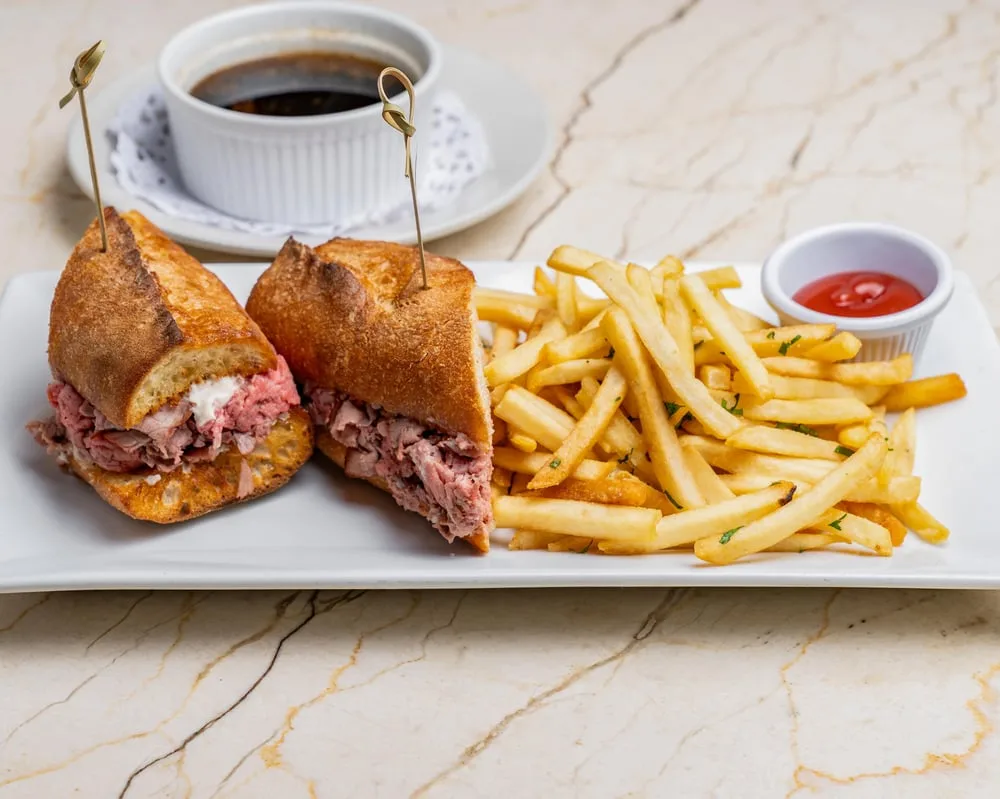
Caption: Juliette is the route's seated act: plates, coffee, a room that lets the morning dress up slightly.
Juliette is where the route stops being errand-shaped.
The restaurant sits on North 5th Street, close enough to Bedford that it can hold a group without pulling the route apart. It works as the middle table because it gives the morning a little ceremony. Not a production. A table. Plates. A chair back. The minor social relief of not eating everything from a paper bag while trying to decide where to stand.
Book if timing matters. Williamsburg brunch punishes optimism, and a group that says "we can just walk in" often means one person will end up quietly managing everyone else's hunger.
What Juliette does for the route is simple: it slows the block down. Bakeri gives you the open. Juliette gives you the pause. After that, Bedford can become useful instead of frantic.
Who This Table Helps
It helps the person who needs a real meal before browsing.
It helps the friend who likes a room with a little character but does not want the day to become a restaurant thesis.
It helps the date that needs conversation to sit across from something other than weather and job titles.
It does not help the group that is already late, under-caffeinated, and pretending nobody is annoyed.
12:30 p.m. Bedford, But Only The Part You Can Still Feel
After Juliette, do not start collecting stores.
Bedford Avenue is useful when treated as a short reading exercise. Look at the windows. Notice which places are trying too hard. Notice which ones have survived long enough to stop shouting. The point is not to shop your way into a personality. The point is to let the street interrupt the meal.
If the group has browsing energy, allow one unplanned stop. One. A small store, a record-bin detour if the day offers one, a window that actually pulls someone in. The number is important. Two stops can still feel like wandering. Five stops becomes retail plankton.
This is also where the tourist version of Williamsburg gets loudest. Not always badly. Some blocks are built to be looked at. But Ada math is strict: every extra stop must earn the feet it costs.
If someone starts naming places from a saved map that are not on the route, ask the only question that matters: "Do we still want the morning we planned?"

1:00 p.m. Reset At Spoonbill & Sugartown
Caption: Spoonbill is not a souvenir stop. It is where the route changes volume.
Spoonbill & Sugartown is the route's cleanest corrective.
The bookstore sits on Bedford Avenue and gives the morning a different tempo: shelves, art books, used books, design spines, paper stacks, the small private choreography of people pretending not to read what someone else just picked up.
That is why it belongs after brunch. Food makes the group louder. Books lower the volume again.
Do not enter with an assignment. Let each person drift. One goes to photography. One goes to fiction. One hovers near theory and buys nothing, which is still a valid form of browsing if done respectfully. The room is useful because it offers parallel solitude without splitting the route.

Caption: The bookstore gives the group a way to be together without talking the whole time.
Buy something small if the room gave you ten good minutes. A postcard, a used paperback, a magazine, a book you will pretend is for the apartment and then leave on the table for six weeks. Streets like Bedford keep their texture because some places are still allowed to be specific. Specific places need customers, not just admiration.
Pro Tips
If you came with one other person, split for fifteen minutes inside the shop and meet at the front. It makes the post-brunch conversation better.
If the group is already tired, make Spoonbill the final stop. A good exit beats a dragged-out finale.
1:45 p.m. The Soft Exit
This route ends cleanly in two directions.
If the morning has done enough, walk to the Bedford Avenue L. Do not apologize for leaving while the day still works. That is how a half-day stays a half-day.
If the weather is carrying its weight, drift toward the waterfront after Spoonbill. Treat it as a bonus, not the point. The skyline is allowed to appear at the end, but it should not be the thesis. Tourists collect views. Locals collect useful corners.
The better ending is not dramatic. Someone has a book. Someone has a pastry box. Someone has decided Juliette was the right amount of dressed-up. Nobody has been forced into another neighborhood by map greed.
That is the morning.
The Crowd
Expect linen sets, coffee walkers, parents visiting from elsewhere, people with expensive dogs, people with cheaper rent histories, three kinds of tote bag, and someone who has turned brunch into a calendar invite.
This is not a complaint. It is the operating condition.
Williamsburg is polished in places, still odd in others, and frequently more interesting when you stop asking it to be old Brooklyn or new Brooklyn. On this route, the job is not to judge the whole neighborhood. The job is to move through one usable strip with some taste and some restraint.
The Obligatory Tourist List
The waterfront: fine, if the light is doing something. Do not make it the first move unless you came for a skyline and nothing else.
Domino Park: useful with children, out-of-town parents, or people who need benches. Less useful if your morning is already full.
Bedford Avenue shopping: acceptable in small doses. Dangerous when it becomes the itinerary.
The "Williamsburg vibe": not a destination. Please stop asking rooms to perform it.
Places in this guide
5 places