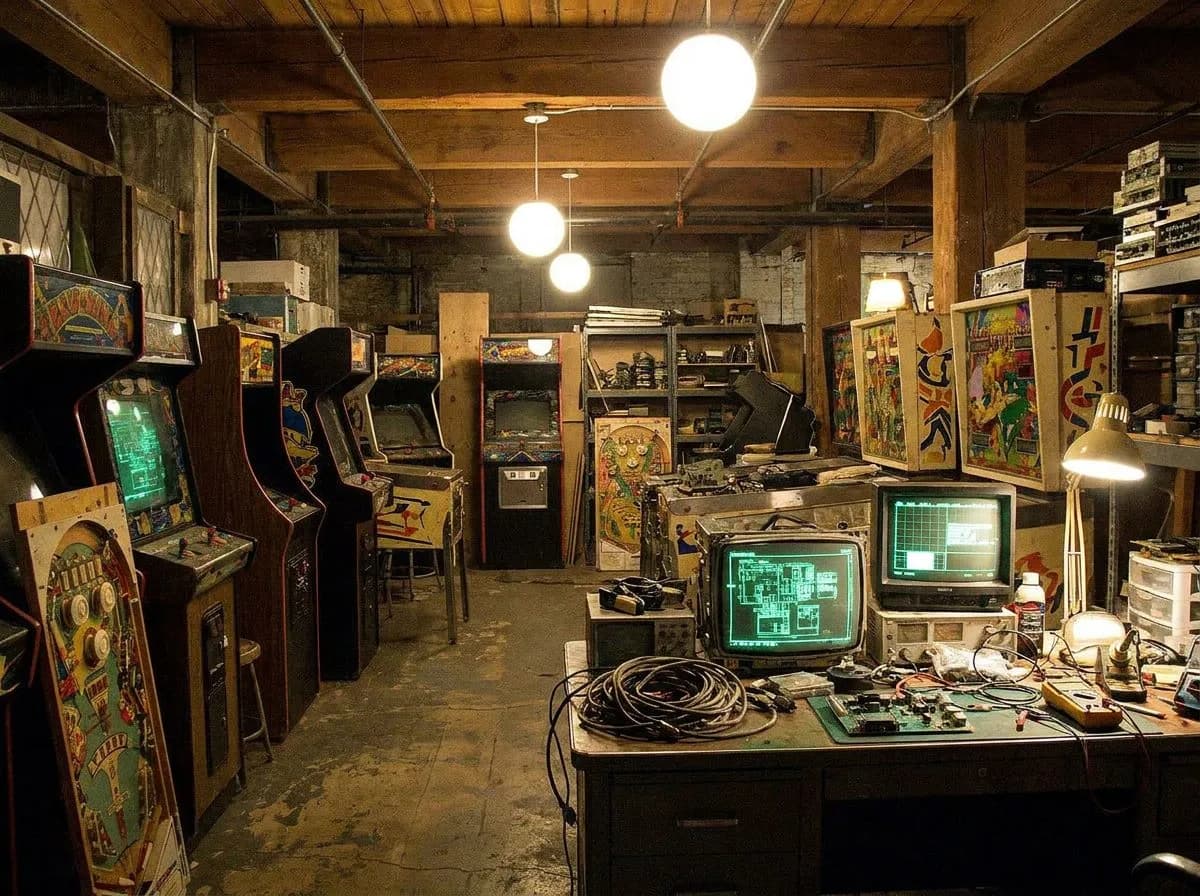
There are basements, and then there is the kind of basement you reach by knocking twice on an unmarked alley door in Wicker Park, stepping down into fluorescent light and the faint ozone tang of soldering flux. This is where broken Galaga cabinets come to be reborn. Where pinball playfields lie tilted under task lamps like patients on operating tables. Where a wall of backglass art—each piece sleeved in archival plastic—leans in silent witness to four decades of coin-op history. The technician who runs this operation does not advertise. Hours are erratic by design. But if you know when to show up, and if you arrive with a machine that deserves saving, the conversation starts.
The alley entrance
The side-alley door is weathered steel, painted a municipal gray that blends into the brickwork. No sign. No hours posted. Just a small intercom button and the unspoken protocol: knock twice, wait, then step back so the security camera catches your face. If the technician is working—and by late 2026, the rhythm has become more predictable—the lock buzzes and you descend a narrow staircase into a room that smells of machine oil, old wood veneer, and the particular mustiness of vintage electronics kept just dry enough to function.
The basement runs deeper than you expect. Exposed beams. Concrete floor. A pegboard wall dense with tools: crimpers, test probes, brushes for cleaning edge connectors. Open cabinets reveal their guts—power supplies pulled forward, monitor chassis propped on wooden blocks, ribbon cables trailing like surgical tubing. It is a working shop, not a showroom. The light is bright and unforgiving. Every scar on every cabinet is visible.
The test bench and the technician's Ms. Pac-Man
Near the main workbench stands a 1982 Ms. Pac-Man cabinet, side art faded but intact, control panel worn smooth by thousands of hands. This is not a client machine. It belongs to the technician, and it serves a specific purpose: every ROM chip, every joystick microswitch destined for a customer's restoration passes through this cabinet first. If the chip boots clean and the ghost behavior is correct, if the joystick responds crisply in all four directions, only then does the part go into inventory. The cabinet is a living test rig, and its CRT monitor glows most mornings with the opening attract sequence, that telltale waka-waka sound filling the basement.
It is a reassuring philosophy. The technician does not trust data sheets or vendor claims. Every component earns its place through performance. On the day I visit, a stack of socketed EPROMs sits beside the Ms. Pac-Man cabinet, each one labeled in careful block letters. One by one, they will be swapped in, tested, verified. This is slow work. Methodical work. The kind that does not scale, and is not meant to.
Pinball playfields under the lamp
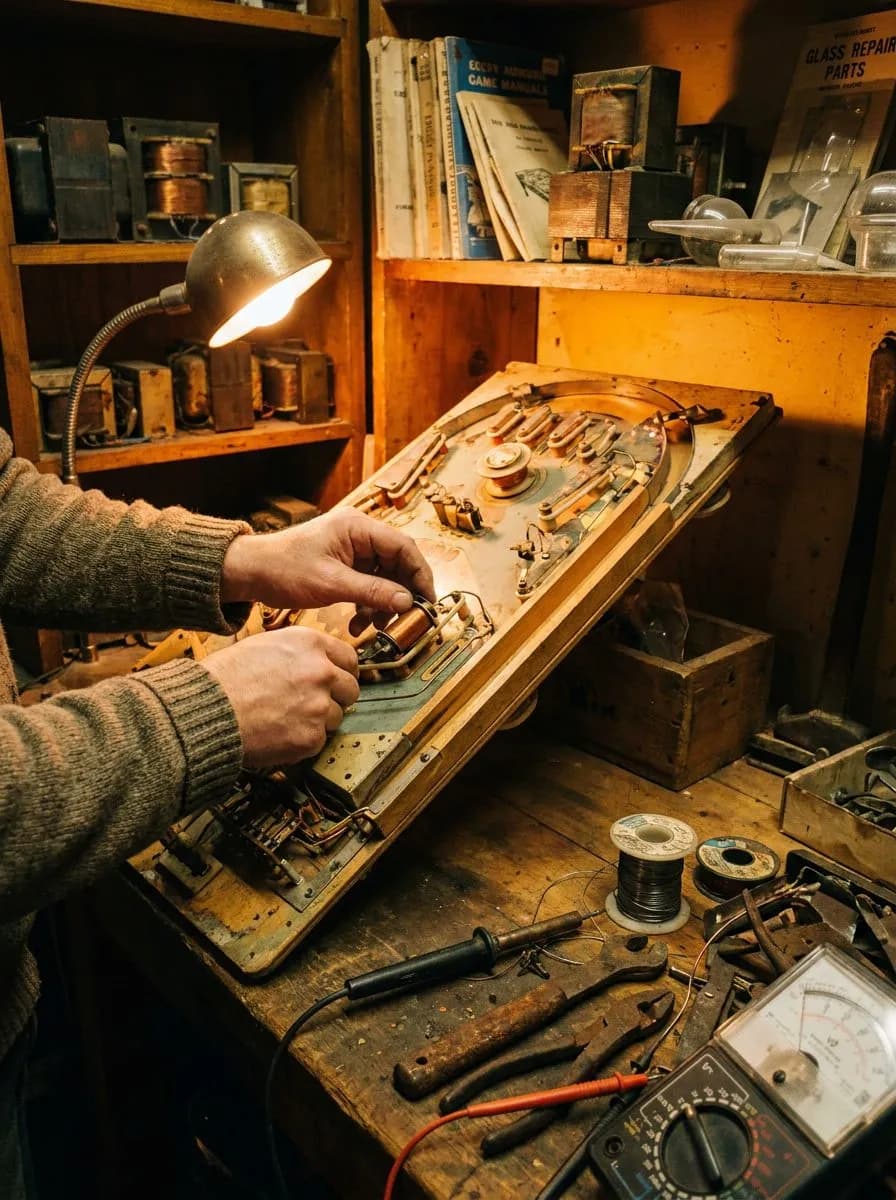
A playfield from a late-seventies Bally machine rests on a padded sawhorse, tilted at a shallow angle so the technician can work without crouching. Rubber bumpers are being replaced one by one, each old ring pried off with a thin blade, each new ring rolled into place and seated with a wooden dowel. The flipper mechanisms have already been removed and sit in a plastic tray nearby, springs and plungers separated, ready for cleaning and inspection. This is where the real craft lives. A playfield is a kinetic sculpture, and every worn part changes the physics. A stretched spring. A cracked rubber ring. A solenoid coil whose windings have begun to char. These are not cosmetic flaws.
The technician quotes a price I had not expected to be so reasonable: forty-five dollars per flipper mechanism for a full rebuild, though the recommendation is to replace both flippers simultaneously to ensure balanced response. It makes sense. A game with one tight flipper and one lazy flipper plays like a car with mismatched tires. The muscle memory fails. The ball drains. For anyone serious about restoring a machine to playable condition—not museum-piece stasis, but actual weekend plans involving friends and beer and the bright crack of a well-timed shot—this is the kind of detail that matters.
Saturday mornings and the diagnostic window
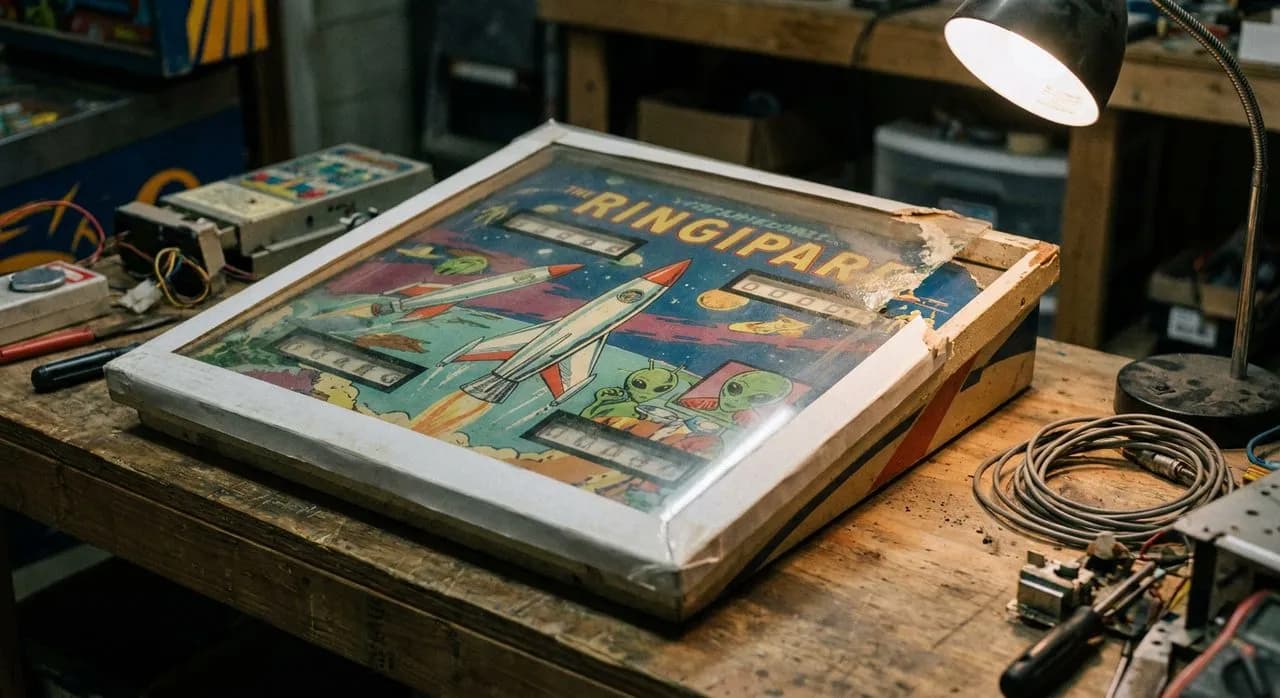
If you want to catch the technician in a talkative mood, arrive on a Saturday morning before eleven. This is when overnight board diagnostics wrap up—EPROMs burning, solder joints reflowed, power supplies left running under load to smoke out weak capacitors. The technician will be tired but satisfied, the kind of tired that comes with solved problems. This is the window when restoration options get discussed. What is worth saving. What is not. Whether that monitor chassis can be recapped or needs to be swapped. Whether the backglass can be stabilized or needs a protective overlay. These are not quick conversations, and they require a certain fluency in the language of old machines.
I visit on a Saturday in the fall, just after ten-thirty, and find the technician cleaning flux residue from a newly repaired sound board. We talk about CRT monitors—how the yoke can drift, how convergence degrades, how even a perfect image today might need adjustment in six months. We talk about coin mechs, the new-old-stock units sourced from warehouse auctions, still in their original packaging, priced at a fraction of what working examples fetch online. The conversation meanders. There is no hurry. The alley door stays locked.
The backglass archive
Against the far wall, a rack holds backglass art in archival sleeves: Gorgar, Xenon, Black Knight, Firepower. Each one is a relic of a specific aesthetic moment, airbrushed fantasy rendered on tempered glass, backlit by a grid of incandescent bulbs. Some are pristine. Others show the crazing and flaking that comes with age and humidity. The technician does not restore backglass in-house—that requires a specialist—but does stabilize and document each piece, photographing under controlled light before sleeving and cataloging.
This is not a commercial archive. These are pieces pulled from machines beyond saving, or bought in estate sales, or traded in networks of collectors who know that backglass is often the most fragile and irreplaceable component. A cabinet can be refinished. A playfield can be shopped. But a backglass, once cracked or delaminated beyond repair, is gone. The technician treats them accordingly, handling each sheet with cotton gloves, never standing them upright without support.
What this place is not
This is not a retro barcade. There are no craft cocktails, no Edison bulbs, no chalkboard menus. This is not a museum where you pay admission to look but not touch. This is a working repair shop, and the machines here are mid-process, half-assembled, sometimes not pretty. If you arrive expecting a curated experience, you will be disappointed. If you arrive with a broken Defender cabinet and a willingness to understand what it will take to make it run again, you will leave with a plan and a timeline and a sense that someone still cares about this work.
The technician does not romanticize the era. These machines were built to extract quarters, not to be art objects. But they were also built with a certain logic, a modularity that makes repair possible if you have the skills and the patience. That is what this basement represents: a refusal to let obsolescence be the final word. A bet that the pleasure of a well-maintained machine—the snap of the flipper, the phosphor glow of the CRT, the mechanical thunk of the coin mech—is worth preserving.
Practical notes
The workshop is located in Wicker Park; verify the exact address and current status directly before planning a visit; verify the exact address and current status directly before planning a visit. Transit access should be verified directly before planning a visit. Street parking is available but competitive on weekends. Hours are irregular; verify current availability directly before visiting. Knock twice on the alley door. The space is not wheelchair accessible—steep stairs, narrow doorway. Bring photos of your machine if you are inquiring about restoration work. Cash or check preferred. No walk-in repairs; consultations are by appointment or opportunistic Saturday availability.
Tags: #KarposFinds #TheOddEdit #Chicago #WickerPark #VintageArcade #PinballRepair #ArcadeCabinets #RetroGaming #CRTMonitors #ElectromechanicalPinball #BackglassArt #Fall2026 #ChicagoWorkshops #HiddenChicago #WeekendPlans
Please drink responsibly. Must be of legal drinking age.
Sources consulted: Arcade Cabinet · Pinball · Wicker Park · Chicago Department of Cultural Affairs · Time Out Chicago
All trademarks are the property of their respective owners.