 Haaland Has Seven Goals and Norway Runs Entirely Through Him
⚽️2026 FIFA WORLD CUP
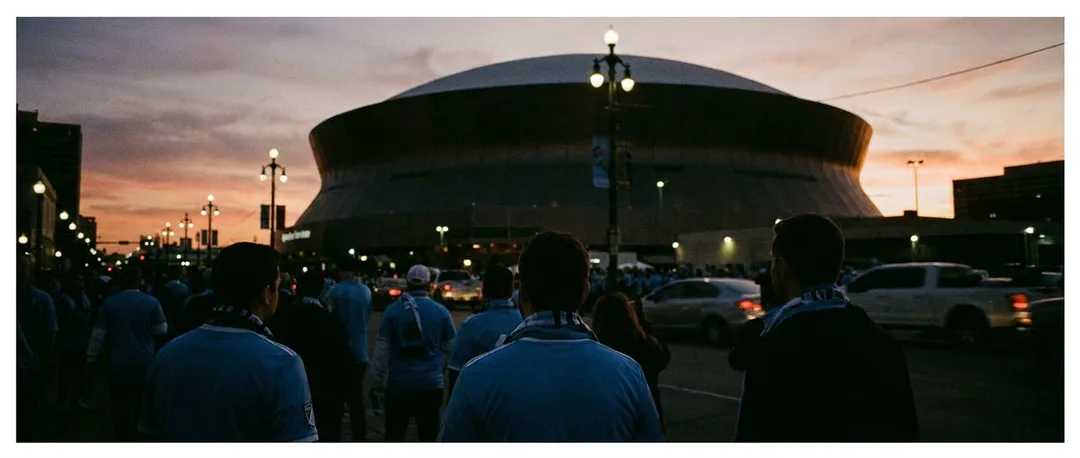
Uruguay's Training at Caesars Superdome Pulls the Bayou City's Latin Community to the Tulane Ave Fence Line
Uruguay's World Cup training camp at the Caesars Superdome practice facilities draws New Orleans's Latin American community from Mid-City and Magazine Street into the Tulane Avenue pre-dawn ritual, with the Celeste training session becoming the most talked-about non-Mardi Gras morning event in recent memory and second-line umbrellas appearing alongside sky-blue Uruguay scarves as fans process toward the stadium.
The chain-link fence along Tulane Avenue becomes a gallery at 5:15 a.m., bodies pressed three-deep against the metal diamonds as Uruguay's Celeste warm up under sodium lights that turn the Superdome's shadow into a cathedral outline. Second-line umbrellas bob beside sky-blue scarves, and the smell of Community Coffee mingles with the diesel exhaust of RTA buses disgorging fans who've ridden from Mid-City and Magazine Street. A grandmother from Carrollton holds a hand-painted sign reading "Darwin, mi amor" while her grandson films on a phone, both speaking rapid Spanish that blends with Portuguese and the occasional Yat accent. This is not Mardi Gras, but it carries the same processional energy—a pilgrimage to watch Luis Suárez and Darwin Núñez run possession drills while the city wakes up around them.
The Parking Equation
The Superdome's Garage 3 opens at 4:45 a.m. for training watchers, but the 200 spots fill by 5:10 a.m. on session days. Regulars arrive by 4:30 a.m. to claim Level 2 spaces nearest the pedestrian bridge that leads to the practice complex fence line. The garage charges $12 flat rate, cash or card, with attendants who've learned to recognize the Uruguay faithful by their Celeste jerseys and thermoses of café con leche.
Street parking along Poydras Street offers overflow capacity—metered spots that don't enforce until 8 a.m., giving fans a three-hour window. The walk from Poydras to the Tulane Avenue fence line takes eight minutes, passing the shuttered windows of office buildings and the occasional panhandler who's learned to greet arrivals with "¡Vamos Uruguay!" for better tips. Loyola Avenue presents a third option: residential permit zones that go unenforced before 7 a.m., though locals report occasional ticketing sweeps.
The RTA's 39 Tulane line runs every 20 minutes starting at 4:40 a.m., picking up riders from the Magazine Street Latin American corridor and depositing them at the Loyola-Tulane stop. Buses fill with standing-room crowds, the air thick with anticipation and the rustle of homemade banners rolled under arms.
The Sightline Sweet Spot
The northeast corner of the practice complex fence—where Tulane Avenue meets Loyola—offers the clearest view of the full pitch. Fans arrive by 5 a.m. to claim spots against the chain-link, pressing phones and cameras through the diamond gaps to capture warm-up sequences. The fence runs 180 feet along Tulane, but only the first 60 feet provide unobstructed sightlines; beyond that, equipment trucks and temporary bleachers block the view.
A grass berm rises behind the fence's midpoint, creating an elevated tier where late arrivals stand on tiptoes or hoist children onto shoulders. The berm's advantage: height. The disadvantage: distance—players appear smaller, facial expressions harder to read. Regulars bring folding step-stools that add eight inches of elevation, transforming the berm into makeshift stadium seating.
The Poydras Street pedestrian bridge offers a third vantage—an aerial view of the pitch's southern half where defensive drills typically unfold. Security doesn't prohibit bridge watchers, but the angle makes autograph access impossible post-session. Photographers favor this spot for wide shots of the Superdome looming behind the training ground, the building's curves framing the Celeste in architectural symmetry.
Café Envie on Decatur Street
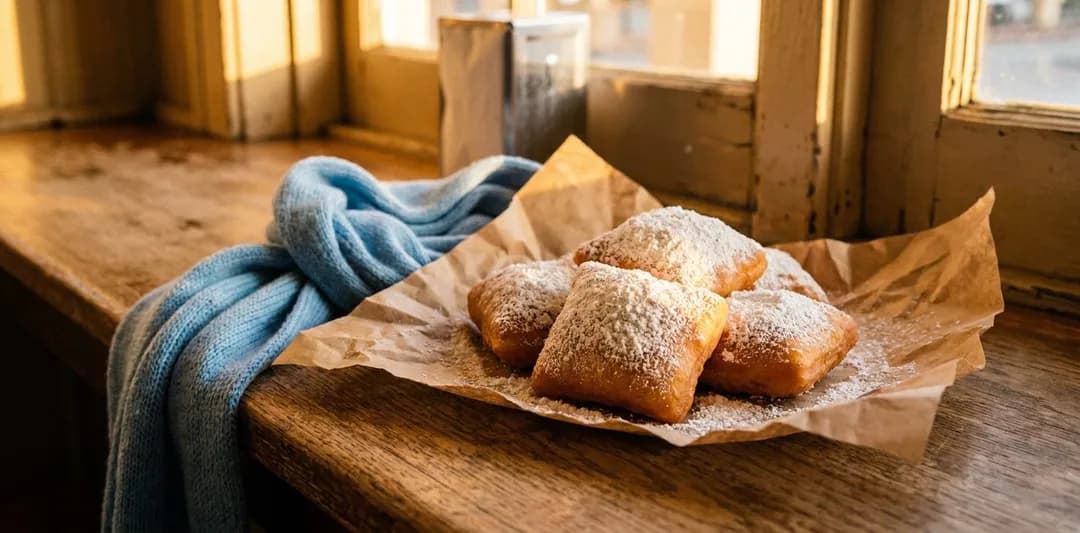
Café Envie, a 24-hour coffeehouse in the French Quarter, becomes the unofficial staging ground for training watchers who arrive too early for the fence line. The café opens at midnight and by 4 a.m. on training days, the back room fills with Uruguay supporters nursing café au laits and beignets, their voices a polyglot hum of Spanish, Portuguese, and English. The walls display vintage soccer prints—Pelé, Maradona, a faded photo of Uruguay's 1950 World Cup victory—that make the space feel like a shrine.
Regulars order the "Garra Charrúa" special: double espresso, buttered croissant, and a side of fresh fruit for $8.50. The name references Uruguay's fighting spirit, and baristas have learned to pronounce it correctly after two weeks of gentle corrections from customers. Tables fill with tactical discussions—who'll start against Brazil, whether Núñez's hamstring has healed—while phones display live updates from Montevideo sports radio.
The café sits 1.3 miles from the Superdome, a 25-minute walk or 8-minute drive that fans time to arrive at Tulane Avenue by 5:15 a.m. Some linger until 4:50 a.m., savoring the last minutes of air conditioning before stepping into the humid pre-dawn.
The Session Itself
Training begins at 5:30 a.m. sharp with a whistle blast that silences the fence-line crowd. Players emerge from the tunnel in sky-blue kits, their cleats crunching on the synthetic turf that gleams under floodlights. Luis Suárez leads the warm-up lap, his gait recognizable even at 80 feet—the slight hitch in his left stride, the way he claps hands to chest after the first lap. Darwin Núñez follows three paces behind, taller, looser, occasionally breaking into a sprint that draws gasps from the fence.
Possession drills dominate the first 30 minutes: 7v7 in a compressed grid, one-touch passing that sounds like a drumbeat—thwack, thwack, thwack—as the ball pings between boots. Suárez operates in the right half-space, demanding the ball with sharp hand gestures, his voice carrying over the fence: "¡Acá! ¡Acá!" Núñez drifts wide left, making diagonal runs that pull imaginary defenders out of shape. The coaching staff shouts corrections in Spanish, their words echoing off the Superdome's concrete flanks.
Shooting drills follow at 6:10 a.m. The crack of leather against crossbar reverberates through the fence line, each miss or goal met with collective groans or cheers. Suárez takes penalties from the right side of the box, placing shots low to the keeper's left with metronomic precision. Núñez attacks from the top of the arc, his strikes rising and dipping, the ball's trajectory visible against the lightening sky.
The session ends at 7 a.m. with a cool-down lap and stretching circle. Players joke in Spanish, their laughter carrying over the fence as they towel off and sip from water bottles.
The Player Window
The autograph window opens at 7:05 a.m. when players walk from the pitch to the tunnel, a 40-foot path that runs parallel to the Tulane Avenue fence. Suárez stops first, signing jerseys and phones thrust through the chain-link, his Sharpie moving in efficient loops. He speaks minimal English but responds to Spanish requests with "Con mucho gusto," his smile broad and genuine.
Núñez follows five minutes later, taller and more reserved, but he pauses for selfies when fans call his name. Children receive priority—he crouches to their eye level, signing forearms and soccer balls with deliberate care. The window lasts 15 minutes before security ushers players toward the tunnel, ending the morning's access with a finality that feels abrupt.
After the Session
The post-training procession reverses along Tulane Avenue, fans streaming toward parked cars and bus stops with signed memorabilia held aloft like trophies. Some migrate to Café Reconcile on Oretha Castle Haley Boulevard, a soul-food spot that opens at 7 a.m. and serves shrimp and grits that become the post-session debrief meal. Others head to Verti Marte on Royal Street for loaded po'boys, the Superdome's outline shrinking in rearview mirrors as the city's morning traffic builds.
Magazine Street's Latin American shops—the Uruguayan butcher, the Argentine bakery—see a bump in foot traffic by 8 a.m., fans stopping to buy empanadas and dulce de leche before work. The training session becomes the day's opening chapter, a shared experience that bonds the neighborhood in sky-blue solidarity.
Practical Notes
• Training sessions run Tuesday, Thursday, Saturday at
Sources consulted: fifa.com (https://www.fifa.com) · neworleans.com (https://www.neworleans.com) · timeout.com/new-orleans (https://www.timeout.com/new-orleans)
All trademarks are the property of their respective owners.
Ask Karpo first
Trying to find Uruguay's open training access at the Caesars Superdome practice complex without getting turned around in the Tulane Ave gate labyrinth or missing the community procession from Mid-City?
Ask Karpo for Uruguay's confirmed New Orleans training schedule, the Superdome practice facility access map, and the Magazine Street Latin community circuit that transforms the pre-dawn walk into something closer to a second line.
Ask Karpo for more information.
Keep reading
- Haaland Has Seven Goals and Norway Runs Entirely Through Him
 World Cup Trophy Ceremony Timing Medals and Postmatch Celebrations
 Olise and France's Attack: The Semifinal Tactical Question