 Haaland Has Seven Goals and Norway Runs Entirely Through Him
⚽️2026 FIFA WORLD CUP
Sweden's World Cup Preparations in Minneapolis Draw Scandinavian-American Fans to the Practice Fields
Sweden's World Cup training camp in Minneapolis draws the city's large Scandinavian-American community to practice sessions near the U of M campus, with the Northeast Minneapolis corridor — home to Swedish Lutheran churches and Norwegian bakeries — turning into an unofficial Blågult neighborhood for the week and fans comparing intel on which session gates allow fence-line viewing.
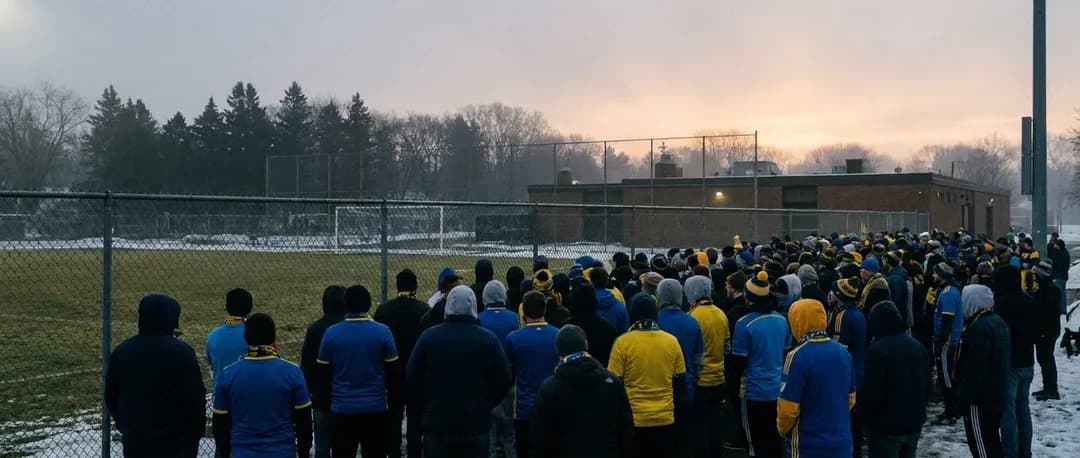
The chain-link fence along the TCF Bank Stadium practice fields begins collecting bodies at 5:47 a.m., twenty-three minutes before the University of Minnesota grounds crew unlocks the pedestrian gate. A woman in a vintage Blågult scarf claims the southwest corner post, the spot where the morning sun backlights the far goal without glare. Her thermos steams in the June cold. Two men speaking Swedish debate whether Magdalena Eriksson will run possession drills on the near pitch or the far one. A teenager holds a homemade sign reading "Heja Sverige" in blue and yellow marker. By 6:30 a.m., forty-seven people line the eastern fence, their fingers hooked through the metal diamonds, their breath visible in the dawn air. The practice fields sit empty, perfectly striped, dew catching the first horizontal light. Then the team bus rounds the corner from Oak Street, and the murmur along the fence shifts to something electric.
The Parking Equation
The University of Minnesota's East River Road lot opens at 5:30 a.m., and fans who arrive before 6 a.m. find spaces within two hundred yards of the practice field gate. After 6:15 a.m., the lot fills toward the back rows, pushing latecomers into a quarter-mile walk past the Huntington Bank Stadium loading docks. Parking costs nothing during summer sessions, but the university posts "2-hour maximum" signs that no one enforces during World Cup camp weeks. Street parking along Oak Street SE offers closer proximity but fewer spots—maybe fifteen spaces total, claimed by 5:45 a.m. on training days. The Green Line light rail stops at Stadium Village station, a twelve-minute walk to the practice fields, with trains running every ten minutes starting at 5 a.m. Fans carrying flag poles or poster boards favor the parking lot over transit; the walk from Stadium Village station involves navigating a pedestrian bridge that complicates oversized gear.

The Sightline Sweet Spot
The eastern fence line offers unobstructed views of both practice pitches, but the southwest corner post—where the woman with the vintage scarf stakes her claim—provides the angle where possession drills, shooting sequences, and tactical walk-throughs all unfold within thirty yards. The fence runs 180 feet along the eastern edge, and fans cluster heaviest in the center fifty-foot section where the near goal sits. A small berm rises behind the southern end, offering elevated sightlines for those willing to stand on wet grass. Regulars bring folding step-stools to see over taller fans pressed against the fence. The northwestern gate, used by staff and media, allows no public access, but fans position themselves ten feet from that entrance to catch players walking from the bus to the locker room trailer. Coaches discourage fence-line interaction during drills, so the best watchers stay quiet, letting the session sounds—whistles, Swedish instructions, the thwack of boots on balls—carry across the grass uninterrupted.
Kramarczuk's Sausage Company
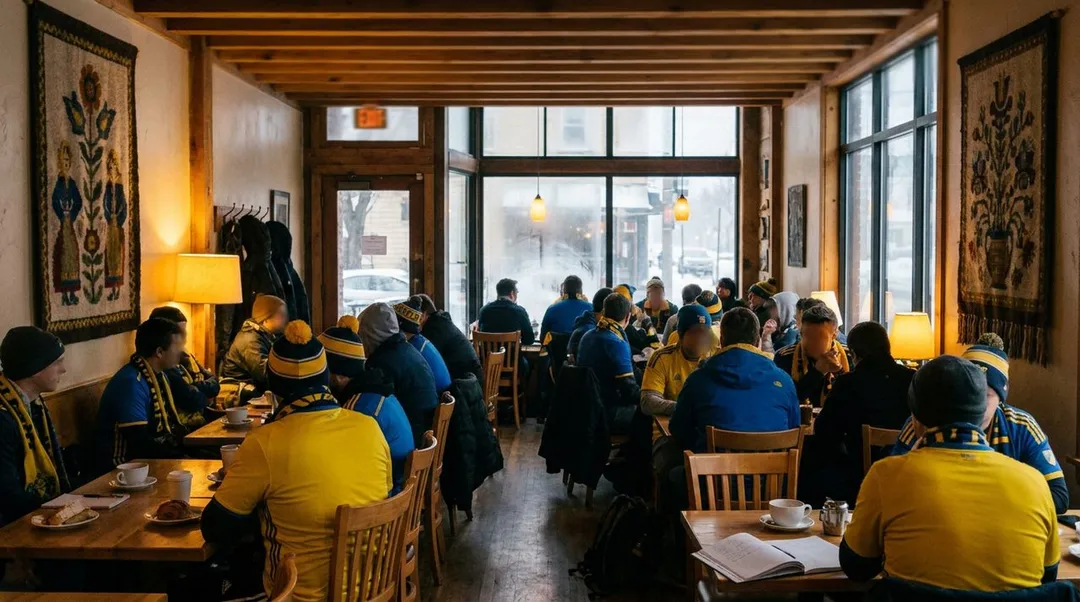
Northeast Minneapolis, two miles from the practice fields, functions as the unofficial staging ground for Sweden's most devoted local supporters. Kramarczuk's Sausage Company on Hennepin Avenue East opens at 8 a.m., and fans arrive directly after morning training sessions, their Blågult scarves still knotted around necks, their phones full of fence-line photos. The Eastern European deli—run by a Ukrainian family since 1954—serves kielbasa and rye bread, not Swedish meatballs, but the Scandinavian-American community claims it as neutral ground where Norwegians, Swedes, and Danes compare notes on which players signed autographs and whether the afternoon session will be open or closed. The lunch counter fills with fans debating Sweden's group-stage matchups, particularly the upcoming japan vs sweden fixture that could determine knockout-round seeding. Old men in Hammarby jerseys drink coffee at the stand-up tables near the window. A bulletin board by the register collects business cards from Swedish-language tutors and notices for Midsommar festivals. The pierogi special costs $8.95. The line stretches to the door by 9:15 a.m.
The Session Itself
Training begins at 7 a.m. with jogging laps and dynamic stretching visible through the fence gaps. The sound of Swedish instructions—sharp, clipped, rising at the end of commands—carries across the dew-wet grass. Coaches set up cone grids for passing sequences, and the rhythm of one-touch drills creates a percussive pattern: thwack-thwack-pause-thwack. Magdalena Eriksson works the left side of the defensive shape, calling adjustments in a voice that cuts through the morning air. Stina Blackstenius runs shooting drills from the top of the box, her right foot favoring the far post, her follow-through high and loose. The goalkeeper coach—a Swede in his fifties with a whistle on a lanyard—shouts "Igen! Igen!" after each save sequence. Fans along the fence stay silent during tactical walk-throughs, when the coaching staff positions players in shape and talks through pressing triggers. The loudest moment comes during small-sided games, when competitive instincts override training decorum and players shout for the ball in rapid Swedish. The session runs ninety-seven minutes. The team breaks into a cooldown circle at 8:37 a.m., and the fence-line crowd begins calculating the autograph window.
The Player Window
The team exits through the northwestern gate between 8:50 and 9:10 a.m., a twenty-minute span when players walk from the practice pitch to the parking lot where the bus idles. Magdalena Eriksson signs consistently, working her way down the fence line with a blue Sharpie, her hair still wet from the session. Stina Blackstenius waves but rarely stops, her headphones already in, her stride purposeful toward the bus. Younger players—those fighting for roster spots—linger longer, signing replica jerseys and posing for selfies with fans who shout encouragement in broken Swedish. Coaches exit last, and the team's assistant coach, a woman in her forties with a Swedish FA windbreaker, sometimes pauses to answer questions about the afternoon session schedule. The autograph window closes abruptly when the bus driver honks twice, a signal that departure is imminent. Fans who positioned themselves closest to the gate—those who arrived at 5:47 a.m.—collect the most signatures. The fence empties by 9:20 a.m., littered with discarded pen caps and crumpled sign posterboard.
After the Session
Northeast Minneapolis absorbs the post-training crowd like a neighborhood built for this purpose. The American Swedish Institute on Park Avenue—a mansion-turned-museum three miles from the practice fields—opens at 10 a.m., and fans drift there to kill time before afternoon sessions, wandering galleries of immigrant history and drinking coffee in the Fika café. Our Lady of Lourdes Catholic Church, the oldest continuously used church in Minneapolis, sits near the river and offers a quiet respite for older fans who remember when this neighborhood spoke more Swedish than English. Surdyk's Liquor on Hennepin Avenue stocks Scandinavian imports—lingonberry preserves, Marabou chocolate, cloudberry jam—and becomes a pilgrimage site for fans stocking up on taste-of-home provisions. Anchor Fish & Chips, a British-style chippy on Central Avenue, serves an incongruous but beloved lunch to fans who've exhausted the pierogi options at Kramarczuk's. The neighborhood hums with Blågult scarves until mid-afternoon, when the cycle resets and fans begin calculating whether the evening session will be open to fence-line watchers.
Practical Notes
• Morning sessions begin at 7 a.m.; fans arrive by 6 a.m. for optimal fence positions
• East River Road parking lot offers free spaces; arrive before 6:15 a.m. to avoid quarter-mile walks
• Bring step-stools for sightline advantages and thermoses for the pre-dawn wait
• Green Line light rail (Stadium Village station) provides transit access but complicates oversized gear transport
Tags: #MinneapolisSports #SwedishNationalTeam #TCFBankStadium #NortheastMinneapolis #WorldCupTraining #ScandinavianAmerica #Blågult #KramarczuksSausage #UniversityOfMinnesota #StadiumVillage #SwedishFootball #TrainingWatchGuide #JapanVsSweden #
Sources consulted: fifa.com (https://www.fifa.com) · timeout.com/minneapolis (https://www.timeout.com/minneapolis) · minneapolis.org (https://www.minneapolis.org)
All trademarks are the property of their respective owners.
Ask Karpo first
Looking for Sweden's public training sessions in Minneapolis without navigating campus parking or missing the Northeast Minneapolis community fan ritual that starts hours before first whistle?
Ask Karpo for Sweden's confirmed Minneapolis training schedule, campus access logistics, and the Northeast corridor café and bakery circuit that Blågult fans have adopted.
Ask Karpo for more information.
Keep reading
- Haaland Has Seven Goals and Norway Runs Entirely Through Him
 World Cup Trophy Ceremony Timing Medals and Postmatch Celebrations
 Olise and France's Attack: The Semifinal Tactical Question