 Haaland Has Seven Goals and Norway Runs Entirely Through Him
⚽️2026 FIFA WORLD CUP
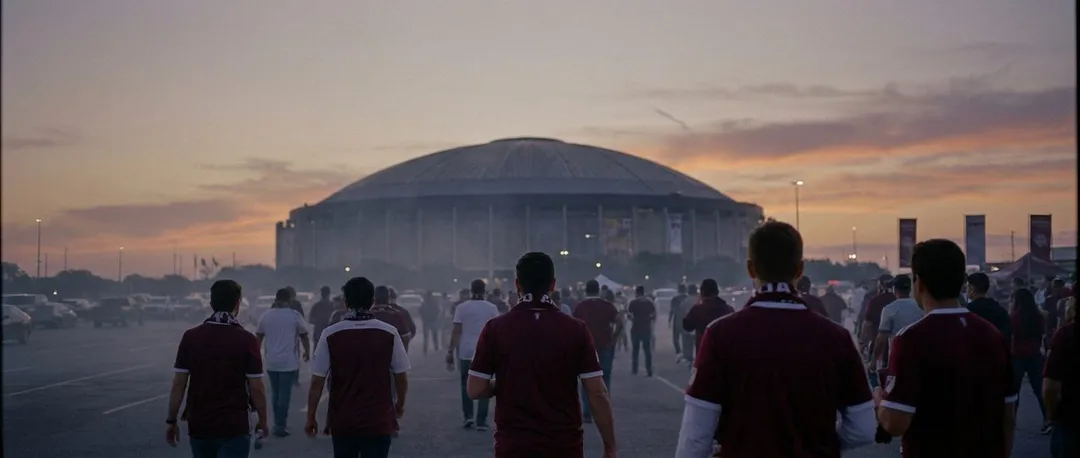
Qatar's Training at NRG Stadium Draws Houston's Arab Community to the Practice Fields Before Dawn
Qatar's World Cup training sessions at NRG Stadium draw Houston's substantial Arab diaspora — one of the largest in North America — to the practice fields well before dawn, with the Southwest Houston Arabic community corridor turning the pregame ritual into a neighborhood celebration and shawarma trucks setting up along Hillcroft Avenue by 5:00 a.m.
The first headlights sweep into the NRG Stadium practice complex parking lot at 4:47 a.m., three hours before Qatar's training session officially begins. The driver, a middle-aged man in a maroon Qatar jersey, parks facing the chain-link fence separating asphalt from turf. Within minutes, a dozen more vehicles arrive—sedans, SUVs, a white panel van with Arabic script on the side. Doors stay closed against the humid Houston darkness. Fans sit inside with dome lights on, drinking coffee from thermoses, watching the empty practice pitch through windshields fogging at the edges. By 5:30 a.m., the lot holds forty cars. By 6:15, over a hundred. The air smells like cut grass and diesel from idling engines. Someone plays Arabic music low through cracked windows. The vigil has begun.
The Parking Equation
The NRG Stadium practice complex operates on first-come logistics. Gates to Lot C—the closest access point to the training fields—open at 6:00 a.m., but the real positioning starts an hour earlier when early arrivals queue along Kirby Drive. Stadium security allows vehicles to stage in a loose formation before the official opening, creating an informal pre-queue that determines fence-line proximity once gates swing wide.
Fans arriving after 6:30 a.m. find Lot C at capacity and get redirected to Lot D, adding a quarter-mile walk to the practice field perimeter. The hardcore supporters—the ones who want front-row fence positions—arrive before 5:00 a.m. without exception. They bring folding chairs that stay in trunks until the lot opens, then race to claim the twenty-yard stretch of fence along the eastern sideline where Qatar typically runs possession drills.
Weekend sessions draw heavier crowds, pushing the arrival window even earlier. On those days, the 4:30 a.m. arrivals aren't outliers—they're strategic. METRORail's Red Line runs to the NRG/Stadium stop, but the first train doesn't arrive until 6:47 a.m., too late for prime positioning. Transit fans accept secondary spots or arrive the night before, sleeping in cars parked on nearby residential streets off Old Spanish Trail.
The Sightline Sweet Spot
The eastern fence line offers the clearest view of Qatar's training setup. The chain-link stands eight feet tall, topped with a single strand of barbed wire that's more decorative than deterrent. Fans press against the metal, fingers hooked through diamond-shaped openings, cameras and phones thrust through gaps. The fence runs for sixty yards, but only the middle twenty provide unobstructed sightlines to the center circle and both penalty areas.
The southern end features a grass berm that rises four feet above field level—a landscaping choice that becomes premium real estate during training sessions. Fans spread blankets on the slope, creating a terraced gallery. The berm holds about thirty people comfortably, fifty if supporters pack shoulder-to-shoulder. Sightlines angle across the width of the pitch, perfect for watching tactical drills and small-sided games.
A third option exists for the patient: the northwest corner, where a service gate opens at 7:15 a.m. to allow equipment trucks access. For ten minutes, while the gate stays propped, fans get a direct view down the goal line. Security tolerates watchers as long as they stay outside the threshold. It's a narrow window, but it offers the only head-on perspective of shooting drills.
Fadi's Coffee & Bakery
The staging ground sits three miles southwest on Hillcroft Avenue, where Fadi's Coffee & Bakery opens at 4:00 a.m. on training days. The small storefront, wedged between a halal butcher and a hookah lounge, becomes mission control for the pre-dawn gathering. By 4:30 a.m., the parking lot holds two dozen cars, fans standing in clusters outside, drinking cardamom coffee from paper cups, eating zaatar manakeesh still warm from the oven.
The owner, Fadi Mansour, props the door open despite the heat, letting the smell of Arabic coffee drift into the humid air. Inside, the television plays Al Jazeera Sport on mute. A hand-drawn map of the NRG complex hangs on the wall near the register, arrows indicating fence positions and parking lot access points. Regulars add notes in marker: "Berm fills by 6:45," "East fence best for photos," "Bring step stool."
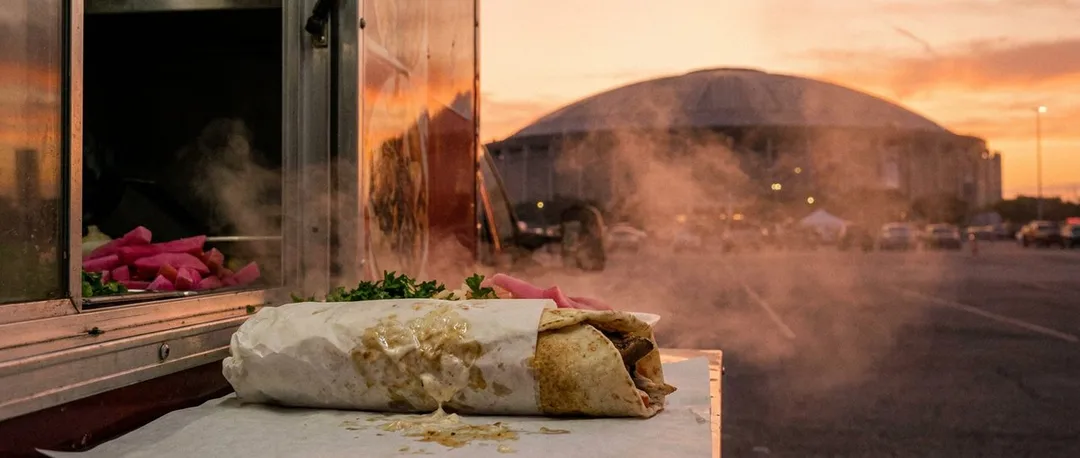
Shawarma trucks arrive on Hillcroft by 5:00 a.m., setting up in the strip mall parking lots between Fadi's and Fondren Road. The trucks don't open until after training—around 10:00 a.m.—but their presence signals the neighborhood's transformation into a temporary fan zone. By the time training ends, Hillcroft becomes a post-session gathering spot, the sidewalks thick with supporters in maroon jerseys, debriefing over chicken shawarma and fresh-squeezed sugarcane juice.
The Session Itself
Training begins at 7:45 a.m. with players jogging from the tunnel in two lines, their cleats clicking on concrete before hitting grass. The sound carries to the fence line—a rhythmic percussion that triggers a ripple of excitement through the waiting crowd. Fans call out names. Someone unfurls a Qatar flag, draping it over the chain-link.
The first twenty minutes involve dynamic stretching and passing circles. Players form groups of six, moving through patterns that look choreographed from the fence line. The coaches' whistles pierce the morning air, sharp and insistent. Fans watch in near-silence, the occasional murmur in Arabic, the click of camera shutters.
Tactical drills start at 8:15 a.m. The team splits into groups—attackers versus defenders in half-field scenarios. The tempo increases. Shouts in Arabic echo across the pitch. The ball pings between players, the sound of contact—foot on leather—crisp in the humid air. Fans along the fence track movements, pointing out formations, debating positioning in low voices.
The star players—Hassan Al-Haydos, Akram Afif—draw the most attention. Al-Haydos favors the right channel during drills, cutting inside from the wing, his left foot perpetually cocked for crosses. Afif works the center, dropping deep to collect the ball, spinning away from pressure. Watchers study their movements like film analysts, noting tendencies, predicting passes before they happen.
The Player Window
Training ends at 9:30 a.m. Players jog toward the tunnel, but the session isn't finished for fence-line fans. A fifteen-minute window opens where players sometimes drift toward the eastern fence, signing autographs, posing for photos. Not every session includes this ritual—it depends on schedule, coaching staff mood, security protocols—but when it happens, the fence line surges with energy.
Al-Haydos typically approaches first, walking slowly along the fence, signing jerseys and phones thrust through the chain-link. He speaks little, nodding at fans, moving methodically. Afif follows, more animated, exchanging words in Arabic, laughing at comments shouted from the crowd. The younger players cluster near the tunnel, hesitant, until a coach waves them toward the fence.
The window closes abruptly when security signals time. Players jog toward the tunnel in a group. Fans linger, cameras still raised, hoping for one more wave, one more acknowledgment. The field empties. Groundskeepers emerge with hoses. The vigil dissolves.
After the Session
The migration back to Southwest Houston begins immediately. Cars stream out of the NRG lots, forming a convoy that heads west on Bellaire Boulevard toward Hillcroft. By 10:15 a.m., the shawarma trucks have lines twenty deep. Fadi's reopens its doors to the post-training crowd, the interior packed with fans replaying drill sequences, analyzing player form, speculating about weekend match lineups.
The neighborhood absorbs the energy. Supporters drift into nearby shops—the Arabic grocery on Harwin, the baklava bakery on Fondren. Some settle into hookah lounges for extended debriefs. Others head to Al-Aseel Restaurant for full breakfast spreads. The training watch becomes an all-morning affair, the community gathering extending hours beyond the ninety-minute session.
By noon, Hillcroft returns to its regular rhythm, but the maroon jerseys remain visible throughout the afternoon, fans carrying the morning's energy into the weekend.
Practical Notes
• Arrive at NRG Lot C by 5:00 a.m. for prime fence positions; 4:30 a.m. on weekends
Sources consulted: fifa.com (https://www.fifa.com) · visithoustontexas.com (https://www.visithoustontexas.com) · timeout.com/houston (https://www.timeout.com/houston)
All trademarks are the property of their respective owners.
Ask Karpo first
Looking for Qatar's public training sessions at NRG Stadium and trying to connect with Houston's Arab community fan network before the opening group match?
Ask Karpo for NRG Stadium training access details, confirmed session times for Qatar's open practices, and the Southwest Houston Arabic community circuit worth knowing.
Ask Karpo for more information.
Keep reading
- Haaland Has Seven Goals and Norway Runs Entirely Through Him
 World Cup Trophy Ceremony Timing Medals and Postmatch Celebrations
 Olise and France's Attack: The Semifinal Tactical Question