 Haaland Has Seven Goals and Norway Runs Entirely Through Him
⚽️2026 FIFA WORLD CUP
Montrose Rooftop Screenings Where Fans Watch Northern Lights Tonight and Tomorrow's Match
A rare aurora forecast draws crowds to an outdoor venue that realizes the same setup works for World Cup nights, blending celestial wonder with terrestrial drama.
When the Sky Does Something Unprecedented Above Texas
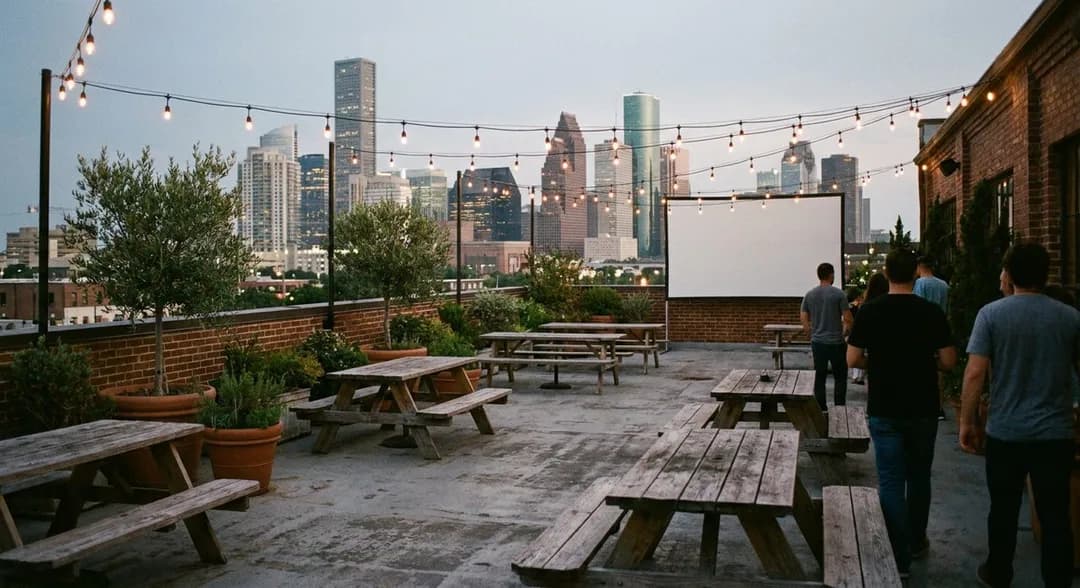
You hear about the aurora forecast on a Tuesday afternoon—solar storm strong enough that Houston might actually see color in the night sky, not just the usual orange glow of streetlights bouncing off humidity. By evening, the rooftop at a Montrose venue that usually hosts yoga classes and private events has turned into an impromptu viewing party. Someone drags up folding chairs. Someone else brings a telescope they clearly don't know how to operate. And then someone realizes: if we're all staring up tonight, why not come back tomorrow when the match is on? The projector's already here. The sight lines work. The crowd energy feels right.
What starts as celestial accident becomes deliberate ritual. The same rooftop that hosts aurora watchers one night pivots seamlessly into a World Cup screening the next, and suddenly you've got a venue that understands something fundamental: people want to gather for moments that feel bigger than their living rooms, whether those moments happen ninety-three million miles away or on a pitch in another time zone.
The Geometry of Watching Up Instead of Forward
The rooftop sits three stories above a Montrose block where bungalows give way to mid-rises, high enough that you're above most tree canopy but not so high you lose the neighborhood's texture. During aurora watch, everyone tilts back in camping chairs, necks craned, phones held overhead trying to capture green streaks that cameras render better than eyes. The air smells like someone's vape pen and the jasmine blooming over a fence two buildings away. You hear the hum of Westheimer traffic a few blocks south, punctuated by the occasional whoop when someone spots actual color.
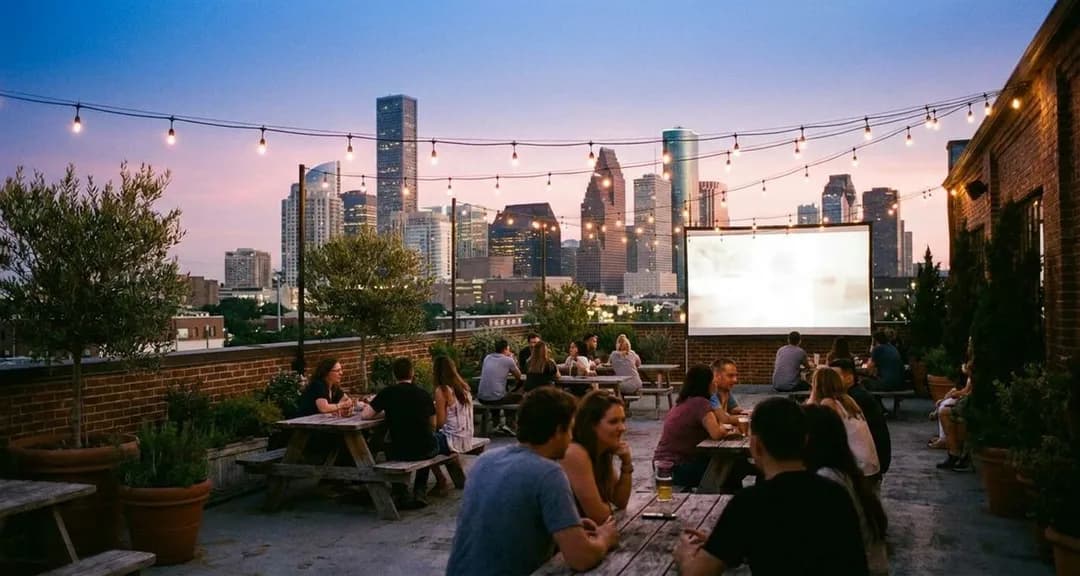
The next night, same chairs, different angle. The projection screen goes up against the north-facing wall, big enough that you can read player numbers from the back row. What doesn't change: that feeling of collective presence, the way a crowd synchronizes breathing during tense moments whether they're watching solar particles or a penalty kick. The rooftop's concrete still holds the day's heat. The same jasmine still blooms. But now everyone's leaning forward instead of back.
Who Shows Up When the Invitation is Implicit
No one's checking tickets or taking reservations—this isn't that kind of thing. Word spreads through group chats and neighborhood apps, the digital equivalent of someone yelling up at your window. For the aurora, you get the amateur astronomy crowd, people who own star charts and can explain magnetosphere dynamics. You get couples who just want an excuse to be outside after dark. You get the guy from the coffee shop who brings his dog even though the dog has zero interest in celestial phenomena.
World Cup night shifts the demographic slightly. More jerseys, more deliberate drinking, more people who've planned their evening around kickoff rather than stumbling into something unexpected. But there's overlap too—the astronomy guy comes back because he liked the vibe, and now he's learning offside rules from someone's aunt who played semi-pro in Guadalajara thirty years ago. The couple returns because they've decided this is their spot now, their accidental discovery that they'll defend possessively to friends who try to claim they knew about it first.
The Logistics of Dual-Purpose Gathering
Someone's running an extension cord from the building's third-floor utility closet, the kind of improvised infrastructure that would make a fire marshal nervous but somehow works. The projector lives in a storage unit most of the time, gets borrowed for outdoor movie nights and presentations, now gets a second life as sports venue equipment. During aurora watch, people bring their own everything—blankets, thermoses, those LED headlamps that make everyone look like they're about to go caving. For the match, there's slightly more organization: a folding table appears with coolers, someone's taking drink orders on Venmo, there's a tacit understanding about contributing to the setup effort.
The sound system is just a Bluetooth speaker someone pairs their phone to, tinny and inadequate during quiet moments but perfectly sufficient when the crowd's providing its own audio. You miss some commentary, catch fragments of analysis between goals, but mostly you're reading the game through collective reaction—the groan that tells you it was close, the eruption that means it's in.
What Happens When Weather Refuses to Cooperate
Houston's sky doesn't always cooperate with viewing plans, celestial or terrestrial. The aurora forecast was strong but the reality was murky—some people swore they saw green, others saw nothing but wishful thinking and camera tricks. The rooftop stayed full anyway because the gathering became its own point. Someone started playing music. Someone else ordered pizza to the nearest cross-street and carried it up three flights. By the time people left, the aurora barely mattered.
World Cup night faces different weather gambling—summer storms that roll in with fifteen minutes' warning, humidity so thick the projection looks like it's underwater. There's a contingency plan involving the ground-floor space with garage doors that roll up, less romantic but more reliable. But everyone hopes for clear skies because the rooftop version feels like something you can't replicate indoors: the breeze that kicks up right when the match hits extra time, the way the city's light pollution becomes backdrop instead of intrusion, the sense that you're watching history while suspended slightly above your normal life.
The Unexpected Regulars Who Claim Territory
By the third or fourth gathering, you start recognizing faces. There's the woman who always sits in the northeast corner with her scorecard and mechanical pencil, tracking something more detailed than the official stats. There's the couple who brings the good snacks—not chips, but the kind of homemade stuff that makes everyone else's contribution look lazy. There's the guy who shows up in a different national team jersey each time, not because he's particularly loyal to any of them but because he likes the anthropology of it, the way different matches draw different crowds.
These regulars don't know each other's names necessarily, but they've developed the casual intimacy of people who've shared something unplanned and good. They save each other seats. They text when they hear about the next screening. They've created a micro-community that exists only on this rooftop, only during these specific convergences of sky events and sports schedules, fragile and perfect precisely because it's not trying to be anything permanent.
Practical Notes
The rooftop screenings happen when they happen—keep an eye on neighborhood social channels and you'll catch wind of the next one. Getting there means finding the right Montrose block, looking for the building with the external staircase that doesn't look like it's open to the public but is. Arrive early if you want a chair; arrive late if you want to stand at the back with the people who can't commit to a full ninety minutes. There's no admission but contributing something—drinks, snacks, a few bucks for the projector fund—is expected. The nearest transit stop is a short walk away, and rideshare drop-off works best at the corner rather than directly in front. Parking in Montrose is always a negotiation with residential permit zones and meters that run later than you'd think.
Tags: #WorldCup2026 #HoustonSoccerCulture #MontroseMoments #RooftopViewing #AuroraBorealis #TexasNightSky #HoustonNeighborhoods #SoccerScreening #OutdoorGathering #MontroseLiving #HoustonEvents #SkyWatching #FIFAWorldCup #CommunityViewing #TexasTravel
Sources consulted: fifa.com · espn.com · timeout.com
Please drink responsibly. Must be of legal drinking age.
All trademarks are the property of their respective owners.
Ask Karpo for more information.
Keep reading
- Haaland Has Seven Goals and Norway Runs Entirely Through Him
 World Cup Trophy Ceremony Timing Medals and Postmatch Celebrations
 Olise and France's Attack: The Semifinal Tactical Question