 Haaland Has Seven Goals and Norway Runs Entirely Through Him
⚽️2026 FIFA WORLD CUP

Lamine Yamal and Spain's Rose Bowl Training Draws LA's Spanish Community Into the San Gabriel Foothills at Dawn
Spain's training sessions at the Rose Bowl practice facilities draw fans from across Greater Los Angeles — the Spanish immigrant community in East LA, second-generation Latinos who have adopted La Roja, and a contingent of Barcelona supporters who tracked Lamine Yamal's breakout season obsessively and arrived in Pasadena with cropped printouts of his Kylian-era comparisons.
The first headlights sweep into Lot H at 4:47 a.m., crunching over gravel still damp from overnight sprinklers. A Honda Civic with an FC Barcelona bumper sticker idles near the chain-link perimeter fence, engine ticking in the dark. Two men emerge, one holding a phone screen that glows blue against the silhouette of the San Gabriel Mountains. By 5:15, seventeen cars have claimed the eastern edge of the lot, closest to the practice pitch where Spain's national team will arrive in ninety minutes. The air smells like eucalyptus and cut grass. Someone has brought a thermos of café con leche and pours it into paper cups that steam in the pre-dawn chill. A woman in a red Yamal jersey—number 19, the Barcelona home kit from last season—leans against the fence and tests the sightline with her phone camera. The Rose Bowl's practice facility sits in a natural bowl carved into Pasadena's foothills, and the eastern fence offers an unobstructed view across two full-sized pitches. By the time the sky turns violet, forty-three people have gathered along a hundred-yard stretch of chain-link, some holding homemade signs in Spanish, others simply waiting in silence.
The Parking Equation
Lot H opens at 5 a.m., though the gate attendant—a Rose Bowl regular who has worked these grounds for eleven years—often arrives early when national teams train. The lot holds 320 cars, but only the first twenty vehicles can claim the prime eastern perimeter spots that abut the practice fence. Fans who arrive after 5:30 park in the secondary rows and walk two hundred yards to the fence line. The lot fills incrementally: a cluster of early arrivals, then a steady trickle between 6 and 6:45, then a surge at 7 a.m. when the session is confirmed to start at 7:30. Parking costs eight dollars, cash or card, and the attendant keeps a folding chair near the booth where he reads the *Los Angeles Times* sports section between arrivals. A few fans park along Rosemont Avenue and walk in through the pedestrian gate, avoiding the fee but adding a quarter-mile uphill approach. The lot's eastern edge becomes a staging ground—coolers, folding chairs, a portable speaker playing Rosalía at low volume. One group has brought a pop-up canopy that they anchor with water jugs, creating a shaded zone that will matter more after the session when the sun climbs over the San Gabriels.

The Sightline Sweet Spot
The fence runs along the eastern boundary of the primary practice pitch, a regulation-sized field with fresh line paint and corner flags that snap in the morning breeze. Fans cluster in two zones: the midfield stretch, where the view is widest and most drills take place, and the southern corner, where the goal is positioned and shooting exercises unfold. The fence is eight feet tall, chain-link with no screening, and offers clear sightlines for anyone taller than five-foot-six. Shorter fans bring step stools or stand on cooler lids. A small grass berm rises behind the fence on the fan side, adding eighteen inches of elevation that sharpens the view. The best spot—claimed by a father and son from Montebello who arrived at 4:52—is midfield on the berm, where the angle captures both halves of the pitch and the players' faces are visible during water breaks. The fence becomes a gallery: phones pressed against metal diamonds, fingers hooked through the links, a few professional cameras with telephoto lenses that draw envious glances. One woman has brought binoculars and narrates for her daughter, calling out player numbers and positions as the squad filters onto the pitch.
Porto's Bakery & Café
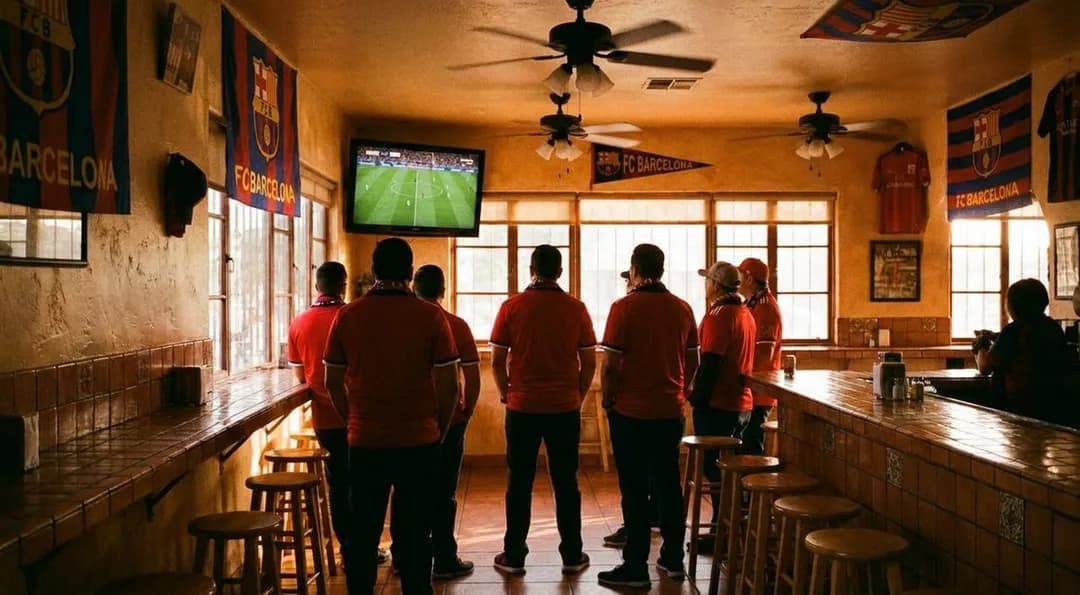
The staging ground for this vigil is not at the Rose Bowl but four miles south in Glendale, where Porto's Bakery & Café opens at 6:30 a.m. and serves as the unofficial pre-session gathering point for Spanish fans who want more than gas-station coffee. The line forms before the doors unlock—thirty people deep by 6:25, most wearing red jerseys or scarves. Porto's is a Cuban bakery, not Spanish, but its pastry case and strong cortaditos have made it a cultural crossroads for LA's Latino communities. Fans order guava pastelitos and cheese rolls, boxes of potato balls that they'll eat cold in the parking lot later. The Glendale location sits on Brand Boulevard, a straight shot north to the Rose Bowl via the 134, and the timing works: order at 6:35, eat in the car, arrive at Lot H by 7:10. Some fans skip Porto's and go directly to the Rose Bowl's perimeter, where a coffee cart operated by a Salvadoran vendor named Miguel sets up near the pedestrian gate at 6 a.m. He sells drip coffee, horchata, and tamales wrapped in foil. Miguel has worked this cart for six years and knows the training schedule for every team that uses the Rose Bowl facilities. He sells forty-three coffees before Spain's session begins.
The Session Itself
The Spanish squad emerges at 7:28, a staggered arrival of players in training bibs—half in yellow, half in blue. Lamine Yamal is among the first five onto the pitch, his gait loose and unhurried, and a ripple of recognition moves through the fence line. He favors the left side during warm-ups, stretching near the touchline where the fence is closest, fifteen yards away. His voice carries in the still morning air—short bursts of Spanish, laughter, a shout toward Pedri. The session begins with possession drills: rondos in tight circles, first-touch passing that sounds like a metronome of contact. The coaches—three assistants and Luis de la Fuente—rotate through the groups, adjusting positions, calling out tempo changes. Yamal plays in the center of his rondo, one-touching the ball with the inside of his right foot, spinning to find the next target. The ball moves fast enough that the fence-line watchers murmur in appreciation. At 7:51, the squad splits for a small-sided game, six-versus-six on a compressed pitch, and the intensity lifts. Yamal scores twice, both times cutting inside from the left and finishing low to the near post. The second goal draws applause from the fence, and he glances over, half-smiling, before jogging back to midfield.
The Player Window
The session ends at 8:47, and the players walk toward the tunnel that leads back to the locker room. The fence line surges—bodies pressing forward, phones raised, voices calling names in Spanish and Catalan. Yamal peels off from the group and walks toward the fence, signing jerseys and phone cases and a Barcelona scarf that someone passes through the chain-link. He signs for six minutes, methodical and unhurried, his marker squeaking against fabric. Pedri joins him, then Ferran Torres. The autograph window lasts eleven minutes before a team official gestures toward the tunnel. Yamal waves once, a small lift of his hand, and the crowd exhales. Three fans remain at the fence after the players leave, hoping for stragglers, but the pitch is empty by 9:02. The grass shows cleat marks in geometric patterns, and a single ball sits forgotten near the center circle until a groundskeeper jogs out to retrieve it.
After the Session
The exodus from Lot H is slower than the arrival—cars idling, fans comparing photos, a group of teenagers debating whether Yamal's left-footed finish was intentional or a mishit. Some drive south into Old Town Pasadena, where the sidewalk cafés along Colorado Boulevard are filling with brunch crowds. Others head east toward El Sereno and Boyle Heights, the neighborhoods where LA's Spanish community has deep roots, stopping at mercados for jamón and Manchego. A contingent of Barcelona fans drives west to Santa Monica, planning to spend the afternoon on the beach. The coffee cart vendor, Miguel, packs his equipment by 9:30, counting cash and loading the cart into a white van. He will be back tomorrow if Spain trains again, same spot, same time. The Rose Bowl practice pitch sits empty under a climbing sun, the grass already drying, the fence line deserted except for a single red scarf tied to the chain-link, fluttering in the breeze.
Practical Notes
• Lot H opens at 5 a.m.; arrive before 5:30 for fence-line parking. Parking is $8.
• Best sightline: midfield section of the eastern fence, elevated on the grass berm.
• Bring sun protection—no shade after 8:30 a.m
Sources consulted: fifa.com (https://www.fifa.com) · timeout.com/los-angeles (https://www.timeout.com/los-angeles) · visitpasadena.com (https://www.visitpasadena.com)
All trademarks are the property of their respective owners.
Ask Karpo first
Planning to reach Spain's early training at the Rose Bowl from East LA without getting stuck on the 210 or arriving after the premium sightline spots along the practice pitch are taken?
Ask Karpo for Rose Bowl training access logistics, the Gold Line Foothill Extension stop nearest to the stadium, and the Pasadena–East LA community fan circuit active during Spain's training week.
Ask Karpo for more information.
Keep reading
- Haaland Has Seven Goals and Norway Runs Entirely Through Him
 World Cup Trophy Ceremony Timing Medals and Postmatch Celebrations
 Olise and France's Attack: The Semifinal Tactical Question