 Chinatown Batik Canting Pen Picker: Fine Spouts for Silk
Hidden Gems & Odd Finds
Joo Chiat Batik Canting Pen Picker: Twin Spouts for Borders
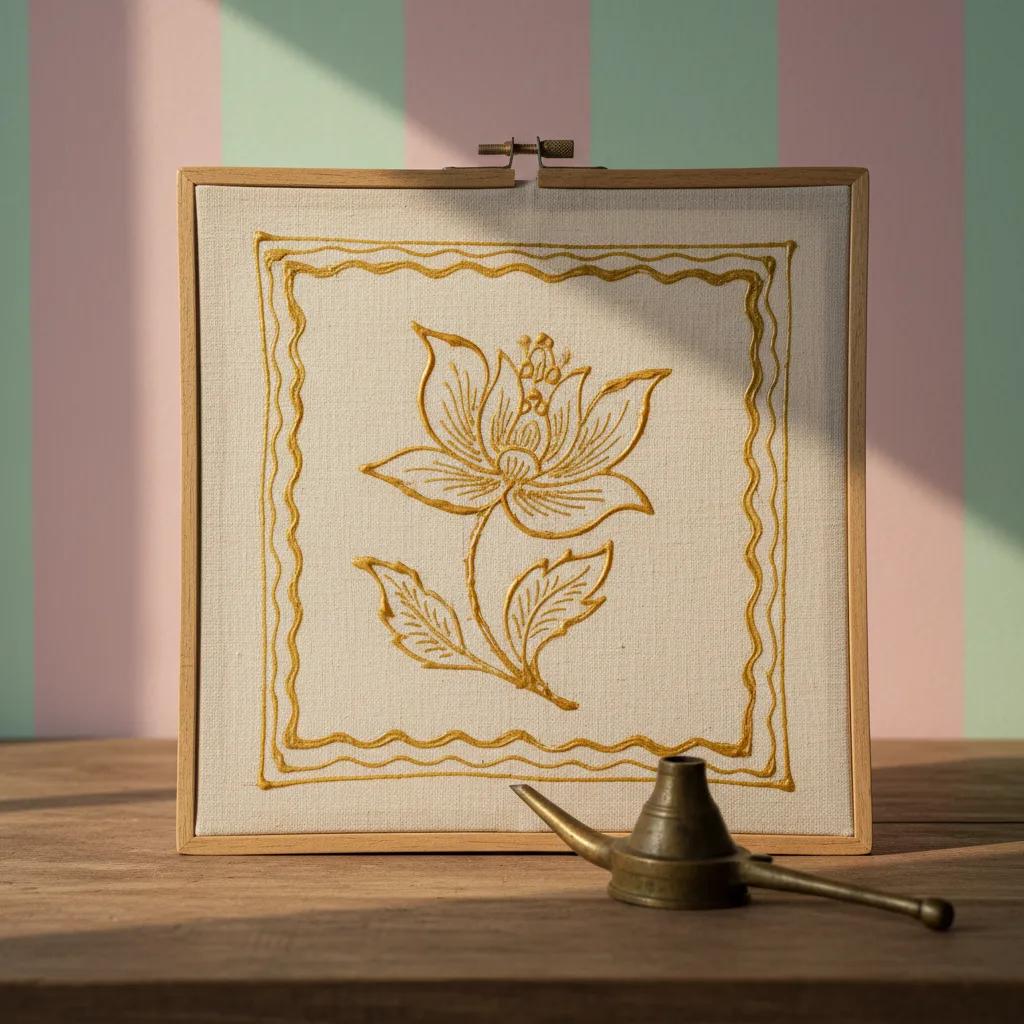
Pastel shophouse tiles inspire a floral cushion cover, and the real choice is whether a twin-spout canting or two single spouts suit its borders.
Floral borders look effortless in finished batik, yet the doubled lines framing each petal are where most home projects wobble. For a batik canting pen picker in Joo Chiat, the useful comparison is between a twin-spout canting that draws two parallel lines in one pass and a pair of single-spout tools used one after the other. The ornate tiles, carved fascias, and pastel facades along the neighborhood's shophouse rows supply endless border ideas, so it helps to settle the tool question before the motifs carry you away.
Start with a cushion cover, not a sampler
A square cushion cover is an honest project size: big enough to hold a central bloom and a framing border, small enough to finish over a few relaxed sessions. Sketch it at full size on newsprint. Place a peony or frangipani-like bloom in the centre and run a double-line border about a hand's width from the edge. Leave the corners open for a small leaf motif. This layout gives you three distinct tasks, outline, parallel border, and fine fill, each of which asks something different of a canting.
Label each area of the sketch with the line you imagine there. The bloom outline might be a single confident stroke. The border is two lines running side by side at a fixed gap. The petal centres could hold tiny dots or short dashes. Once these labels exist, you are no longer choosing a tool in the abstract; you are choosing the smallest set of spouts that can complete this exact cushion without frustration.
Twin spouts reward steady hands and simple curves
A canting with two spouts soldered side by side lays down parallel lines with an unchanging gap, which is exactly what a tidy border needs. The advantage is consistency: the gap cannot drift because the spouts are fixed. The challenge is turning corners. On a tight curve, the inner spout travels less distance than the outer one, and wax can bunch or thin. Twin spouts therefore suit straight runs and gentle arcs far better than tight scrolls.
When you handle a twin-spout canting, check that both openings sit at the same height. If one spout is slightly lower, it touches the cloth first and drags while the other barely marks. Look at the bowl as well. Feeding two spouts drains wax roughly twice as quickly, so a larger reservoir saves you from stopping halfway along a border edge, where a restart is most visible. Hold the tool level and imagine drawing the border of your cushion in one unbroken loop.
Two single spouts give you freedom at the corners
The alternative is to draw each border line separately with one single-spout canting, guided by a faint pencil line. It is slower and the gap may vary a little, but you gain control at corners, where you can ease each line around at its own pace. For a cushion border that wraps around rounded corners or dips into scallops, this freedom often produces a cleaner result than forcing a twin spout around the bend.

Single spouts also handle the bloom outline and leaf veins, so one medium-width tool can serve most of the cushion. If you choose this route, pay attention to the handle. You will draw many more strokes, and a handle that is too short brings your fingers close to the warm bowl, while one that is too long feels unwieldy. Hold it as you would a pencil tilted slightly back and notice whether your wrist settles or strains.
Fill details call for the finest opening
Petal centres and leaf textures in Peranakan-inspired designs are often filled with tiny dots or short flicks. A very fine single spout, or a dedicated dotting canting, handles this work. Because these openings are small, wax cools inside them quickly. Work with the bowl only partly full and return it to the heat often. Expect to clear an occasional clog by warming the spout rather than poking it, which can distort the opening.
You may decide that dots are optional for a first cushion. A bloom with clean outlines and a crisp border already reads beautifully once dyed. Adding fill texture later, perhaps on a second cover, lets you learn how a fine spout behaves without risking a piece you have already invested hours in. Choosing to delay a technique is a valid decision, not a shortcut.
Wax, cloth, and the humid afternoon
Singapore's humidity affects how quickly wax sets on the cloth. On a warm, damp afternoon, wax may stay soft a moment longer, letting lines spread slightly. A wax blend with more beeswax and resin holds edges well under these conditions and resists cracking, which suits floral work where clean petals matter. A paraffin-heavy blend cracks more readily, giving a weathered texture that some people love on borders and dislike on blooms.
Medium-weight cotton is a good partner for a cushion cover. It accepts wax evenly, survives repeated dyeing and washing, and stands up to daily use on a sofa. Thin cloth looks lovely but can pucker under a twin-spout border, as the double line of wax stiffens a narrow band. Bring a swatch of your chosen fabric when browsing so you can compare how each spout's line might sit on it.
Wandering Joo Chiat with your sketch
The pleasure of Joo Chiat lies in its details: patterned floor tiles glimpsed through doorways, carved timber panels, and facades painted in soft greens, pinks, and blues. Walk slowly and photograph or sketch border patterns that echo your cushion. You might also find craft classes, design studios, or small shops worth stepping into. Keep your one question close: twin spout, or two single spouts, for this border on this cloth?
If you want ideas before leaving home, Karpo APP can suggest nearby craft, textile, and heritage spots around Joo Chiat. You decide which of those suggestions to visit, in what order, and how to travel there. Treat each suggestion as a prompt rather than a schedule, and give yourself permission to linger wherever a tile pattern or a painted shutter sparks a new border idea.
Deciding without overbuying
If your border runs mostly in straight lines with soft corners, a twin-spout canting plus one fine single spout for details is a tidy pair. If your border curls and scallops, choose one medium single spout and one fine spout instead, and accept that each border line takes two passes. Either pairing finishes the cushion. Avoid buying both approaches at once; the comparison only becomes meaningful after you have completed one cover and looked closely at where the lines held true.
Ask Karpo for more information.
Keep reading
- Chinatown Batik Canting Pen Picker: Fine Spouts for Silk
 Tiong Bahru Batik Canting Pen Picker: Handles and Bowls
 Katong Batik Canting Pen Picker: Wide Spouts for Wave Fills