 North Beach Tailor Alteration Shop Finder: Inherited Suits
Neighborhood Guides
SF Transit Station Pitstop Finder: 20-Minute Taco Detour
Plan a Mission District taco stop around your chosen twenty-minute budget, food needs, and return direction, with a smaller option for the evening trip.
A taco stop near Sixteenth Street Mission can fit an evening commute when dinner has a clear boundary. Tell the Karpo APP where you are coming from, where you go next, and whether twenty minutes is your own total allowance or just the time you want to spend getting food. Ask for a compact taqueria suggestion and an easier alternative. A one-block search preference is a constraint, not proof that a suitable counter is available inside it.
Decide whether this is dinner or pickup
The first distinction is where you plan to eat. Taking tacos home creates a different request from eating them before another train ride. A seated dinner needs room for ordering, receiving food, eating, and leaving. Pickup still involves a handoff and carrying the meal. Spell out which version you mean instead of relying on the word “quick.” That adjective does not tell Karpo whether a table matters or whether dinner can wait until you reach your destination.
Sixteenth Street Mission is the BART anchor for this neighborhood scenario. Start from the station location that corresponds to your arrival, then describe the direction you intend to leave. Someone walking home through the Mission can accept a different deviation from someone returning to the platform. Give that distinction to the planning conversation early. It keeps a food recommendation from sending a through-traveler along the route of a person whose commute ends at street level.
Make the one-block limit precise enough to use
Ask yourself what “within one block” means for this trip. It might mean one block from your exit, one block added to your direct journey, or one block in the direction of home. Those interpretations produce different candidates. Tell Karpo which version you intend, and name the corner you are using if you know it. You can keep the request approximate while being explicit about the reason for the boundary: less walking, fewer crossings, or an easier return.
Do not let an attractive food description silently expand that limit. If a suggestion falls beyond it, either reject the option or deliberately change the request. Expanding the radius is a decision you make, rather than a fact the app should assume. For someone tired after work, the purpose of the pitstop may be to avoid an extra journey. A more famous taqueria is not automatically a better answer to that particular evening need.

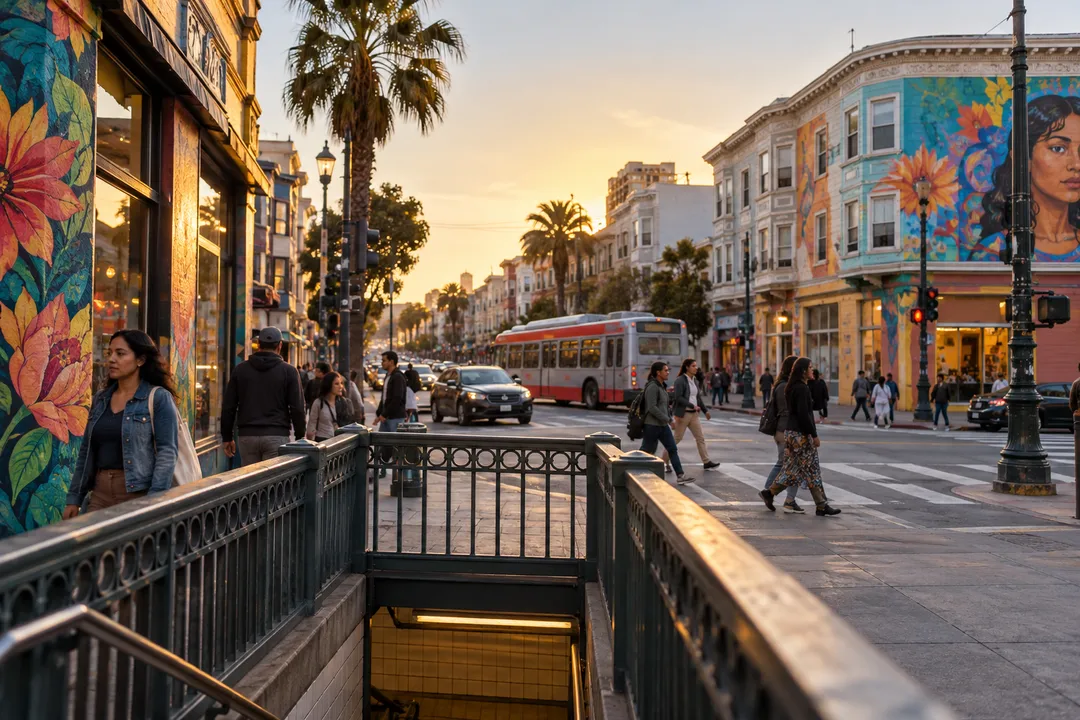
AI-generated Mission streetscape and taco illustrations; no named taqueria, menu item, or present stock is depicted.
Put the meal requirements ahead of the reputation
Describe the food you actually want. Perhaps two tacos are enough for a small dinner, or perhaps you need a larger item that stays together until home. Tell Karpo about dietary restrictions and ingredients you avoid. If authenticity matters to you, explain what you mean: a preparation style, a filling, or a preference for a particular kind of tortilla. That is more useful than treating “authentic” as a universal ranking that settles every choice.
No suggested dish should be understood as a stock report. If a dietary requirement is essential, the actual merchant interaction must resolve it before you order. Keep unsupported menu details out of the plan. You can ask Karpo to compare food formats without inventing a present price or claiming that a particular filling is waiting. A clear request about what you can eat helps narrow the conversation even when you have not named a shop.
Count the whole sequence inside twenty minutes
Imagine spending four minutes moving toward the stop, eight on the ordering and pickup process, five eating a small meal, and three getting ready to continue. This is a sample allocation you might choose, not an observation about service near the station. The pieces already consume twenty minutes. A detour to a second counter, a long menu discussion, or an extra crossing has to replace something. It cannot simply disappear from the arithmetic because the stop is nearby.
For takeaway, you could remove the eating portion and reserve more space for carrying and returning to transit. For a relaxed meal, you might instead abandon the tight allowance and choose dinner as the next activity. Both revisions are reasonable when made openly. The troublesome version is calling a sit-down meal a short transfer while budgeting only for the walk. Ask Karpo to help compare those versions of the evening before selecting a place.
Use a dinner request with an exit condition
Try: “I will be at Sixteenth Street Mission BART this evening and want a small taco dinner before continuing my trip. Keep suggestions within one block of the exit I describe. My personal total allowance is twenty minutes. I prefer vegetarian fillings and can carry food home if needed. Give me one plausible option and a simpler branch that does not require searching farther away.” Change the food requirement to match your own meal.
Then add an exit condition you can use independently. You might decide to skip the stop if the visible ordering process feels too involved, or to switch to pickup if a table would add a separate wait. These are choices, not predictions of the line. Karpo is helping you formulate a manageable plan; it is not monitoring the counter or promising that dinner will arrive by the end of your allowance.
Keep the food practical for the onward trip
Think about the container before committing to the meal. Several open tacos, loose salsa, and a drink can be awkward with a work bag. Ask for food-format suggestions that match how many hands you have available. A meal eaten at the counter and a meal carried on transit should not be treated as interchangeable. If you want to keep food closed until home, that detail may matter more than which option has the most elaborate description.
When traveling with a companion, agree whether you are buying one shared order or making separate choices. A friend adding an errand on another block changes the plan for everyone waiting. Tell Karpo whether the group needs to remain together and whether one person's dietary needs set the destination. One coherent dinner stop is easier to budget than two independent searches that happen to begin at the same station entrance.
Return attention to the journey after the handoff
Once dinner is ready, settle the container and put payment items away before stepping back into pedestrian movement. If you are taking transit again, follow the operator's instructions for the actual journey. The meal recommendation does not establish a departure time or an accessible station route. If you are walking home instead, keep the destination in the conversation so any revised food suggestion follows that direction rather than returning you to the original starting point.
Open the Karpo APP with a dinner format, a meaningful one-block boundary, and an honest total allowance. Ask for one focused suggestion around Sixteenth Street Mission and a fallback that makes the evening easier. You can leave with food, choose pickup for home, or continue without the detour. Each is a deliberate result when the purpose is a manageable commute with dinner attached, rather than collecting more restaurant possibilities as the evening gets later.
Ask Karpo for more information.
Keep reading
- North Beach Tailor Alteration Shop Finder: Inherited Suits
 Hayes Valley Tailor Alteration Shop Finder for Boutique Buys
 Pac Heights Tailor Alteration Shop Finder for Heirloom Gowns