 North Beach Tailor Alteration Shop Finder: Inherited Suits
Neighborhood Guides

North Beach Scenic Pedestrian Stroll Up the Filbert Steps
A North Beach scenic pedestrian stroll is free and takes about two hours: Washington Square, Coit Tower, then the Filbert Steps down to Levi's Plaza.
North Beach packs a scenic pedestrian stroll into barely a square mile, and the whole route costs nothing. Start at Washington Square, walk the diagonal of Columbus Avenue to the Beat landmarks near Broadway, climb Telegraph Hill to Coit Tower, then descend the Filbert Steps toward the waterfront. Budget two hours at an easy pace, wear shoes with grip, and give the hill climb your freshest legs rather than saving it for last.
Washington Square at First Light
Washington Square is not actually square. It is a five-sided lawn bounded by Columbus Avenue, Union, Stockton and Filbert Streets, and it serves as the living room of the neighborhood. On the Filbert side, Saints Peter and Paul Church lifts its twin spires over the grass. The church was completed in 1924, and its facade is the backdrop for countless photos, including the famous pictures of Joe DiMaggio and Marilyn Monroe after their 1954 wedding.
Arrive early and the lawn tells you who lives here. Small groups of older Chinese residents from neighboring Chinatown practice tai chi in slow unison, dog walkers trade gossip near the benches and a few runners loop the perimeter before work. A bronze statue of Benjamin Franklin stands near the center, a nineteenth-century gift that once doubled as a water fountain. Give the square ten unhurried minutes before you move on, because it sets the tempo for everything after.
Columbus Avenue and the Beat Corner
Columbus Avenue slices diagonally through the street grid, which is why North Beach feels slightly off-kilter compared with the rest of the city. Walk south from the square toward Broadway and you pass Italian-American storefronts, painted awnings and the steady hum of espresso machines through open doors. Look up as well as in: many buildings above the shops are early twentieth-century flats rebuilt after the 1906 earthquake and fire, with bay windows and cornices worth a second glance.
At Columbus and Broadway sits City Lights, the bookstore Lawrence Ferlinghetti co-founded in 1953 and the publisher of Allen Ginsberg's Howl. Beside it runs Jack Kerouac Alley, a short pedestrian passage renamed for the writer in 2007, with lines of poetry set into its paving. Stand at the alley's midpoint and read the stones underfoot. It takes two minutes and explains more about the neighborhood's reputation than any plaque on the avenue.
Grant Avenue's Quieter Upper Blocks
Rather than climbing straight up Telegraph Hill from Columbus, cut over to upper Grant Avenue and walk north between Vallejo and Greenwich. Grant is one of the oldest streets in San Francisco, and these upper blocks are narrower and calmer than the avenue below. Expect small galleries, vintage storefronts and old bar signs, plus residents who greet the shopkeepers by name. The sidewalks are tight, so let people pass when the pavement pinches near doorways.
Here is an honest call: skip Broadway between Columbus and Kearny if you are doing this walk late in the evening. That stretch is the strip-club and nightclub block, and after dark it is loud and crowded with bar-hoppers rather than strollers. In daylight it is harmless and briefly interesting for its neon history, but it is a corridor to pass through, not a place to linger with a camera.
The Climb to Coit Tower
From Grant and Greenwich, follow the Greenwich Street stairs or the Lombard Street sidewalk up to Pioneer Park on the crest of Telegraph Hill. The last stretch is steep enough that most people stop at least once, and that pause is where the views start opening east toward the Bay Bridge. If your knees protest, the Muni 39 Coit bus climbs from Washington Square to the summit parking circle and saves you the whole ascent.
Coit Tower was finished in 1933, paid for with money left to the city by Lillie Hitchcock Coit, a wealthy patron famous for her devotion to local firefighters. Inside the base, murals painted in 1934 under a New Deal art program depict California farm work, factory floors and city streets. Even if you do not ride the elevator to the observation level, step into the ground-floor lobby to see those panels, which are one of the most important public art works in the state.
Down the Filbert Steps and Napier Lane
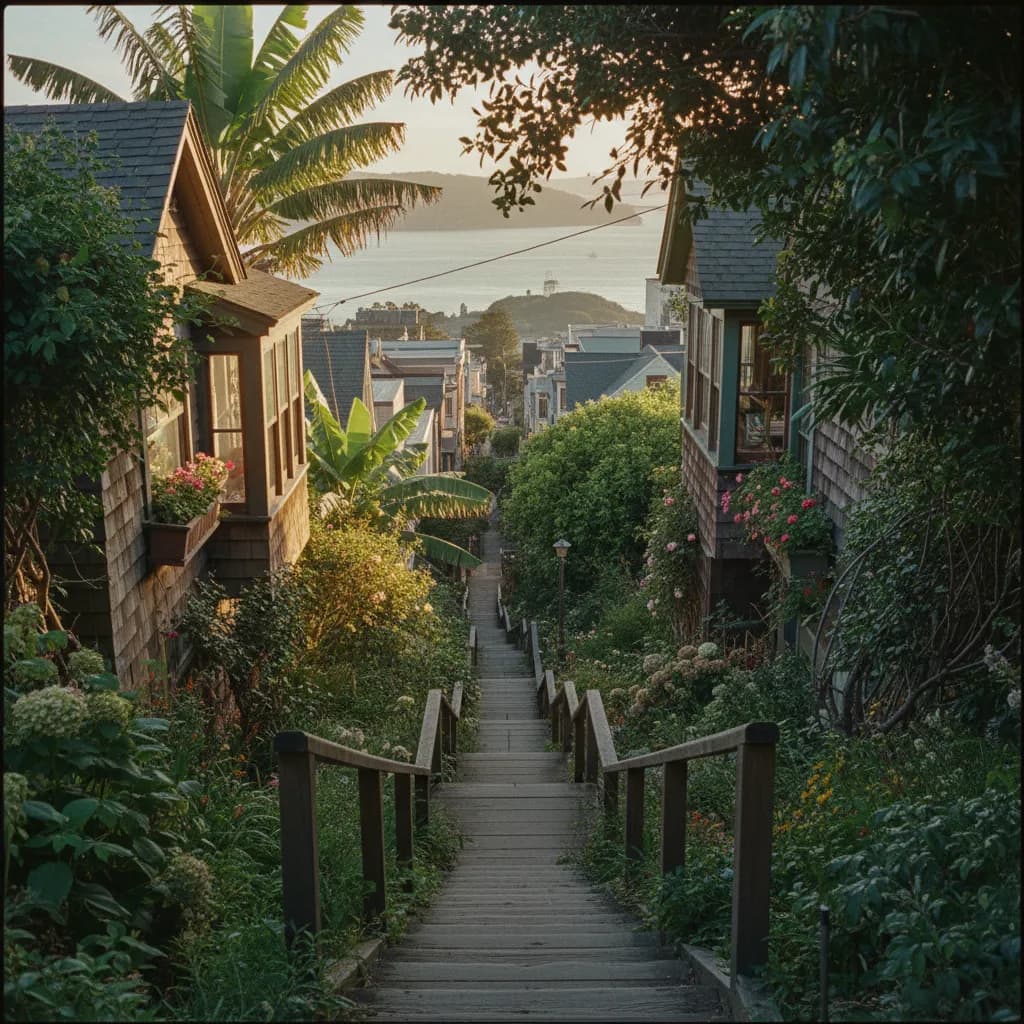
The reward for the climb is the descent. Walk around the tower to its eastern side and find the top of the Filbert Steps, which drop steeply toward Sansome Street. Within a few flights the city noise vanishes. The stairs pass through dense private and community gardens, including the plantings started by a resident named Grace Marchant, who spent decades turning a dumping slope into the lush tangle you see today.
Halfway down, Napier Lane branches off as a wooden boardwalk lined with nineteenth-century cottages, one of the last plank streets in the city. Walk it slowly and quietly, since these are private homes with tiny front gardens. Listen for the wild parrots of Telegraph Hill, a flock of cherry-headed conures that roost in the area and often announce themselves with loud screeches. Seeing them is never guaranteed, so treat any sighting as a bonus rather than the goal.
Who Walks North Beach and When
Weekday mornings bring the locals: tai chi groups in the square, retirees reading newspapers outside cafes, and parents walking children to school along Stockton. Late mornings on weekends shift toward visitors, with tour groups gathering under the church spires and long queues for brunch near the square. Late afternoon is the sweet spot for the steps, when the light rakes across the gardens and commuters are still downtown.
Fog is the wild card. Summer mornings, especially in July and August, often wrap Telegraph Hill in grey, and the view from Pioneer Park can shrink to a few hundred feet. September and October usually deliver the clearest days. If you wake to heavy fog, start with the lower Columbus Avenue stretch and City Lights, then save Coit Tower for the afternoon, when the marine layer sometimes burns off.
Planning the Route With Karpo APP
Karpo APP fits the moment before you leave home. Tell it you want a two-hour North Beach walk that starts at Washington Square, includes the Filbert Steps and avoids Broadway's late-night block, and it can line up the stops in a sensible order. Ask it to add a sit-down coffee break before the climb or a bookstore browse at the end, and keep that list handy as you walk.
Be clear on what it does not do. Karpo APP does not report live crowds on the steps, track fog or parrot sightings, or hold a table anywhere along the route. It is a planning companion that saves you from building the order of stops yourself. Use the city's Muni trip planner for live bus times, and look out the window for the fog check.
Getting There and a Flat Backup Route
Several Muni lines reach the area. The 30 Stockton and 8 buses run along Stockton Street past Washington Square, and the Powell-Mason cable car line skirts the western edge of the neighborhood on its way to Fisherman's Wharf. The full loop described here is roughly two miles, with one steep climb in the middle. Public restrooms are scarce, and the ones near Coit Tower can have a line on busy afternoons.
If stairs are not an option, skip Telegraph Hill and walk a flat figure eight instead: Washington Square, Columbus Avenue to Jack Kerouac Alley, back along upper Grant, and finish on the benches facing the church. That version takes under an hour. For a longer day, continue from the bottom of the Filbert Steps along the Embarcadero to the Ferry Building, about a twenty-minute walk south along the water.
Ask Karpo for more information.
Keep reading
- North Beach Tailor Alteration Shop Finder: Inherited Suits
 Hayes Valley Tailor Alteration Shop Finder for Boutique Buys
 Pac Heights Tailor Alteration Shop Finder for Heirloom Gowns