 North Beach Tailor Alteration Shop Finder: Inherited Suits
Neighborhood Guides
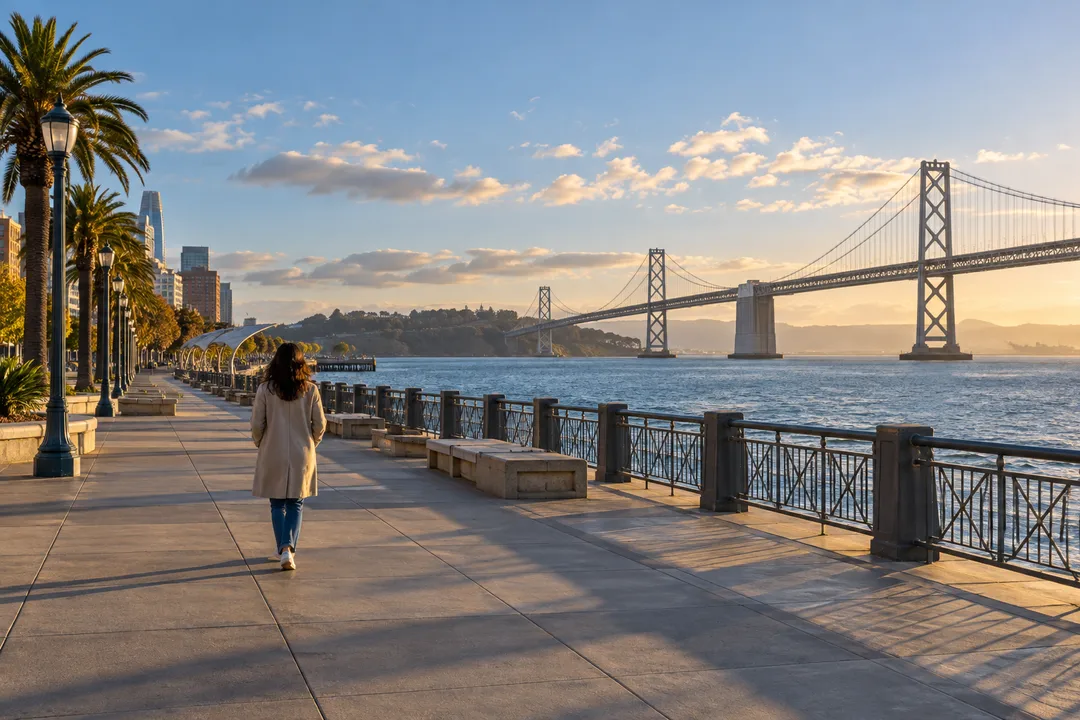
SF Post Work Route Planner: 5 Waterfront Walk Answers
Plan an Embarcadero reset walk with a clear turnaround, a homeward connection and room for changing light, without turning sunset into a rushed deadline.
An Embarcadero walk can be a small space between the workday and home, without becoming another appointment to keep. Use a post-work route planner to choose a starting point, a comfortable stretch beside the bay and a clear homeward connection. The useful plan has a turnaround you can recognize and permission to finish early. Five questions help you shape that waterfront reset around the time and energy you actually have, rather than around an idealized photograph of sunset.
1. Where should the waterfront walk begin?
Begin at the place where your workday route can reasonably meet the waterfront. If you are leaving FiDi, that might be a connection toward the Ferry Building area. If you are already farther south, a start along the Embarcadero may avoid an unnecessary trip north just to follow somebody else's route. The start should reduce the distance between work and the walk. Choosing it because it appears first in a list can turn a restorative break into a cross-downtown errand.
Give the planner your real starting intersection and the connection you intend to use afterward. Ask for a waterfront entry point that makes sense between those two anchors. Keep the journey to the promenade separate from the waterfront walking itself, especially if the first section takes most of your available energy. A shorter bay-side stretch can be more satisfying than a long approach that leaves you ready to stop as soon as you reach the water.
2. How do you choose a direction and turnaround?
Choose one direction first, then name a feature you can recognize as the turnaround. The Ferry Building and Bay Bridge are useful geographic reference points along this part of the city, but your route does not need to link them as a requirement. Ask for a clear street or public waterfront landmark at which to decide whether to continue. The important property is recognizability. A vague "walk until it feels right" can leave the return portion longer than you intended.
Compare an out-and-back walk with a one-way walk ending near an onward connection. The first is easy to understand because you retrace a known stretch. The second can reduce repetition, but it needs a useful exit at the far end. Neither is automatically better. If you are uncertain about your energy, the out-and-back version gives you a simple early turn. If you already know where you want to continue, the one-way version may fit the shape of your evening more naturally.
Set the return portion aside before extending the outward leg. A personal walking allowance describes the whole outing, not just the distance until you turn. You might decide to use a short first stretch and pause at the turnaround decision rather than committing to a longer endpoint immediately. That is a pacing choice you make for yourself. It should never be presented as a measured walking time from an unnamed office or as a guarantee about the state of the path.
3. Does sunset need to be the deadline?

No. You can plan for evening light without making a precise sunset moment the test of whether the walk succeeded. The Embarcadero faces the bay on the city's eastern waterfront, so a western sunset is not a promise that the sun will drop into the water directly ahead of you. Think about reflected light, changing color and the skyline as well as the sun itself. Weather and your position affect what you see, and a pleasing photograph remains a possibility rather than an appointment.
If a particular light condition matters, consult an appropriate weather and sunset reference for the date you have chosen, then keep enough flexibility to enjoy a different view. Do not ask the itinerary to guarantee a clear horizon or a vivid sky. If you leave work after the light you wanted, shorten the walk or choose another evening. A waterfront reset still has value when the sky is gray. The route should serve your mood instead of making you race through intersections to rescue a picture.
4. What happens when the water feels too exposed?
Decide in advance whether you want a shorter walk or an indoor destination afterward. These are different solutions. Shortening the walk protects the simplicity of the outing, while a food or drink stop adds another choice and a separate time commitment. Do not assume a nearby building is available as free shelter or that a waterfront-facing business has room for you. Keep any indoor stop a deliberate destination that fits your needs, rather than an unspecified refuge built into the route.
For a companion who wants more walking than you do, agree on the point where you will separate or pause. You can share a first section without sharing the entire evening. Tell the planner which person needs the shorter route and whether both people must return to the same connection. This makes a useful itinerary more likely than averaging two incompatible walking preferences. A good endpoint is one everybody understands, even if each person continues differently from there.
5. What should you ask Karpo to put in the plan?
Open the Karpo APP and give the request a concrete shape: "Help me make an Embarcadero unwind walk from [work intersection], finishing toward [homeward connection]. I prefer [walking allowance], would like a recognizable turnaround and do not need a dinner stop. Compare an out-and-back version with a one-way version." Add any step-free access or seating requirements. Ask for the reason to choose each version, so you can assess the suggestion before beginning the walk.
The answer should leave you with a starting approach, an ordered waterfront stretch, a turnaround or endpoint and a homeward sequence. Read the proposal on a map and remove detours that exist mainly to add attractions. If public path access, a crossing or a transit connection is unresolved, treat it as a concrete question rather than a hidden certainty. Karpo can help you organize the route request and revise your preferences. The suggestion is not a promise of an unobstructed path or a monitored journey.
Practical notes for the homeward transition
Carry the minimum plan you need: where to meet the water, which way to walk, where to turn and how to continue home. Use the relevant transit operator for the specific homeward service, and keep your own stop decision independent of a hoped-for sunset. Leave room to stand and look without adding another destination. When the walk has done its job, you can end it. The most useful waterfront itinerary is often the one that gives you a clear way out as well as a pleasant way in.
Ask Karpo for more information.
Keep reading
- North Beach Tailor Alteration Shop Finder: Inherited Suits
 Hayes Valley Tailor Alteration Shop Finder for Boutique Buys
 Pac Heights Tailor Alteration Shop Finder for Heirloom Gowns