 North Beach Tailor Alteration Shop Finder: Inherited Suits
Neighborhood Guides
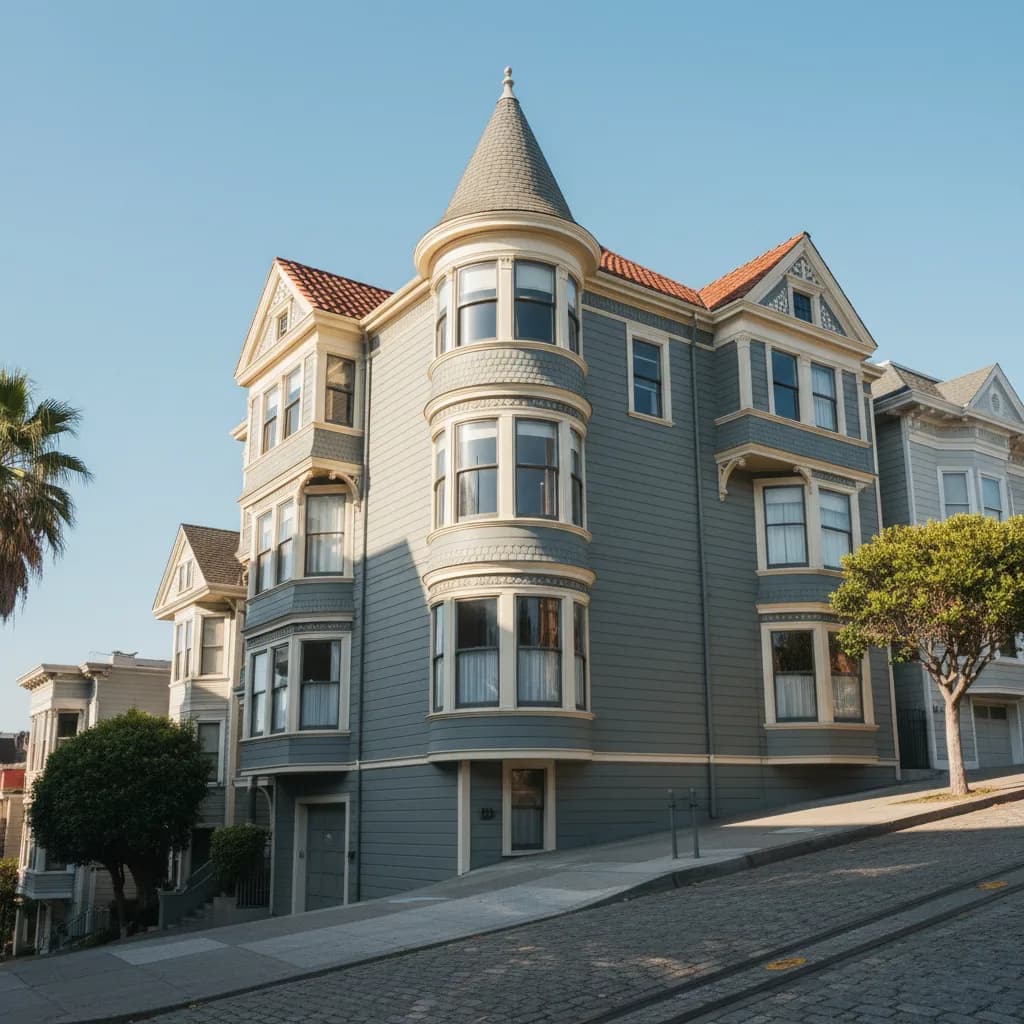
Free Pacific Heights Neighborhood Historical Walking Tour
A free Pacific Heights history walk links the 1886 Haas-Lilienthal House, Lafayette Park and Alta Plaza in under three miles; only the house tour costs extra.
When the 1906 fire raced west, soldiers dynamited mansions along Van Ness Avenue to stop it, and the houses on the hill above survived. That is why a neighborhood historical walking tour of Pacific Heights still reads like a catalog of Victorian and Edwardian San Francisco wealth. The route below is free and self-guided, about two and a half miles from Franklin Street to the Lyon Street Steps, with one optional ticketed stop inside a house museum.

The Haas-Lilienthal House on Franklin Street
Start at 2007 Franklin Street, between Washington and Jackson, where the Haas-Lilienthal House has stood since 1886. Built for grocery wholesaler William Haas, it is a towering Queen Anne with a corner turret, carved gables and a wraparound of bay windows, and it is the only private Victorian home in the city open regularly as a museum. San Francisco Heritage runs guided tours inside, which are ticketed, but the exterior alone shows how ornate wooden houses got before the earthquake.
Look at the houses on either side to see what changed after 1906. Many neighbors were rebuilt or replaced in stucco, brick and stone, materials chosen partly because the fire had shown how quickly wood burned. Franklin Street itself carries heavy one-way traffic toward the Golden Gate Bridge, so step off it after your photos. Walk one block west on Washington Street and the noise drops immediately as you approach the park.
Lafayette Park and the Spreckels Palace
Lafayette Park occupies a hilltop between Washington, Sacramento, Gough and Laguna Streets, and its summit gives one of the best views in the neighborhood across the bay. On the park's north edge, at 2080 Washington Street, rises the limestone mansion that architect George Applegarth designed in 1913 for sugar heir Adolph Spreckels and his wife Alma. Its formal French facade fills most of a block, and it is a private home today, owned by novelist Danielle Steel.
Alma Spreckels is worth a minute of your time here. She went on to found the California Palace of the Legion of Honor museum, and the same Applegarth designed both buildings. Locals on the park benches are mostly dog walkers and nannies, and the upper lawn is a favorite of tennis players heading to the courts. Honest tip: the stairs on the park's west slope are a shortcut, but they are uneven, so take the paved path if you are in slick shoes.
Jackson and Webster: Red Sandstone and Brick
Walk north to 2090 Jackson Street at Laguna, where the Whittier Mansion was completed in 1896 for businessman William Franklin Whittier. It was built of red Arizona sandstone and is one of the few stone houses that came through the 1906 earthquake largely undamaged. Its heavy, square massing feels almost like a fortress next to the lighter wooden homes on nearby blocks, which is the contrast most architecture fans come to see.
Continue west to 2550 Webster Street, between Washington and Jackson, where architect Willis Polk designed the dark clinker-brick Bourn Mansion in 1896 for William Bourn II, whose family fortune came from gold mining and the Spring Valley Water Company. Polk deliberately used rough, overburned brick to make the house look older than it was. Both mansions are private, so admire them from the sidewalk and keep your camera at street level rather than at the windows.
Alta Plaza and the What's Up, Doc? Steps
Head west along Jackson Street to Alta Plaza Park, bounded by Jackson, Clay, Steiner and Scott Streets. The south side of the park is a dramatic set of terraced stone steps, and film fans know them from What's Up, Doc?, the 1972 comedy in which a car chase bounces down the stairs. At the top, turn around to see the long view south toward the Western Addition and downtown, a view that explains why the wealthy wanted to live up here once cable cars climbed the hill.
If you want a coffee break, the commercial stretch of Fillmore Street between Jackson and Sutter is a short detour downhill, with shops and cafes in early twentieth-century storefronts. It is pleasant but not essential to the history, so skip it if your legs are tired. Movie fans heading to Steiner and Broadway will spot a house made famous by the 1993 film Mrs. Doubtfire; it is a private residence, so take your photo from across the street and move on.
Broadway's Grand Blocks and the Lyon Street Steps
Work your way north to Broadway and walk west between Divisadero and Lyon. These blocks hold some of the largest single-family houses in San Francisco, with Beaux-Arts, Tudor and Mediterranean revival facades lined up along the ridge, and the bay views between them stretch to the Golden Gate Bridge and the Marin Headlands. You will see gardeners, delivery drivers and runners more than residents, and the street is very quiet.
Broadway ends at the Lyon Street Steps, a long, landscaped staircase dropping north to Green Street beside the stone wall of the Presidio. On weekday mornings it is busy with people doing stair workouts, and the unspoken rule is to stay to the right so climbers can pass. From the top you look down over the Palace of Fine Arts dome and the bay, a fitting end to a walk built on hillside views.
Getting There, Timing and a Shorter Option
The 1 California bus runs along the south edge of Pacific Heights and the 22 Fillmore crosses it north to south, so you can start at Franklin and return from Fillmore or the Presidio without retracing your steps. Late morning light is ideal for the facades on Jackson and Washington, and early evening brings the best color on the bay from Broadway. Fog often arrives in the afternoon in summer, so bring a jacket.
If the full route feels long, a two-park loop of Haas-Lilienthal, Lafayette Park, the Whittier and Bourn mansions and Alta Plaza covers the essential history in about ninety minutes. Ask Karpo APP to arrange the stops around a Haas-Lilienthal tour time or a lunch on Fillmore, and it will suggest a walking order that avoids doubling back. Everything listed is visible from public sidewalks and parks.
Ask Karpo for more information.
Keep reading
- North Beach Tailor Alteration Shop Finder: Inherited Suits
 Hayes Valley Tailor Alteration Shop Finder for Boutique Buys
 Pac Heights Tailor Alteration Shop Finder for Heirloom Gowns