 North Beach Tailor Alteration Shop Finder: Inherited Suits
Neighborhood Guides
Inner Sunset Neighborhood Historical Walking Tour: 1894 Fair
This free Inner Sunset history walk links Golden Gate Park's 1894 Music Concourse, Irving Street and the 16th Avenue Tiled Steps, and it needs no booking.
The sunken lawn between the de Young Museum and the California Academy of Sciences was dug for a world's fair: the California Midwinter International Exposition of 1894, staged in Golden Gate Park to lure visitors west during a national depression. This neighborhood historical walking tour of the Inner Sunset starts in that bowl, then follows the streetcar line that turned sand dunes into a neighborhood, and finishes on two tiled staircases. It is free, self-guided and about three miles long.
The Music Concourse, Built for a World's Fair
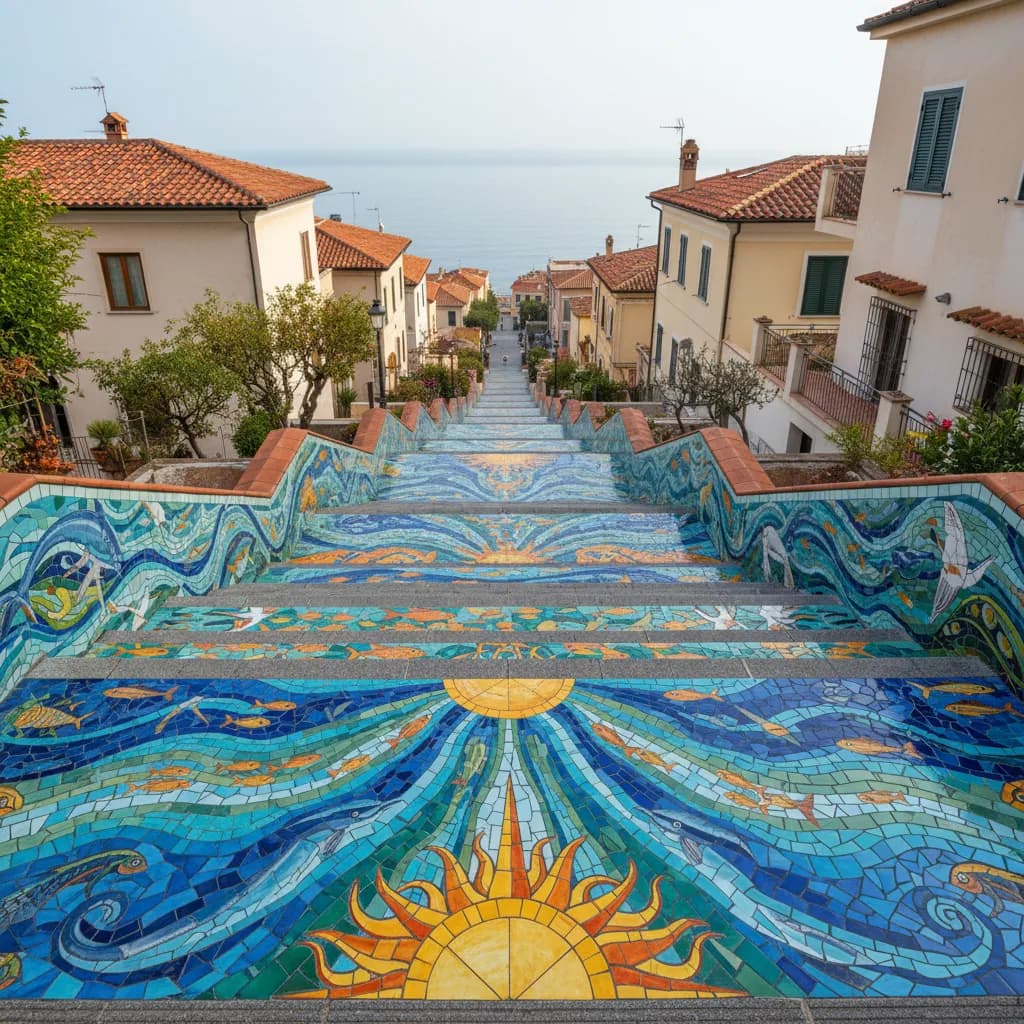
Enter Golden Gate Park at 9th Avenue and Lincoln Way and walk north to the Music Concourse. The rows of pollarded plane trees and the sunken oval were laid out for the 1894 exposition, when this area held exhibit halls, a Ferris-style wheel and international pavilions. At the west end stands the Spreckels Temple of Music, a classical bandshell given to the city by sugar magnate Claus Spreckels in 1900. On some Sundays a band still plays there, as it has for more than a century.
The museums ringing the bowl are newer than they look in old postcards. The de Young reopened in 2005 in a perforated copper building by Herzog and de Meuron, and its twisting observation tower has free public access to the top floor, with a view across the park to the Pacific. The California Academy of Sciences, rebuilt by Renzo Piano and opened in 2008, has a planted living roof. Both museum interiors are ticketed; the concourse itself is free.
The Japanese Tea Garden's Fair Origins
On the concourse's northwest side, the Japanese Tea Garden is the most direct survivor of the 1894 fair. It began as an exhibit called the Japanese Village, and after the exposition closed, Japanese gardener Makoto Hagiwara took charge of it and expanded it for decades, with his family living on the grounds until they were forced out during the wartime incarceration of Japanese Americans in 1942. The garden is ticketed, but the story belongs on any history walk here.
Honest advice: if you only have time for one paid stop, choose based on mood rather than reputation. The tea garden is at its quietest right after opening on weekday mornings, when the drum bridge and pagoda photograph without crowds; by midday on weekends it fills with tour groups. If the line at the gate is long, the free observation tower at the de Young offers a better use of a short visit.
Irving Street and the N Judah Streetcar
Leave the park on 9th Avenue and walk south two blocks to Irving Street. Until the early twentieth century, this part of the city was mostly windblown sand known as the Outside Lands. Development accelerated after the 1906 earthquake, when families moved west, and again after the N Judah streetcar began running through the Sunset Tunnel in 1928. Today the train still rolls down Irving between Arguello and 9th Avenue before turning onto Judah, and it remains the neighborhood's lifeline.
Walk the commercial blocks of Irving and 9th Avenue to see the Inner Sunset's two eras side by side. Stucco storefronts with flats above date mostly from the 1920s and 1930s building boom, while restaurants serving Japanese, Chinese, Thai and Burmese food reflect the families who settled here later. Regulars include medical students and nurses on breaks from the university campus up the hill and parents walking children home from school, so the sidewalks feel residential even on a weekday lunch hour.
Parnassus Heights and the University on the Hill
Look up from Irving and you will see the hospital towers of UCSF's Parnassus campus on the slope of Mount Sutro, where the university's affiliated colleges opened in 1898. Behind them rises Sutro Tower, the red and white broadcast mast completed in 1973 that now defines the city skyline from almost everywhere. The steep streets of Parnassus Heights are lined with Edwardian and Mission Revival homes worth a detour if your legs are fresh.
If you want a nature break, the trails of Mount Sutro Open Space Reserve start behind the campus and climb through a eucalyptus forest that is usually damp and cool. It is easy to get turned around in the fog, so stick to the main trail markers and skip it entirely on wet days, when the paths become muddy. Otherwise, continue south and west through the residential grid toward the hills of Golden Gate Heights.
The Hidden Garden Steps and 16th Avenue Tiled Steps
At 16th Avenue between Kirkham and Lawton Streets you reach the Hidden Garden Steps, a mosaic staircase completed by neighbors and artists in 2013, decorated with flowers, insects and creatures. A block south, at 16th Avenue and Moraga Street, the larger 16th Avenue Tiled Steps climb 163 risers covered in a continuous mosaic that flows from sea to sky. It was completed in 2005 by artists Aileen Barr and Colette Crutcher with hundreds of local volunteers.
The steps are a residential public stairway, not a theme park, so keep music down and do not sit across the full width. At the top, continue up to Grand View Park, a sandy summit with one of the widest views of the western neighborhoods, Golden Gate Park and the ocean. Mornings are usually the clearest; by late afternoon, fog often pours over the hill and hides the view, so plan the climb early.
Getting Around, Weather and a Short Version
The N Judah stops at 9th Avenue and Irving, right at the start of the walk, and the 7 Haight-Noriega bus runs along Lincoln Way beside the park. The full route is about three miles with significant hills at the end, so wear supportive shoes and carry a layer; the Inner Sunset is often foggy and cooler than downtown, especially in summer afternoons.
For a shorter version, stay with the Music Concourse, the tea garden exterior and Irving Street, which keep the 1894 fair and streetcar chapters in under ninety minutes on flat ground. Ask Karpo APP to time the stairs for a clear morning and add a lunch stop on Irving, and it will propose an order of stops that matches your energy. Every stop here is a public park, street or stairway that you can join at any point.
Ask Karpo for more information.
Keep reading
- North Beach Tailor Alteration Shop Finder: Inherited Suits
 Hayes Valley Tailor Alteration Shop Finder for Boutique Buys
 Pac Heights Tailor Alteration Shop Finder for Heirloom Gowns