 North Beach Tailor Alteration Shop Finder: Inherited Suits
Neighborhood Guides

SF Historic Walking Route: Read Fillmore in 2 Layers
A Fillmore historic walking route pairs present streets with community history. Separate what survives, what changed, and what the pavement cannot explain.
A Fillmore historic walking route should make room for what you cannot see. Attractive facades and a familiar neighborhood name are only part of the story. The Western Addition's history includes community formation, forced removal, and redevelopment, and a street photograph cannot explain those changes on its own. Plan the outing in two layers: first read a small, carefully chosen piece of community history, then walk a compact area with questions that the present streets can help you explore. The goal is not to recreate a vanished neighborhood from imagination. It is to notice where the visible city needs a documentary companion.
Read before you draw a line
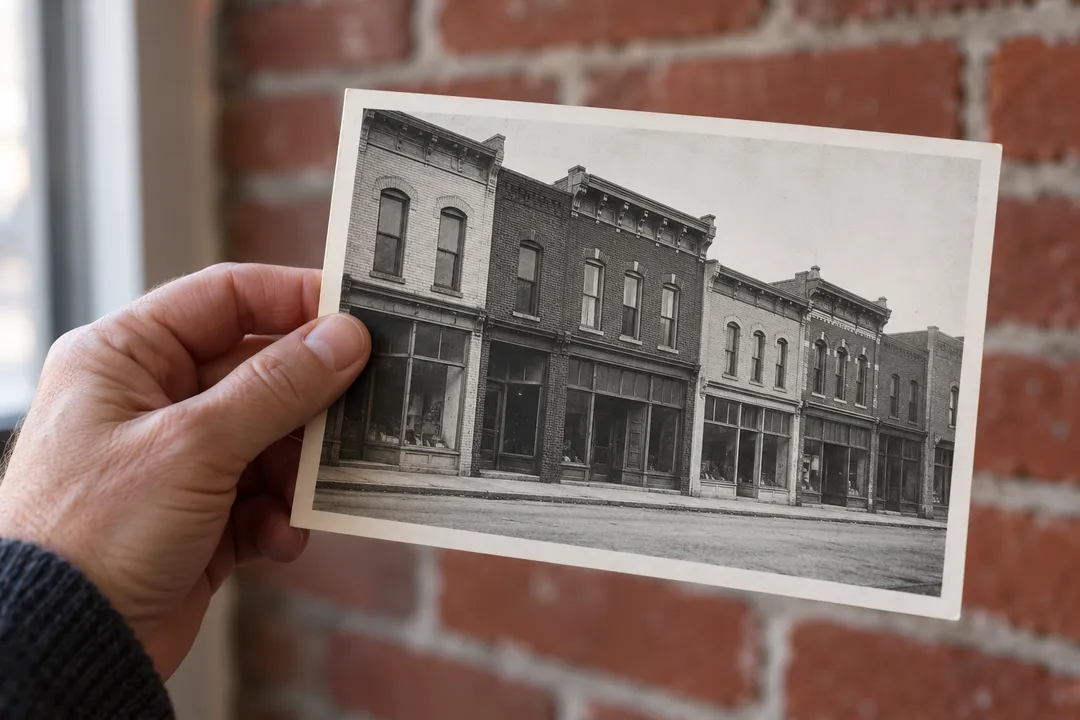
The hand-held photograph above is an AI-generated illustration, not an archival record. The University of San Francisco's Western Addition research guide offers a chronology that can help establish a sequence of changes. KQED's Fillmore project provides another way into the neighborhood's social history. Start with a limited topic rather than trying to summarize everything: Japanese American displacement, Black cultural life, or redevelopment and its effects on the built environment. These topics connect, but they should not be compressed into one undifferentiated story. Give your walk a question that can be discussed responsibly, and keep the broader context available for later reading.
Choose a short passage or a few notes to carry. Record who produced the material and whether it describes a specific time, a particular community, or a later interpretation. That simple habit prevents a historical quotation from becoming a claim about everyone who has lived in the area. If your group includes people with different familiarity with the history, share the background beforehand. Do not make one companion responsible for explaining a community simply because of their identity. A walk can invite discussion without appointing a stranger or a friend as its unpaid historian.
Separate absence from emptiness
On the street, a large building or a change in block pattern may prompt a question about redevelopment. It does not reveal the full history of the site. Resist describing a place as empty before construction unless your research actually establishes that. The absence of an earlier building from today's view does not mean an absence of earlier residents, businesses, or social life. In your notes, distinguish a visible condition from the historical process you are trying to understand. The phrase 'I cannot see it here' is very different from 'it was never here.'
This distinction changes the way you take photographs. Instead of searching only for a surviving landmark, make a pair of images that records a contrast you genuinely observed: a change in scale, a difference in setback, or the relationship between a busy road and smaller residential streets. Do not label the pair as proof of displacement without documentary support. Its value lies in showing the question that brought you to the neighborhood. Captions should describe the view accurately and leave room for the research to be more complicated than the photograph.
Keep Japantown and Fillmore histories distinct
A route in this part of the city may bring you near Japantown as well as Fillmore Street. Treat that proximity as an opportunity for careful comparison, not a reason to merge the histories. The USF chronology records the formation of Nihonmachi in the Western Addition and later changes in the area's population. Those are historical processes involving people, policy, and movement. They are not simply two decorative themes for a shopping walk. If you include both areas, explain which question connects them and where the focus of your route changes.
For a first outing, it may be better to choose one thread and save the other for another day. That allows time for a pause, a conversation, and a return to a difficult passage in your notes. A route becomes superficial when every change of street requires a complete change of historical subject. You do not need to visit every culturally significant place nearby to take the neighborhood seriously. A limited walk with a clear question can be more respectful than a rapid sequence of sites introduced through a few borrowed sentences.
Listen without turning residents into evidence
The people you encounter are living their lives, not performing the past for visitors. Avoid asking a shop employee to validate a historical narrative while they are working. If a public program, exhibition, or organized conversation interests you, approach it as a separate activity with its own terms. Do not assume that every nearby cultural venue offers casual historical interpretation. Equally, do not invent a scene of musicians, longtime residents, or family businesses to make the article feel vivid. The ordinary street is enough. Its complexity does not require a staged encounter.
Within your own group, make space for different reactions. One person may notice architecture, another may connect the reading to family history, and another may need time to think. Avoid treating a heavy subject as a quiz about dates. A useful question is what the streets made easier to understand and what remained invisible. That allows the walk to deepen the reading without pretending to replace it. If the conversation becomes absorbing, find a place to pause without blocking circulation, then put the map away until the discussion is finished.
Build a return that fits the subject
Choose an endpoint that gives the group room to stop and decide what comes next. It need not be a famous destination. The end of a reflective walk should not automatically become a rush toward another attraction. Decide in advance whether you want a meal, a quiet break, or a direct journey home. Keep any commercial stop optional so a busy dining room does not become the final argument of the outing. If you choose a business after the walk, make that decision using its own information rather than an assumed historical connection.
Practical Notes
Use a current map for street connections and a historical document for historical interpretation. They perform different jobs. A historic map may show a building or street pattern that no longer provides a usable route. Do not navigate from it. Keep the walking area compact, consider slopes and crossings individually, and let a companion's comfort determine when to shorten the outing. No interior access, event admission, or business availability is implied by this route concept. An exterior walk can still have depth when the background reading is specific and the claims stay proportionate to the evidence.
In the Karpo APP, frame your request around the topic rather than a generic list of landmarks: a Fillmore history walk that makes room for redevelopment questions and a quiet discussion pause. Review the suggestions against the focus you chose before leaving. Build the final street sequence in your own navigation map. Afterward, return to the research guide and identify one point you now understand differently. Save another question for an archive, a book, or a public program. The purpose of the two layers is to keep the walk open to learning rather than ending with a confident story the streets alone cannot support.
Ask Karpo for more information.
Keep reading
- North Beach Tailor Alteration Shop Finder: Inherited Suits
 Hayes Valley Tailor Alteration Shop Finder for Boutique Buys
 Pac Heights Tailor Alteration Shop Finder for Heirloom Gowns