 North Beach Tailor Alteration Shop Finder: Inherited Suits
Neighborhood Guides

SF Historic Walking Route: Chinatown Beyond the Main Street
A Chinatown historic walking route can pair Grant Avenue with nearby lanes while keeping public passages, private thresholds, and neighborhood life distinct.
A Chinatown historic walking route becomes more interesting when the main street is your point of comparison rather than your entire itinerary. Grant Avenue offers one view of the neighborhood. Smaller lanes change the scale, the line of sight, and the way you share space with people going about ordinary errands. Build a compact route that moves between those scales, then returns to a street you can recognize. The aim is not to discover a supposedly secret Chinatown. It is to observe a living neighborhood without mistaking a passageway, a private entrance, or a photogenic balcony for an invitation.
Begin with a public-street boundary
On your walking map, distinguish through streets from lanes and paths that merely appear to connect. A thin line on a map can represent several kinds of passage. Do not build the route around an unverified shortcut through a building. Choose a public-street backbone first, and add a lane only when its connection is clear. Grant Avenue and Stockton Street can serve as different reference lines for orientation, but the walk does not need to cover both from end to end. A smaller circuit makes it easier to notice changes without continually consulting directions.
Make your first stop an orientation pause. Stand away from shop entrances and identify the direction of your return before taking photographs. The slope and tall facades can make a short distance feel more enclosed than it looks on a map. Give each companion the same endpoint and a simple way to describe the route back. That is more useful than agreeing to follow whoever is holding the phone. If somebody wants to pause for food or shopping, separate that choice from the route's essential connections so the rest of the group understands where the walk resumes.
Treat the lane as a different kind of room
The shift from a wider avenue to a narrow lane changes how a group should move. Spread-out conversation that works on a broad pavement may block the passage here. Walk in a smaller formation, stop where others can pass, and move aside before opening a notebook. These are suggestions for considerate behavior, not claims about a venue's rules. The historical interest of a lane does not override its everyday use. A delivery, a resident carrying groceries, or somebody sweeping an entrance has priority over your attempt to frame an unobstructed picture.
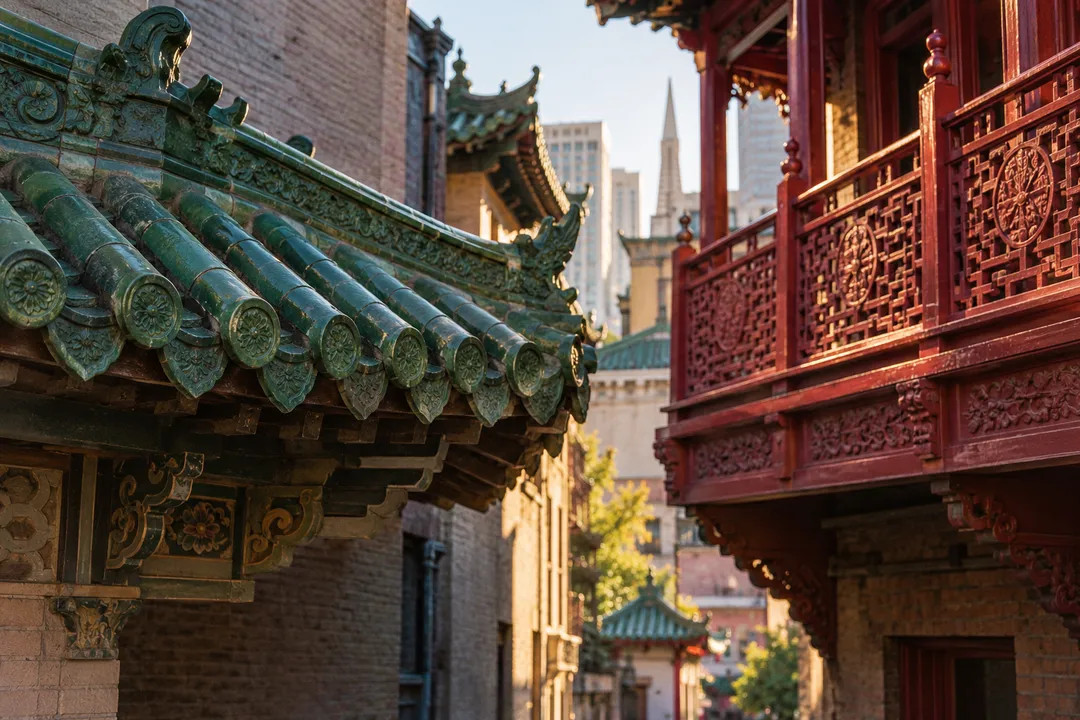
Look upward only after finding a safe place to stand. Balconies, projecting windows, and changes in roofline can create several layers within one view. Notice the relationship between the ground floor and upper floors rather than treating decoration as the whole story. A building can contain several uses and histories that are invisible from the pavement. Avoid inferring the age or purpose of an interior from an exterior motif. Record a question when a detail is intriguing. A photograph paired with a careful question is more useful than a confident caption invented on the spot.
Make comparison your organizing method
Choose a recurring feature to follow between the main street and the lanes. It might be the width of doorways, the direction of balconies, or the transition between painted wood and brick. That gives a mixed group something concrete to discuss without requiring everyone to recognize architectural terms. Each person can select a detail, explain what they noticed, and distinguish observation from interpretation. Keep the exercise brief enough that it does not become a lecture. The point is to sharpen attention, not to turn residents' homes and workplaces into a classroom that occupies the whole passage.
A second comparison concerns movement. Observe where people stop and where they keep walking. A busy corner may be a poor place for a long historical explanation, even if it is central to your route. Move the discussion to a less constrained public space and refer back to the feature you saw. Do not follow or photograph individual residents to illustrate neighborhood life. Buildings and street connections can carry your account without using strangers as props. If you want a portrait or a close view of someone's work, ask directly and accept a refusal without negotiation.
Let research complicate the postcard
Use a local historical institution's material to prepare one question about rebuilding, community organization, or changing street life. The Chinese Historical Society of America is a useful place to begin that research. Do not reduce the neighborhood to colorful facades or describe every decorative feature as ancient. A historical walk needs to distinguish the age of a community from the age of a building and the age of the architectural language applied to it. Those can be different stories. You can explore that distinction without assigning unsupported dates to the doorways along your route.
Keep the research portable. A short note containing one documented question and a few relevant streets is easier to use outdoors than a long collection of copied paragraphs. Read the background before leaving, then spend the walk looking rather than scrolling. If a building raises a question beyond your notes, leave it unresolved until later. The most responsible account may say that you observed a change in form without explaining its cause. A route is a way to encounter evidence. It does not make every observation sufficient evidence for a historical conclusion.
Food and shopping belong to a separate branch
A walk can include food without becoming a list of unsupported recommendations. Decide whether you need a seated meal, a takeaway pause, or simply time to browse. The route should not depend on a particular business being available. Choose any purchase after reading the information provided by that business, and keep its entrance clear while deciding. If your group divides between shopping and walking, set a reunion point outside the narrow lane network. Avoid giving a meeting point as only a storefront color because signs and displays are less reliable than an identifiable street junction.
Practical Notes
This route concept emphasizes public streets and exterior observation. It does not include admission to homes, association buildings, workplaces, or museums. Avoid promising a step-free circuit until you have examined the actual street connections and slopes. If the group includes somebody who needs regular seated rests, plan those separately rather than assuming a small circuit means an easy walk. Rain changes both footing and comfort in narrow passages. Make shortening the route a normal choice, with a direct return to your backbone street instead of a final attempt to collect every lane.
When asking the Karpo APP for ideas, describe the task as a compact Chinatown history walk with a main-street-and-lane comparison. Include whether your priority is architecture, community history, or a gentle shared outing. Evaluate suggestions against the same boundary: public street, clear connection, enough room to stop considerately. Put your chosen circuit into your navigation map and keep the endpoint visible. End with a conversation about what the change in scale helped you notice. That makes the walk a specific experience rather than a race through a collection of supposedly hidden places.
Ask Karpo for more information.
Keep reading
- North Beach Tailor Alteration Shop Finder: Inherited Suits
 Hayes Valley Tailor Alteration Shop Finder for Boutique Buys
 Pac Heights Tailor Alteration Shop Finder for Heirloom Gowns