 North Beach Tailor Alteration Shop Finder: Inherited Suits
Neighborhood Guides

North Beach Historic Architecture Walking Route: 5 Climbs
Follow a North Beach historic architecture walking route from the 1907 Sentinel Building to Washington Square spires and the 1933 Coit Tower concrete column.
Sliced diagonally by Columbus Avenue—a thoroughfare graded in the 1870s straight across San Francisco's orthogonal street grid to link the financial waterfront with the northern docks—North Beach packs wedge-shaped flatiron corners, Gold Rush brick vaults, and cliffside wooden stairways into a remarkably compact basin. Because the April 1906 firestorm consumed most of the valley floor while sparing pockets at the base of Jackson Square and high on the eastern cliffs of Telegraph Hill, a North Beach historic architecture walking route lets you trace how Italian-American masons, Beaux-Arts architects, and New Deal engineers rebuilt the neighborhood between 1852 and 1933.
Gold Rush Brick Survivors and the 1907 Copper-Green Flatiron
Begin at the southern threshold of the neighborhood where Pacific Avenue, Kearny Street, and Columbus Avenue converge. Just one block east along Pacific Avenue and Hotaling Place lies the Jackson Square Historic District, the sole cluster of commercial buildings in downtown San Francisco that withstood both the 1850s waterfront fires and the 1906 conflagration. Erected during the 1850s and 1860s atop reclaimed tidal mudflats and abandoned Gold Rush sailing ships along the old Yerba Buena Cove shoreline, these two- and three-story red-brick warehouses still display heavy cast-iron window shutters designed to seal out flying embers and arched brick window lintels laid in thick lime mortar.
Step back to the triangular gore of Columbus Avenue, Kearny Street, and Pacific Avenue to stand before the Sentinel Building, commonly known as Columbus Tower. Designed by architects Salfield and Kohlberg and completed in 1907 after political boss Abe Ruef's workers finished the steel frame amid post-earthquake rubble, this seven-story flatiron wedge wraps its acute corner in verdigris copper bays, glazed green-and-ivory terra-cotta tiles, and a domed rooftop observation lantern. Look up along the Columbus Avenue and Kearny Street facades to see how rounded metal bay windows maximize daylight inside every narrow triangular office floor.
Post-1906 Edwardian Bays along Grant Avenue and Columbus Avenue
Walk northwest up the diagonal spine of Columbus Avenue and turn onto Grant Avenue between Broadway and Vallejo Street, the historic commercial lane of Little Italy. After the April 1906 fire leveled the nineteenth-century wood-frame tenements here, Italian-American property owners and local builders reconstructed the entire corridor within thirty-six months. To comply with tightened municipal fire codes while preserving the intimate scale of European street life, builders erected three- and four-story Edwardian flats above high-ceilinged ground-floor bakeries, letterpress print shops, and espresso bars.
Pause at the intersections of Grant Avenue with Vallejo Street, Green Street, and Union Street to study the distinctive geometry of North Beach corner buildings. Wherever Columbus Avenue slices across the rectangular street grid, triangular and trapezoidal lots produced acute-angled corner turrets, curved glass storefronts, and continuous sheet-metal cornices stamped with classical egg-and-dart moldings. Cast-iron fire escapes zig-zagging down the stuccoed and wood-sided elevations double as miniature wrought-iron balconies overlooking the street. Just off Columbus Avenue on Green Street, look for the Casa Coloniale Italiana John Fugazi, designed by Italo Zanolini and completed around 1913 with glazed polychrome terra-cotta portrait medallions, Della Robbia garlands, and arched Italian Renaissance windows.
Romanesque Twin Spires at Washington Square and Telegraph Hill Steps
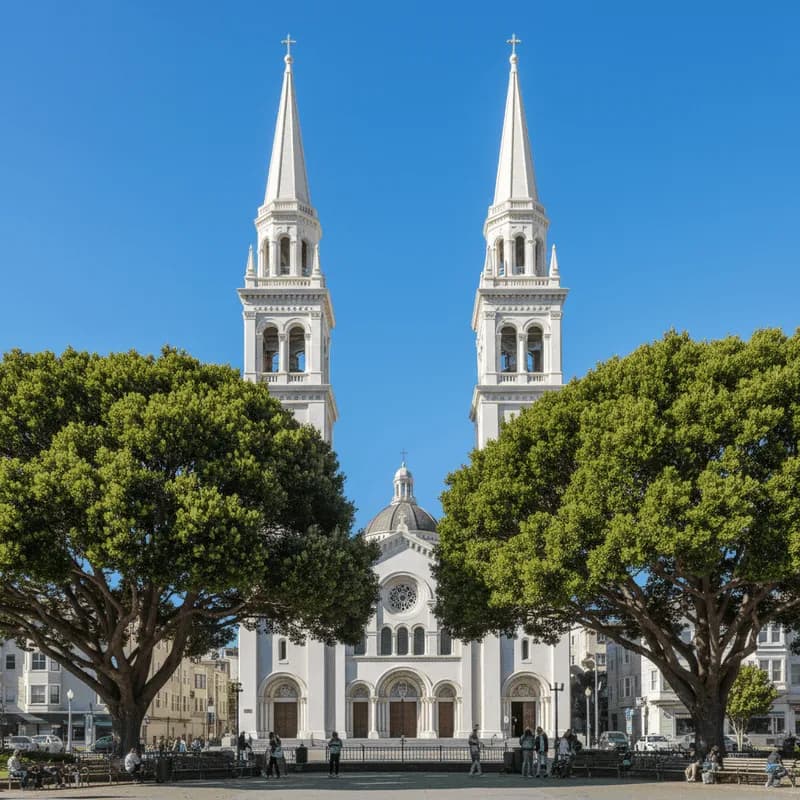
Continue north to Washington Square Park, established as a public commons in 1850 between Columbus Avenue, Union Street, Stockton Street, and Filbert Street. Dominating the northern flank of the lawn along Filbert Street is Saints Peter and Paul Church, designed by architect Charles Fantoni and constructed between 1913 and 1924. Modeled in an Italian Romanesque and Gothic Revival fusion, its twin towers rise nearly two hundred feet, encrusted with white glazed terra-cotta pinnacles, sculpted angels, and deeply recessed rose windows, while the main portal architrave carries a carved Italian inscription from the opening canto of Dante Alighieri's *Paradiso*.
From the eastern edge of Washington Square, follow Filbert Street uphill toward the summit of Telegraph Hill, where paved asphalt gives way to the steep wooden treads of the Filbert Steps and the Greenwich Steps. Perched along the eastern cliff face on Napier Lane—a narrow pedestrian boardwalk above Montgomery Street—stand Carpenter Gothic and Italianate wooden cottages dating from the 1860s and 1870s. During the final hours of the 1906 fire, neighborhood residents famously saved these pre-earthquake redwood homes by soaking burlap sacks in barrels of locally fermented red wine and beating back sparks blown up the hillside.
Crowning the crest of Telegraph Hill in Pioneer Park stands Coit Tower, completed in 1933 from a bequest left by volunteer firefighter patron Lillie Hitchcock Coit. Designed by Arthur Brown—the same Beaux-Arts master who created San Francisco City Hall—this fluted reinforced-concrete column rises two hundred ten feet above the hilltop without a single piece of historical revival ornament, using board-formed concrete shadows and recessed vertical flutes to echo a classical Doric shaft while housing twenty-seven New Deal fresco murals inside its ground-floor rotunda.
Hillside Pacing, Tourist Corners to Skip, and Your Foggy-Day Plan B
Start your North Beach walk at nine in the morning at the Sentinel Building so you climb the Filbert Steps and reach Pioneer Park before midday tour buses queue along Telegraph Hill Boulevard. Morning sunlight coming off the bay illuminates the eastern wooden cottages along Napier Lane and casts sharp geometric shadows across the fluted concrete shaft of Coit Tower, while late morning light warms the white terra-cotta facade of Saints Peter and Paul Church across Washington Square. Wear supportive walking shoes for the steep Filbert Street incline and keep voices hushed when passing the private wooden garden gates along Napier Lane.
Skip walking the neon-lit blocks of Broadway between Columbus Avenue and Montgomery Street during late Friday and Saturday nights if your focus is quiet architectural study, and skip trying to drive a car up the single-lane cul-de-sac of Telegraph Hill Boulevard on weekend afternoons. If bay fog obscures the summit of Telegraph Hill or a sudden shower makes the wooden Filbert Steps slick, switch to your Plan B by staying on the lower contour of Union Street, Mason Street, and the North Beach Branch Library plaza at Mason and Columbus, or looping south through the sheltered brick alleys of Hotaling Place in Jackson Square. Open the Karpo APP before you head out to map these five North Beach architectural stops and pair your climb with a classic neighborhood espresso or focaccia bakery stop.
Ask Karpo for more information.
Keep reading
- North Beach Tailor Alteration Shop Finder: Inherited Suits
 Hayes Valley Tailor Alteration Shop Finder for Boutique Buys
 Pac Heights Tailor Alteration Shop Finder for Heirloom Gowns