 North Beach Tailor Alteration Shop Finder: Inherited Suits
Neighborhood Guides
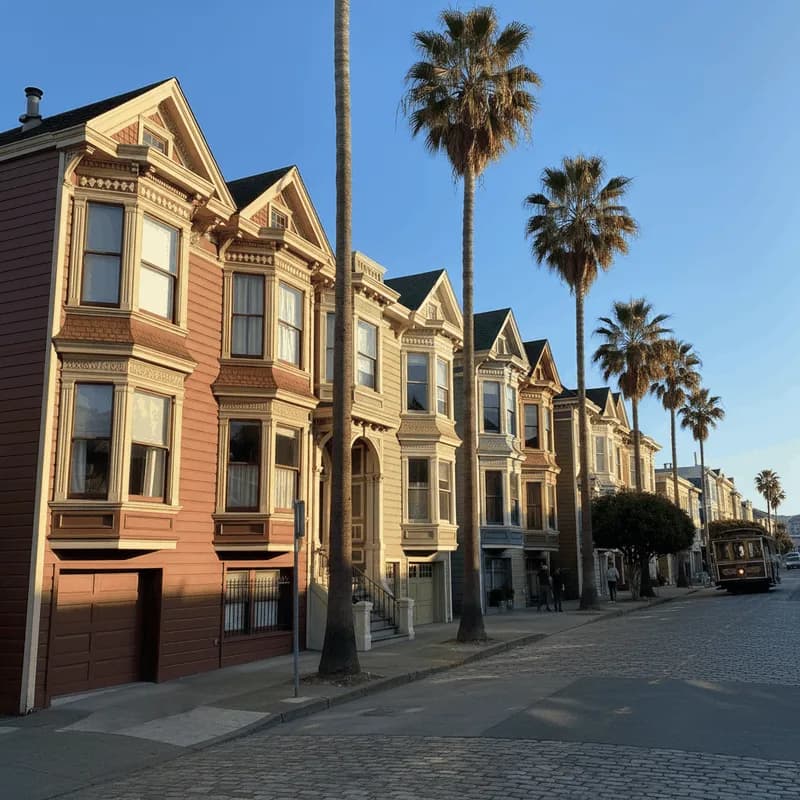
Mission Historic Architecture Walking Route: 5 SF Blocks
Walk a Mission District historic architecture walking route from the 1791 Mission Dolores adobe chapel to Liberty Street Victorians and 1927 Spanish towers.
Dolores Street is more than a palm-lined boulevard dividing sunny park lawns from neighborhood cafes. In April 1906, its wide median served as the desperate firebreak where firefighters using water from a single surviving hydrant stopped the three-day conflagration that consumed northeastern San Francisco. Because the flames halted at the edge of Dolores Street near Twentieth Street, a Mission District historic architecture walking route lets you step across an invisible historical boundary. On one side stand the city's oldest surviving eighteenth-century adobe walls and intact nineteenth-century wooden Victorian rows. On the other rise the Edwardian flats and Spanish Colonial Revival civic halls built during the post-earthquake reconstruction.
Adobe Walls of 1791 and Churrigueresque Towers on Dolores Street
Begin your walk on Dolores Street at the corner of Sixteenth Street in front of Misión San Francisco de Asís, universally known as Mission Dolores. Completed in 1791 through the labor of Ohlone, Coast Miwok, Bay Miwok, and Patwin builders, this low-slung sanctuary is the oldest intact structure in San Francisco. Step back toward the median palms to study how its four-foot-thick walls of sun-dried adobe brick, coated in protective lime plaster, and its low-pitched roof of hand-hewn redwood timbers lashed together with rawhide survived the violent earthquakes of 1868, 1906, and 1989.
Immediately north of the low adobe chapel rises the soaring Mission Dolores Basilica, designed by architects Shea and Lofquist and completed in 1918 to replace a brick parish church ruined in the 1906 quake. Standing before the two facades side by side offers a masterclass in California Hispanic architectural memory: while the 1791 chapel relies on heavy Doric engaged columns painted in earthen pigments, the 1918 basilica erupts in exuberant Spanish Churrigueresque cast-stone ornament, spiral colonnettes, scalloped niches, and twin red-tiled bell towers.

Comparing 1927 Civic Revival at Mission High with 1910 Turnverein Masonry
Walk two blocks south down the terraced incline of Dolores Street to Eighteenth Street, where the full-block campus of Mission High School faces the western slope of Mission Dolores Park. Designed by City Architect John Reid Junior and completed between 1925 and 1927 after an earlier school burned, the building carries the Churrigueresque Spanish Colonial Revival vocabulary onto a monumental civic scale. Look up at the octagonal corner bell tower inspired by the eighteenth-century Cathedral of Chihuahua in Mexico, the glazed polychrome tilework inside the dome lantern, and the intricately cast terra-cotta portals framing the Eighteenth Street entrance.
Turn east on Eighteenth Street for two blocks toward Lapidge Street and Guerrero Street to view the San Francisco Women's Building. Originally erected in 1910 as the Turnverein Hall for a German-American gymnastics and cultural club, this four-story reinforced-concrete and stucco landmark pairs Mission Revival curved parapets and deep bracketed eaves with a monumental four-story exterior mural, *Maestrapeace*, painted in 1994 by seven women artists. Notice how the muralists integrated their composition directly into the 1910 architectural rhythm of arched ballroom windows, projecting cornice brackets, and symmetrical pilaster bays.
Climbing the 1870s–1890s Victorian Timeline of Liberty Street
Return to Guerrero Street or Dolores Street and walk two blocks south to Liberty Street, designated in 1983 as the Liberty Street Historic District. Stretching three blocks between Valencia Street and Castro Street, the lower block between Valencia Street and Guerrero Street and the middle block climbing toward Dolores Street showcase nearly every residential wood-framing style built in late nineteenth-century San Francisco. Because redwood was abundant and easily milled by steam-powered jigsaws and lathes along the bayfront, local carpenter-builders lavished middle-class cottages with three-dimensional wooden ornament.
As you walk uphill from Guerrero Street toward Dolores Street, learn to distinguish the three dominant Victorian styles side by side. Early 1870s Italianate houses feature slanted three-window bays, tall narrow sash windows capped by arched hood moldings, and flat false-front parapets crowned by oversized scroll brackets that hide low-pitched roofs behind them. Mid-1880s Stick-Eastlake homes swap curved arches for squared three-sided bays, vertical wooden strips that express the internal framing studs, and incised geometric sunrises chiseled into wooden friezes. Finally, late-1880s and 1890s Queen Anne residences break into asymmetrical gables, round corner witch's-hat turrets, fish-scale redwood shingles, and stained-glass transoms.
Before leaving the Liberty Street and Dolores Street ridge, compare those pre-1906 redwood single-family homes with the multi-unit Edwardian flats built between 1907 and 1914 along the eastern side of Guerrero Street and Valencia Street where the 1906 fire burned. Stripped of Victorian gingerbread, those post-quake buildings rely on smooth horizontal wood siding, rounded barrel-front bay windows, classical dentil cornices, and recessed marble-tiled entrance vestibules engineered to house the bricklayers, ironworkers, and carpenters who rebuilt San Francisco.
Microclimate Timing, Blocks to Skip, and Your Valencia Street Plan B
Protected from Pacific ocean fog by the twin ridges of Twin Peaks and Buena Vista Hill, the Mission District enjoys clearer morning skies than almost any other neighborhood in San Francisco. Start your architectural route between nine in the morning and eleven-thirty, when eastern sunlight illuminates the east-facing facades of Mission Dolores and Mission High School before casting crisp afternoon shadows across the redwood millwork on Liberty Street. As you stroll along the grassy Dolores Street median—planted with Canary Island date palms and Mexican fan palms for the 1915 Panama-Pacific International Exposition—you will share the path with architectural sketchers, dog walkers, and preservation enthusiasts photographing the contrast between the downtown skyline and 1880s gables.
Skip routing a quiet architectural study down Sixteenth Street between Mission Street and Valencia Street during weekday commuter rush hours, when BART plaza crowds and bus transfers pack the narrow sidewalks and obscure the surviving post-1906 Edwardian brick cornices. Also skip the Eighteenth Street edge of Dolores Park on warm Saturday and Sunday afternoons if you want unobstructed curb sightlines of Mission High School's Churrigueresque portal. If gusty afternoon winds pick up along the hilltop of Liberty Street or weekend park crowds spill across Eighteenth Street, switch to your Plan B by descending one block east to Valencia Street between Nineteenth Street and Twenty-Second Street, or detouring into the sheltered residential lane of Fair Oaks Street, where another intact row of late-Victorian redwood facades lines a quiet tree-shaded street. Open the Karpo APP before setting out to sequence your five Mission District architecture stops alongside nearby coffee bars and park overlooks.
Ask Karpo for more information.
Keep reading
- North Beach Tailor Alteration Shop Finder: Inherited Suits
 Hayes Valley Tailor Alteration Shop Finder for Boutique Buys
 Pac Heights Tailor Alteration Shop Finder for Heirloom Gowns