 North Beach Tailor Alteration Shop Finder: Inherited Suits
Neighborhood Guides
Inner Sunset Historic Architecture Walking Route: 5 Stops
Follow an Inner Sunset historic architecture walking route from 1900 Golden Gate Park sandstone to 1918 Lansburgh brick and 1920s Storybook stucco facades.
Until the California Midwinter International Exposition opened inside Golden Gate Park in 1894, the windswept hills and sand dunes south of Lincoln Way were known to San Franciscans simply as the Outside Lands. Streetcar extensions, the relocation of 1906 earthquake refugee cottages, and the opening of the Sunset Tunnel for the N-Judah municipal railway in 1928 transformed those dunes into a neighborhood where Arts and Crafts shingle cottages, Italian Renaissance Carnegie masonry, and whimsical 1920s Storybook stucco homes stand shoulder to shoulder. Walking an Inner Sunset historic architecture walking route from the Ninth Avenue park gates up toward Parnassus Heights and west to Funston Avenue reveals how builders tamed shifting coastal sand with inventive domestic design.
From the 1894 Midwinter Concourse to Lincoln Way Streetcar Rows
Begin your walk just inside the Ninth Avenue and Lincoln Way entrance to Golden Gate Park at the sunken oval of the Music Concourse, excavated for the 1894 Midwinter Fair. At the western head of the plaza rises the Spreckels Temple of Music, a French Renaissance Revival bandstand designed by the Reid Brothers and completed in 1900 from warm Colusa sandstone with twin Corinthian colonnades and a seventy-foot coffered shell. Steps away on the northern rim of the concourse stands the hand-carved cedar gate of the Japanese Tea Garden, originally created as the Japanese Village exhibit for that same 1894 exposition using traditional mortise-and-tenon timber joinery without iron nails. The success of the 1894 exposition convinced real estate developers that families would ride electric streetcars out to the western dunes if streets were graded and planted along the park perimeter.
Cross Lincoln Way onto Ninth Avenue and Irving Street to examine the earliest wave of Inner Sunset construction erected between 1895 and 1912. Alongside three-story Edwardian flats with rounded barrel-front bay windows and classical dentil cornices, sharp-eyed walkers exploring the side blocks between Fifth Avenue and Twelfth Avenue can still spot small wood-frame cottages that began life as 1906 earthquake relief shacks in Golden Gate Park's Camp Nineteen. When the refugee camp closed in 1907 and 1908, residents hitched teams of horses to their fourteen-by-eighteen-foot redwood cottages, hauled them across Lincoln Way onto affordable sand lots, and stitched two or three cottages together behind new shingled or stuccoed street fronts.
First Bay Tradition Shingles and Clinker Brick on Willard and Carl Streets
Head east along Irving Street and climb the gentle slope of Willard Street, Arguello Boulevard, and Carl Street toward the wooded flanks of Mount Sutro and Parnassus Heights. Here, between 1905 and 1920, builders working in the First Bay Tradition and the California Arts and Crafts movement rejected painted Victorian millwork in favor of unpainted redwood shingles, exposed rafter tails, and overhanging gabled eaves that shed coastal fog drip. Look at the foundation walls and exterior chimneys along Willard Street and Woodland Avenue, where masons laid dark, vitrified clinker bricks—bricks that warped and blackened when placed closest to the kiln fire—into rustic, textured mortar joints.
As you pause at the corner of Carl Street and Cole Street or Willard Street, notice how the 1928 completion of the Sunset Tunnel beneath Buena Vista Hill reshaped the surrounding blocks. Engineers carved a wide concrete portal at Carl Street to carry electric streetcars directly from downtown Market Street into the Inner Sunset, prompting builders to line the portal approaches with late-1920s Mediterranean Revival apartment courts featuring tiled lobby vestibules, wrought-iron entry grilles, and stepped mission parapets.
Romanesque Towers on Judah and G. Albert Lansburgh's 1918 Carnegie Library
Walk west along Judah Street to Funston Avenue, where the twin towers of Saint Anne of the Sunset Church command the skyline above the avenues. Constructed for a rapidly growing Irish-American parish and completed during the 1920s and 1930s, this reinforced-concrete basilica blends Lombard Romanesque and Byzantine motifs across a monumental faceted facade. Stand on the northern sidewalk of Judah Street to admire the deeply recessed triple entrance arches, the polychrome mosaic tympanum panels, the central wheel window, and the arcaded belfries that serve as a visual compass point across the grid.
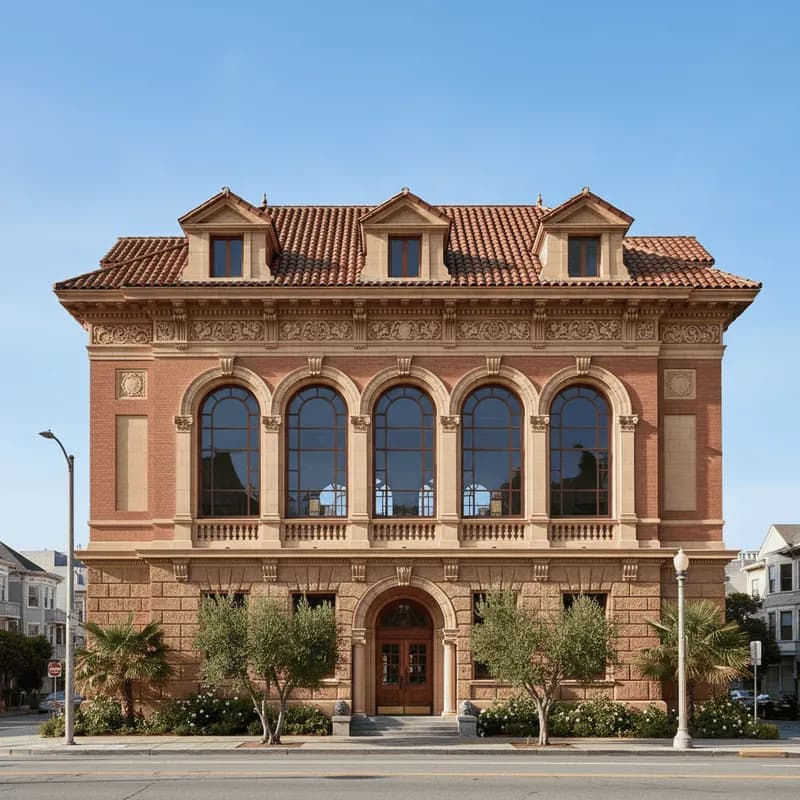
Continue four blocks west along Irving Street to Eighteenth Avenue to inspect the Sunset Branch of the San Francisco Public Library, opened in March 1918 and designed by theater and civic architect G. Albert Lansburgh with funding from Andrew Carnegie. Built as an Italian Renaissance Revival villa set back behind a landscaped terrace, the library pairs warm tapestry brickwork laid in patterned bands with cream glazed terra-cotta window surrounds, a projecting red clay tile roof, and five grand arched reading-room windows that flood the second-floor hall with northern daylight.
Storybook Revival Whimsy, Busy Blocks to Skip, and Your Park-Edge Plan B
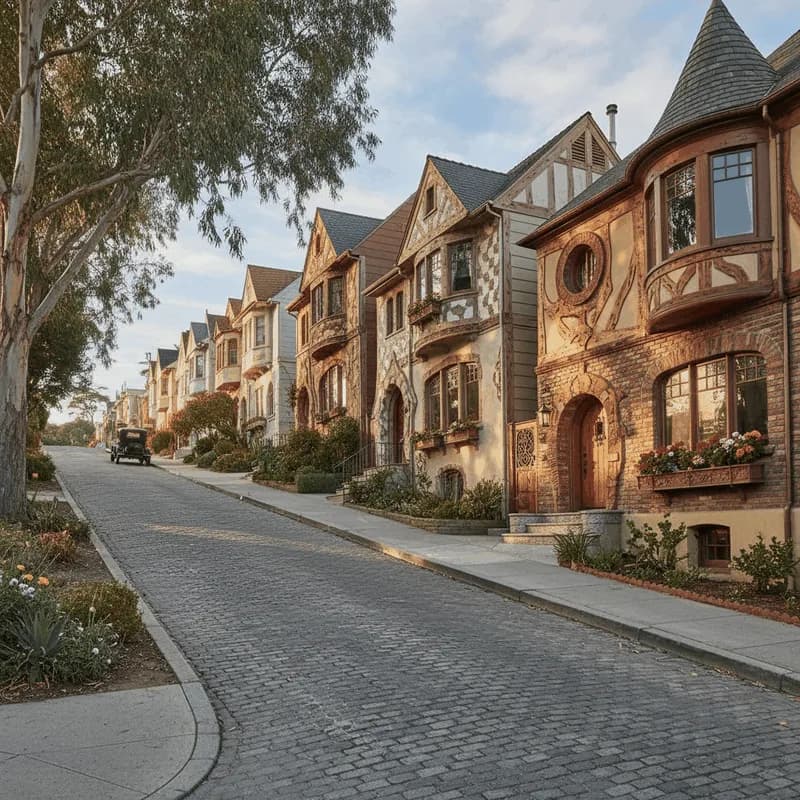
On your return loop along Fourteenth Avenue, Fifteenth Avenue, and Funston Avenue between Judah Street and Lawton Street, study the fantastical 1920s and 1930s Storybook Revival stucco row houses inspired by San Francisco builders Oliver and Emile Rousseau. Built on standard twenty-five-foot-wide avenue lots above ground-floor garages, no two facades are alike. Builders gave adjacent homes conical French Normandy stair turrets, half-timbered Tudor gables, Moorish keyhole arches, and deliberately wavy asphalt shingle eaves that make a city block look like a theatrical stage set. Even the smallest hardware details—hand-hammered iron door knockers, exterior chimney pots, faux dovecotes, and leaded amber glass bull's-eye panes—turn standard streetcar-era row lots into handcrafted architectural vignettes.
Late morning between ten o'clock and one in the afternoon is the ideal window for walking the Inner Sunset, after morning ocean stratus burns back toward the beach and before late-afternoon fog fingers slip through Golden Gate Park. Skip walking the hospital delivery and ambulance corridor along Parnassus Avenue between Third Avenue and Hillway Avenue during weekday shifts if you want quiet sidewalk observation, and skip Nineteenth Avenue entirely, where six lanes of state highway traffic create constant noise. If cool coastal mist rolls down Judah Street or weekend brunch crowds pack the narrow sidewalks of Ninth Avenue between Lincoln Way and Irving Street, switch to your Plan B by stepping across Lincoln Way into the tree-sheltered paths of the Golden Gate Park Botanical Garden perimeter or strolling the calm residential terrace of Tenth Avenue and Eleventh Avenue. Open the Karpo APP before you start to sequence these five Inner Sunset architectural stops and pair your walk with a warm bakery stop on Irving Street.
Ask Karpo for more information.
Keep reading
- North Beach Tailor Alteration Shop Finder: Inherited Suits
 Hayes Valley Tailor Alteration Shop Finder for Boutique Buys
 Pac Heights Tailor Alteration Shop Finder for Heirloom Gowns