 North Beach Tailor Alteration Shop Finder: Inherited Suits
Neighborhood Guides

Pacific Heights Art Walk Route Planner: Free Fillmore Loop
Begin on Upper Fillmore Street, climb the free 1855 stone terraces of Alta Plaza Park, and pass the 1886 Haas-Lilienthal House on Franklin Street.
Perched along an east-west sandstone ridge high above the Marina waterfront and the central valley floor, Pacific Heights pairs museum-worthy Gilded Age residential architecture with the intimate storefront ateliers of Upper Fillmore Street. Organizing your afternoon through a Pacific Heights art walk route planner solves the neighborhood's biggest geographical challenge: climbing the steep north-south cross streets without exhausting your legs before you reach the ridge crest. By riding transit or starting mid-slope at California and Fillmore Streets, ascending gently to the terraced stone overlooks of Alta Plaza Park, and following the flat ridgeline east along Jackson and Washington Streets toward Franklin Street, you experience a seamless architectural and decorative arts promenade.
Upper Fillmore Storefront Ateliers Between California and Jackson
Begin your walk at the intersection of California and Fillmore Streets and stroll four blocks north toward Jackson Street. Immediately after the April 1906 earthquake and fire destroyed downtown San Francisco east of Van Ness Avenue, Fillmore Street stood untouched and served for several crucial years as the city's main commercial and civic boulevard. That historical chapter left Upper Fillmore with a remarkably intact sequence of late-nineteenth- and early-twentieth-century wood-and-masonry commercial buildings whose tall ground-floor windows were built for natural daylight display.
Today those high-ceilinged bays between Sacramento, Clay, and Washington Streets house custom archival framing workshops, ceramic and botanical vessel showrooms, European paper and stationery counters, and small fine-art print salons. Walk up the eastern sidewalk in the morning when sunlight illuminates the western bay windows across the street, then cross at Clay Street to inspect the hand-glazed entryway tiles, cast-iron pilasters, and upper-story bay mullions preserved above the shop awnings. Because the rise from California Street to Clay Street is gradual compared to the sheer northern drop north of Broadway, these four blocks make an effortless warm-up.
Ascending the 1855 Symmetrical Stone Terraces of Alta Plaza Park
At Clay and Fillmore Streets, turn west one block to Steiner Street to reach the southern foot of Alta Plaza Park. Acquired by the city in 1855 under the Van Ness Ordinance and sculpted out of a former nineteenth-century stone quarry, this twelve-acre hilltop park is famous for its grand, symmetrical Beaux-Arts-inspired stair terraces rising up the southern slope from Clay Street. Admission to the park terraces and upper promenade is completely free year-round, and each landing offers a wider architectural horizon over the city.
Pause halfway up the wide stone steps to look south across the Victorian rooftops of the Western Addition toward the gilded dome of the 1915 San Francisco City Hall and the forested crest of Twin Peaks. Once you reach the upper cypress-lined perimeter path along Jackson Street, walk to the northern balustrade to take in the contrasting view down the steep plunge of Pierce and Scott Streets toward the terracotta dome of the 1915 Palace of Fine Arts, the Golden Gate Strait, and Angel Island. Landscape photographers and urban sketchers prize this upper terrace between two and four o'clock in the afternoon, when coastal haze lifts off the water and sidelight sharpens the surrounding mansions.
Walking the Flat Ridge East Past Beaux-Arts and Queen Anne Landmarks
Instead of dropping down the steep northern cliff, exit the northeast corner of Alta Plaza Park at Jackson and Steiner Streets and walk east along the level ridgeline of Jackson, Washington, and Broadway. Because you are already at the crest of Pacific Heights, the six-block walk east from Steiner Street to Gough and Franklin Streets stays nearly flat while passing one of the densest concentrations of turn-of-the-century architectural craftsmanship on the West Coast. Along Broadway near Divisadero and Scott, notice how architects Willis Polk and Ernest Coxhead blended shingle-style textures with classical sandstone proportions, culminating in the monumental 1899 Italian Renaissance-style James C. Flood Mansion on Broadway.
Half a block off Broadway on Webster Street between Washington and Jackson Streets, pause to admire the dark clinker-brick facade of the Bourn Mansion, designed in 1896 by architect Willis Polk for William Bowers Bourn II, president of the Empire Mine and the Spring Valley Water Company, who later commissioned Filoli estate down on the Peninsula. Polk's use of oversized, unevenly fired brick courses, Georgian limestone lintels, and a recessed symmetrical entry court marked a decisive shift away from Victorian wood ornamentation toward restrained Classical Revival masonry along the Pacific Heights spine.
Continue east along Washington Street past Buchanan and Laguna Streets to reach the northern border of Lafayette Park, another lush hilltop commons dating back to the 1860s and redesigned with curving pathways and coastal meadow plantings. Directly facing the park's northern edge on Washington Street stands the gleaming white Utah limestone facade of the Spreckels Mansion, completed in 1913 by architects George Applegarth and Kenneth MacDonald Jr. in French Baroque château style for sugar magnate Adolph Spreckels and Alma de Bretteville Spreckels—the civic arts patron who later founded the Legion of Honor museum in Lincoln Park.
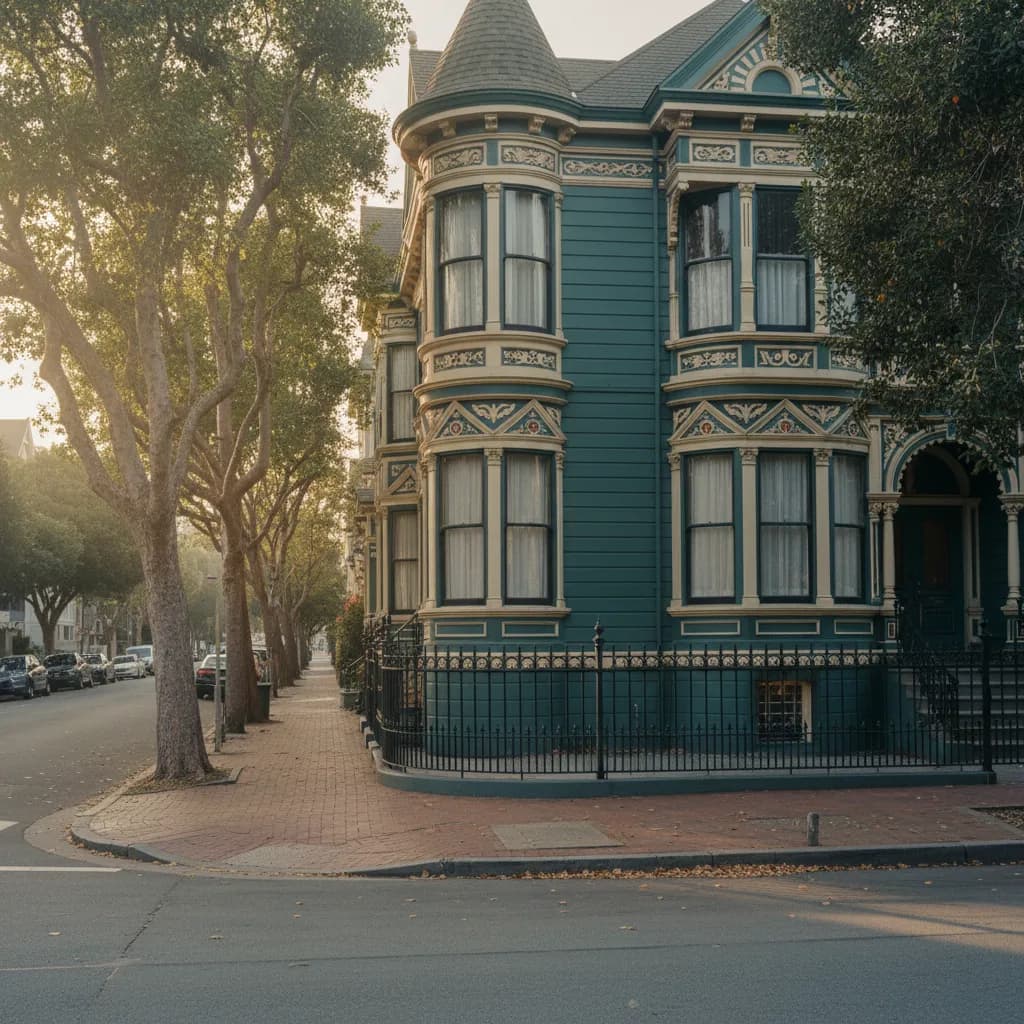
Turn one block east to Franklin Street between Washington and Jackson Streets to study the exterior of the Haas-Lilienthal House, built in 1886 by architect Peter R. Schmidt for William and Bertha Haas and preserved since 1973 by San Francisco Heritage as a historic house museum. Its soaring corner witch's-hat turret, fish-scale redwood shingles, turned porch spindles, and carved gabled dormers survived the April 1906 firestorm by a single block when soldiers and firefighters held the line down on Van Ness Avenue.
If you want to check docent tour schedules, compare nearby tea rooms and patisseries back on Fillmore Street, or plan where to sit down for a late lunch after your architectural loop, open the Karpo APP and ask in natural language for tailored Pacific Heights recommendations.
Ridge Navigation, Transit Shortcuts, and Afternoon Wind Tips
The smartest rule for any Pacific Heights walking route is to let public transit handle the initial vertical climb from sea level. Ride the Muni 22-Fillmore electric trolleybus north up Fillmore Street or take the 1-California bus straight to the intersection of California and Fillmore Streets, placing you near the top of the ridge before you take your first step. Remember that north-south streets north of Jackson Street—especially Fillmore, Webster, and Divisadero dropping toward the Marina—exceed twenty percent grade and feature sidewalk steps rather than flat ramps.
Because Alta Plaza Park and Lafayette Park sit fully exposed on the high sandstone spine facing the Golden Gate, ocean breezes pick up noticeably after three o'clock in the afternoon even when lower neighborhoods feel warm. Bring a light windbreaker or merino layer, wear grippy flat soles for the stone park stairs, and use the Karpo APP whenever you are ready to transition from Franklin Street back to an espresso counter or wine bar along Upper Fillmore.
Ask Karpo for more information.
Keep reading
- North Beach Tailor Alteration Shop Finder: Inherited Suits
 Hayes Valley Tailor Alteration Shop Finder for Boutique Buys
 Pac Heights Tailor Alteration Shop Finder for Heirloom Gowns