 North Beach Tailor Alteration Shop Finder: Inherited Suits
Neighborhood Guides

North Beach Art Walk Route Planner: Free Columbus Loop
Start beneath the Language of the Birds installation on Columbus Avenue, cross Jack Kerouac Alley, and view free 1934 WPA frescoes inside Coit Tower.
Cutting diagonally across San Francisco's rigid street grid from Broadway toward the northern waterfront, Columbus Avenue creates triangular plazas, sunlit cafés, and narrow stair climbs that reward slow visual exploration. Building your afternoon around a North Beach art walk route planner connects three distinct eras of Bay Area artistic life: twenty-first-century suspended plaza sculptures, post-war Beat Generation literary lanes, and monumental 1934 New Deal frescoes crowning Telegraph Hill. Starting at the southern gateway where Chinatown meets North Beach and ascending gradually toward Pioneer Park keeps the hill climb manageable while letting you end with panoramic bay light.
Suspended Books and Literary Stonework at Broadway and Columbus
Anchor the southern start of your walk at the triangular plaza where Columbus Avenue intersects Broadway and Grant Avenue. Overhead hangs Language of the Birds, a permanent public art piece installed in 2008 by artists Brian Goggin and Deroo that suspends twenty-three translucent polycarbonate books on stainless-steel cables so their open pages mimic wings in flight. Look down at the pavement directly beneath the flock to spot dozens of bronze-lettered words and phrases embedded into the concrete, representing both English poetry and Chinese literary idioms.
Step across the plaza into Jack Kerouac Alley, the narrow lane connecting Columbus Avenue with Grant Avenue alongside the historic storefront of City Lights Booksellers and Publishers. Founded in 1953 by poet Lawrence Ferlinghetti and Peter D. Martin as the country's first all-paperback bookshop and designated a San Francisco Historic Landmark in 2001, City Lights anchors the northern side of the alley. Once a cluttered service shortcut, the passage was completely repaved in 2007 with Italian porphyry cobblestones, custom iron bollards, and engraved stone quotations bridging Western Beat poets and Chinese calligraphers.
Along the southern and western walls of Jack Kerouac Alley, vibrant exterior murals celebrate North Beach's bohemian literary heritage alongside Mesoamerican and Pacific Rim visual motifs. Because the lane is strictly pedestrianized, you can linger in the middle of the cobblestones to study the brushwork and then duck inside the wood-shelved upstairs poetry room at City Lights or browse neighboring framing and letterpress windows along Grant Avenue.
Before leaving the Broadway intersection, glance one block south down Columbus Avenue toward Kearny Street to spot the distinctive verdigris copper-trimmed wedge of the Sentinel Building, also known as Columbus Tower, which was completed in 1907 in the flatiron style and later restored by filmmaker Francis Ford Coppola as the home of American Zoetrope. Right across Columbus Avenue from City Lights, the tiny cul-de-sac of Saroyan Place—named for playwright and author William Saroyan—tucks beside the 1968 maritime-and-bohemian ephemera collection at Specs' Twelve Adler Museum Cafe, illustrating how every narrow court off lower Columbus preserves a physical layer of twentieth-century San Francisco arts history.
Craft Storefronts on Grant Avenue and Washington Square Monuments
Instead of staying exclusively on busy Columbus Avenue, turn north up upper Grant Avenue between Vallejo and Filbert Streets. This four-block corridor preserves early twentieth-century post-quake brick facades painted in Mediterranean sage, terracotta, and cream tones, housing independent print studios, handmade paper shops, and small contemporary exhibition rooms. Morning and early-afternoon walkers can examine hand-pulled etchings, vintage Italian poster lithography, and small-batch ceramics displayed right behind the curved glass storefront bays, where wood-trimmed transoms and mosaic tile thresholds date back to the neighborhood's post-1906 reconstruction.
At Filbert Street, angle west one block into Washington Square Park, established as one of San Francisco's earliest public greens in 1847. Framing the northern edge of the lawn are the twin neo-Gothic spires of Saints Peter and Paul Church, completed in 1924, while the park path features historical bronze sculptures including the 1879 Benjamin Franklin monument—under which a nineteenth-century time capsule was buried—and sculptor Haig Patigian's dramatic 1933 Volunteer Firemen Memorial. If you want to compare nearby espresso bars, focaccia bakeries, or trattoria tables around the square before climbing Telegraph Hill, open the Karpo APP and ask in plain English for North Beach stops that fit your pace.
Climbing Telegraph Hill to the 1934 WPA Frescoes at Coit Tower
From the eastern side of Washington Square, follow Filbert Street or Greenwich Street uphill toward Pioneer Park at the summit of Telegraph Hill. Completed in 1933 with a bequest from civic patron Lillian Hitchcock Coit and designed by City Hall architect Arthur Brown Jr., the fluted white concrete column of Coit Tower rises two hundred ten feet above the hilltop cypress groves. While the elevator to the upper observation deck requires a paid ticket, stepping into the ground-floor rotunda to view the historic mural cycle is open to walkers during daytime hours.
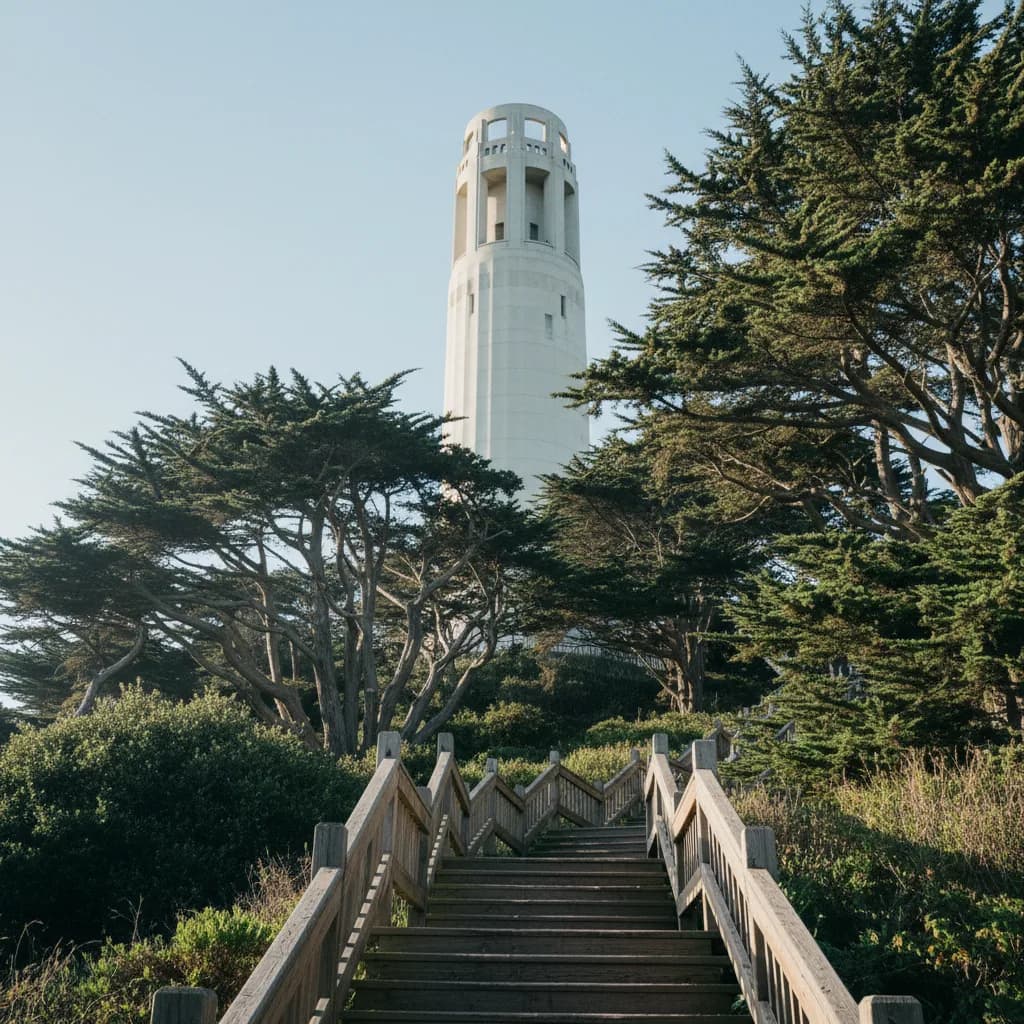
Painted in 1934 by twenty-six local artists and assistants under the federal Public Works of Art Project—the New Deal forerunner of the WPA—the Coit Tower murals were executed primarily in true buon fresco, binding pigment directly into wet lime plaster modeled after Mexican muralist Diego Rivera's technique. Walk clockwise around the circular ground-floor corridor to examine panoramic scenes of California orchards, Depression-era city newsstands, library reading rooms, maritime docks, and steel foundries, each bustling with period portraits and social commentary.
After circling the interior rotunda, step back outside onto the Pioneer Park stone terrace beneath the wind-sculpted Monterey cypresses to take in the sweeping view down toward the San Francisco-Oakland Bay Bridge and Marin Headlands. Descend the eastern slope of Telegraph Hill for a block along the wooden landings of the Filbert Steps, where nineteenth-century carpenter-built cottages constructed in the 1860s and 1870s sit tucked inside lush hillside gardens of hydrangeas, roses, and trumpet vines.
Pacing the Hill Climb, Muni Transit Links, and Best Daylight Windows
Because the ascent from Washington Square up to Pioneer Park gains roughly two hundred feet of elevation over three steep blocks, wear supportive walking shoes with good traction on brick and wooden stairs. Walkers who prefer to skip the uphill climb can board the Muni 39-Coit bus right beside Washington Square at Columbus and Union Streets, ride straight to the Pioneer Park turnaround at Coit Tower, and then walk downhill through the gardens back toward North Beach.
Arriving at the Broadway and Columbus gateway around one-thirty in the afternoon lets you view the Coit Tower rotunda frescoes well before late-afternoon park closing hours and then return to Jack Kerouac Alley just as twilight illuminates the suspended polycarbonate books of Language of the Birds. Transit connections are straightforward via the Muni 30-Stockton, 45-Union/Stockton, and 8-Bayshore buses or the Chinatown-Rose Pak Central Subway station two blocks south on Stockton Street, and you can check the Karpo APP anytime to narrow down evening aperitivo or dinner options along Columbus Avenue.
Ask Karpo for more information.
Keep reading
- North Beach Tailor Alteration Shop Finder: Inherited Suits
 Hayes Valley Tailor Alteration Shop Finder for Boutique Buys
 Pac Heights Tailor Alteration Shop Finder for Heirloom Gowns