 North Beach Tailor Alteration Shop Finder: Inherited Suits
Neighborhood Guides

Presidio And Marina: Free Architectural Landmark Walk In SF
Explore the Palace of Fine Arts and Presidio on a free architectural landmark walk past classical Greco-Roman rotundas and historic brick barracks.
Where San Francisco's Marina District meets the historic military reservation of the Presidio, you will encounter one of the most striking architectural juxtapositions in California: Bernard Maybeck's dreamlike classical rotunda at the Palace of Fine Arts set against the disciplined 1890s brick barracks of the Presidio Main Post. Built for the 1915 Panama-Pacific International Exposition to celebrate the city's rise from the 1906 ruins, Maybeck's monumental Roman colonnade reflects serenely in its surrounding lagoon, while the adjacent Presidio preserves centuries of Spanish adobe and American military garrison design. This free self-guided architectural landmark walk takes you across manicured parklands and bayside lawns to explore two centuries of monumental West Coast architectural history.
Bernard Maybeck and the Romance of Classical Ruin
Situated at the northern edge of the Marina District adjacent to the Presidio military reservation, the Palace of Fine Arts is one of San Francisco's most beloved and visually arresting architectural monuments. Designed by visionary Bay Area architect Bernard Maybeck for the 1915 Panama-Pacific International Exposition, the structure was originally intended to celebrate the completion of the Panama Canal and showcase San Francisco's miraculous rebirth following the 1906 earthquake. While virtually all other exposition buildings were temporary plaster shells demolished after the fair closed, the Palace of Fine Arts was saved by public affection and later entirely reconstructed in permanent concrete.
Maybeck, an École des Beaux-Arts graduate with a deeply romantic sensibility, drew inspiration from Piranesi's engravings of classical Roman ruins and Arnold Böcklin's symbolist painting Isle of the Dead. Rather than creating a conventional museum box, Maybeck designed an open-air classical rotunda flanked by a curved Corinthian colonnade encircling an artificial lagoon. The monumental structure was conceived deliberately to evoke a melancholic Greco-Roman ruin overgrown with greenery, inviting visitors to reflect on the transient nature of human achievement amidst the quiet beauty of nature.
Colonnades, Weeping Women, and Terra Cotta Details
As you stroll along the paved walking path bordering the lagoon, pause beneath the monumental Corinthian colonnade to examine the intricate architectural details. The massive fluted columns are surmounted by colossal capitals adorned with acanthus leaves and classical friezes. Atop the perimeter colonnade box structures, sculptor Ulric Ellerhusen created the iconic 'Weeping Women' figures: introspective allegorical statues draped in classical robes, with their backs turned toward the viewer and their heads bowed over weeping urns, mourning the loss of artistic inspiration.
The massive central rotunda rises 162 feet above the water, topped by an intricately coffered dome featuring allegorical bas-relief panels designed by Bruno Louis Zimm that depict the struggle between art and materialism. In the 1960s, philanthropist Walter S. Johnson led a multi-million-dollar preservation campaign that meticulously dismantled the crumbling original staff and plaster structure, recasting every column, arch, and ornament in durable poured concrete. The warm ochre and dusty terracotta tones of the structure harmoniously capture the golden coastal light that sweeps off the Pacific Ocean.
The Presidio Main Post and Red Brick Military Order
From the western edge of the lagoon, cross Lyon Street to enter the Presidio of San Francisco, transitioning from classical fantasy to strict nineteenth-century military functionalism. The Presidio operated as an active military garrison under Spanish, Mexican, and United States flags for over two centuries before its conversion to a national park in 1994. Head up the gentle grade toward the Main Post, the historic institutional core of the military reservation.
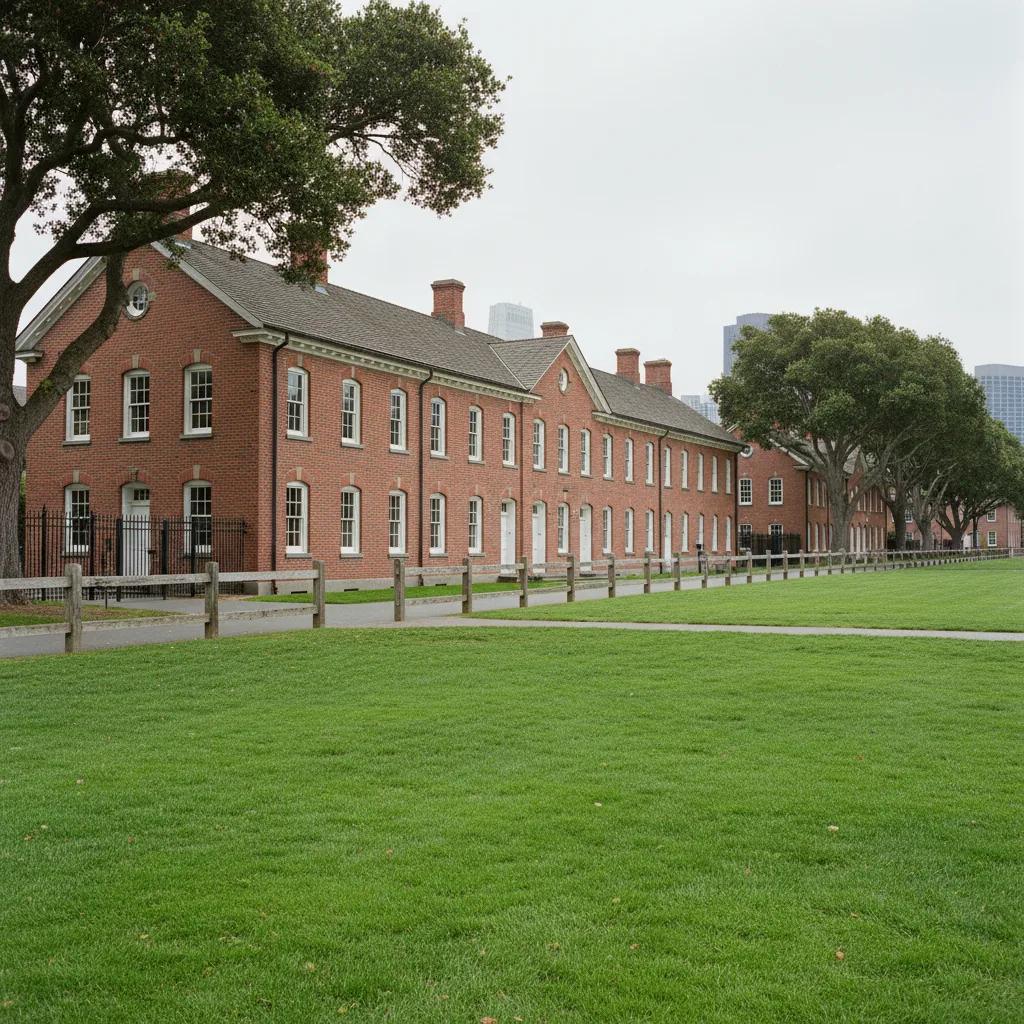
Along Montgomery Street stands an imposing row of five identical red-brick barracks constructed between 1895 and 1897. Designed in the Colonial Revival style, these two-story barracks feature monumental double-tiered wooden porches, white painted balustrades, classical pediments, and deep slate gabled roofs that line up with military precision across the parade lawn. The uniform rhythm of the brick arches and white timber posts exemplifies the institutional dignity of late Victorian military architecture, providing a striking contrast to Maybeck's nearby romantic curves.
Spanish Colonial Revival and the Oldest Standing Walls
Continue along the perimeter of the Main Post to 50 Moraga Avenue to inspect the Presidio Officers' Club. Beneath its white-stuccoed exterior and exposed heavy timber vigas lies the oldest standing architectural fabric in San Francisco: original adobe brick walls constructed by Spanish soldiers in the late 1770s to establish the northernmost military outpost of New Spain. The building was remodeled and expanded in the 1930s in the Spanish Colonial Revival style, featuring red clay barrel tile roofs, an interior courtyard patio, and deeply recessed timber-lintel doorways.
Just up the hill at 130 Fisher Loop, examine the Presidio Chapel, completed in 1931. Built in the Mission Revival idiom with a graceful bell-tower campanario, the chapel features hand-hewn ceiling beams and vibrant stained-glass windows depicting California mission history. The seamless blend of early Spanish adobe roots, Victorian brick discipline, and 1930s revivalism makes the Presidio an architectural archive that mirrors the broader political and cultural shifts of California over two and a half centuries.
Who This Route Suits and When to Walk
This scenic outdoor walking route is ideal for landscape lovers, history enthusiasts, and travelers looking for an easy, flat walk combined with world-class photographic opportunities. The route spans approximately two miles total between the Palace of Fine Arts and the Presidio Main Post, utilizing paved multi-use pathways and park sidewalks. Late afternoon before sunset is the premier time to visit, as the setting sun illuminates the Palace rotunda in rich amber hues and casts dramatic shadows across the Presidio's parade lawn.
Public access to the Palace of Fine Arts park grounds, lagoon perimeter, and colonnade is completely free and open twenty-four hours a day, 365 days a year. While the structure's interior exhibition hall is occasionally leased for private galas, the exterior grounds and monumental arches are always accessible to the public. Comfortable walking shoes and a light windbreaker are recommended, as maritime winds off the Golden Gate frequently sweep through the lagoon basin.
Practical Notes for Navigating Downtown Facades
Public transit access is straightforward: take the Muni 30 Stockton or 28 19th Avenue bus line, both of which stop directly adjacent to the Palace of Fine Arts on Richardson Avenue or Lombard Street. Inside the Presidio, the free PresidiGo shuttle runs frequent circuits connecting the Main Post with the downtown Transbay Transit Center and Embarcadero BART station.
Restrooms and drinking water are available at the Palace of Fine Arts park facilities and within the Presidio Visitor Center on the Main Post. For detailed historic trail guides, architectural walking loops, and transit connections throughout the Golden Gate National Recreation Area, utilize the Karpo APP.
Ask Karpo for more information.
Keep reading
- North Beach Tailor Alteration Shop Finder: Inherited Suits
 Hayes Valley Tailor Alteration Shop Finder for Boutique Buys
 Pac Heights Tailor Alteration Shop Finder for Heirloom Gowns