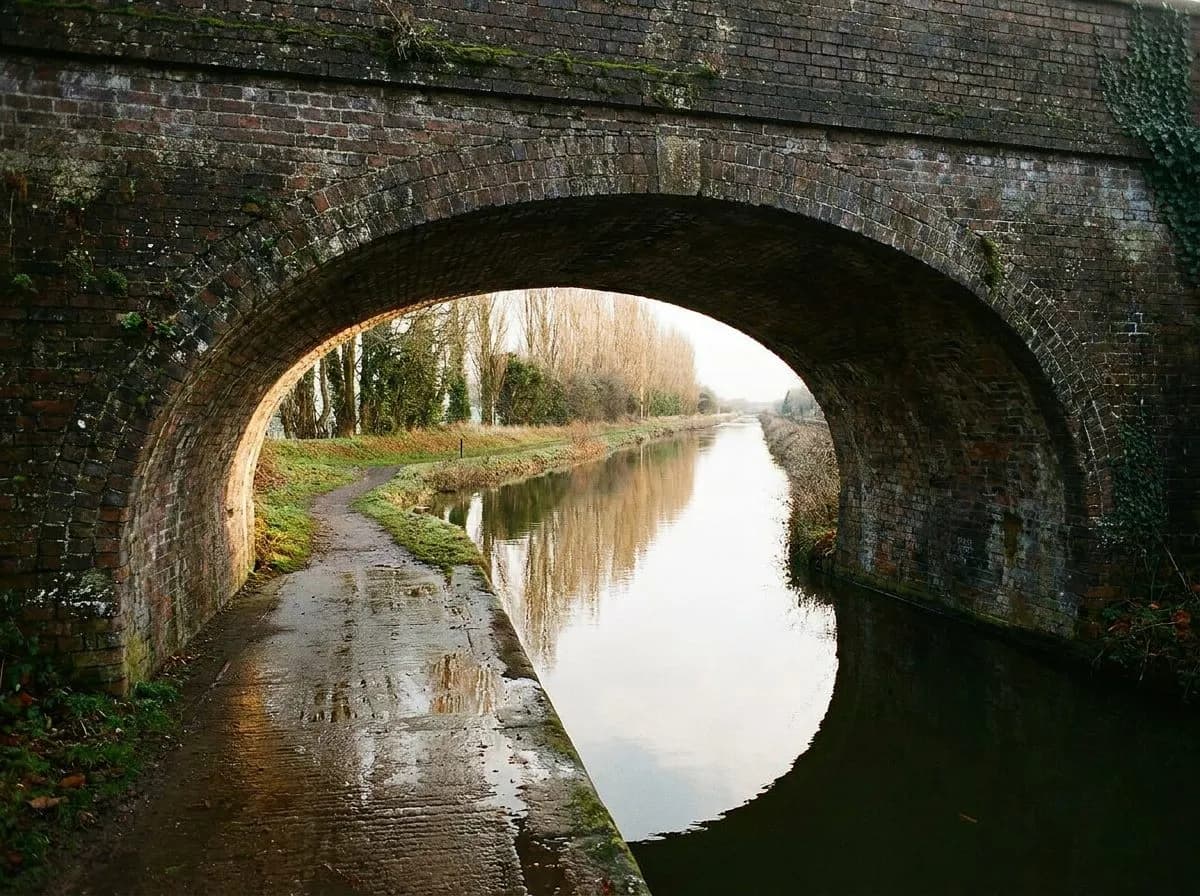
The towpath smells different before the city wakes. Damp brick, still water, the faint diesel sweetness of a narrow boat engine turning over somewhere in the pre-dawn grey. This two-mile ribbon of compacted earth and Victorian engineering connecting Broadway Market to Victoria Park isn't much to photograph in the hard light of afternoon, but catch it in the first hour of daylight and it becomes something else entirely: a commuter artery for a different kind of traveler, a summer travel route measured in footsteps rather than miles per hour, a liminal corridor where Hackney's neighborhoods blur into one another along the water.
First light, first movement
The towpath between Cat & Mutton bridge and Victoria Park gate opens officially at sunrise, but the southern section near Broadway Market sees narrow boat movement as early as 6:15am. You'll hear them before you see them—the low rumble of an engine, the soft splash of water against a hull as someone begins the slow churn eastward. By the time the sky goes from charcoal to pewter, two or three boats are already underway, their occupants moving with the unhurried purpose of people whose commute is measured in locks rather than tube stops.
This is the hour when the canal belongs to its residents. Dog walkers appear in clusters, nodding to one another with the quiet solidarity of the early-rising. A heron stands motionless near the Cat & Mutton bridge, waiting. The light is still soft enough that the graffiti on the brick arches reads like texture rather than statement, and the water holds the sky's color long enough to notice.
Through London Fields
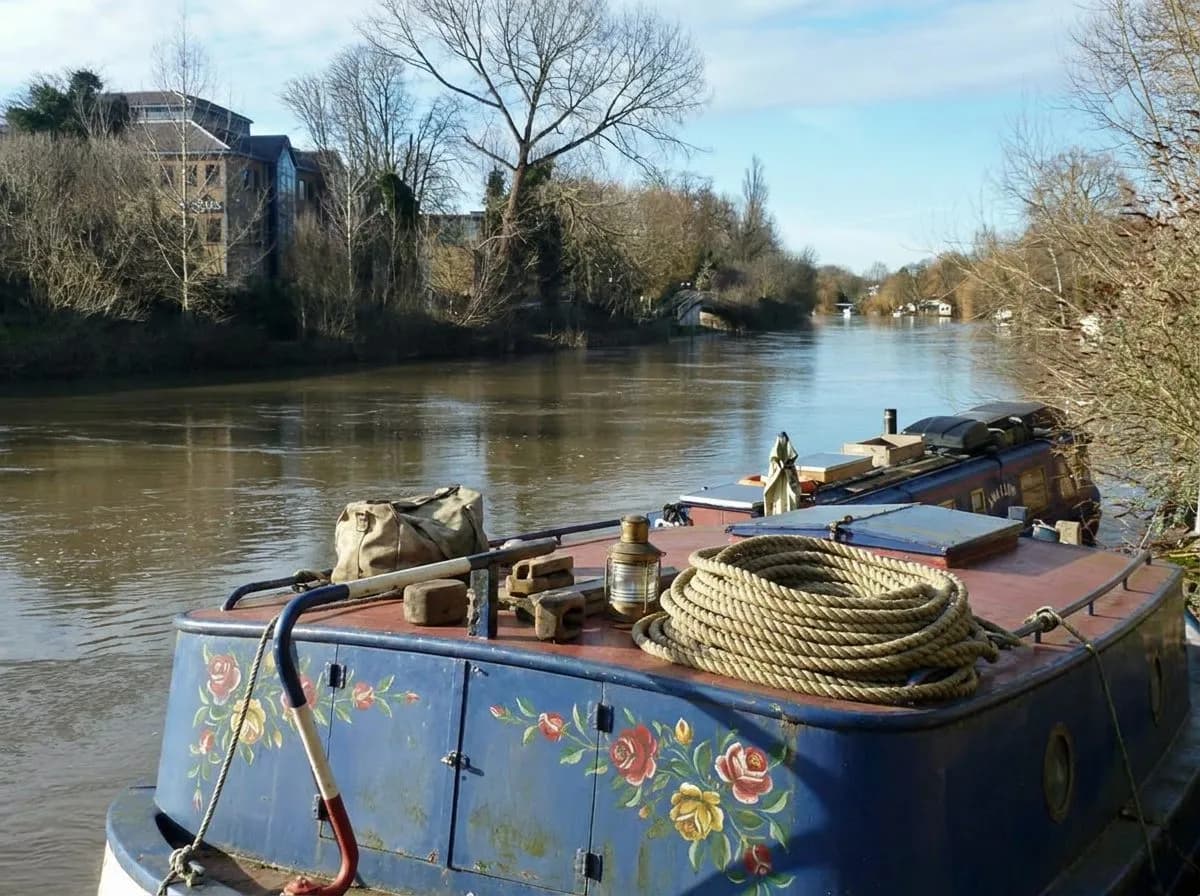
The stretch past London Fields offers the canal at its most domestic. Narrow boats line both banks, their painted hulls bright against the grey stone—pillar-box red, racing green, a particularly optimistic yellow. Potted herbs crowd the roofs. Bicycles lean against cabin doors. Smoke curls from a chimney even in late summer, because the mornings still hold a chill that burns off by nine.
You're walking through someone's neighborhood here, quite literally—these boats are homes, not holiday lets. The etiquette is museum-quiet: admire the window boxes, the hand-painted name boards, the ingenious storage solutions visible through portholes, but keep moving. The towpath narrows in places, forcing you close to moored boats, close enough to hear a kettle whistle or a radio murmur. It's an intimacy that feels both accidental and essential to the route's character.
The quarterly shuffle
The narrow boat mooring between Acton's Lock and Old Ford Lock has time-limited moorings, and resident boaters move vessels according to current Canal & River Trust mooring rules. Walk this stretch on one of those mornings and you'll witness a kind of aquatic choreography—boats untethering, reversing, gliding forward into newly vacated spaces, the whole floating neighborhood reshuffling itself with surprising efficiency. It's a reminder that the canal is a working waterway still, governed by rules and rhythms invisible to those of us just passing through.
Between moves, though, the moorings settle into a temporary permanence. You begin to recognize boats, to notice when someone's added new window boxes or repainted their cabin. The canal rewards repeat visits this way—it's never quite the same walk twice, but the variations are subtle enough to require attention.
Under the bridges
The Victorian brick bridges punctuate the route like chapters. Each one announces itself with a drop in light and temperature, the towpath suddenly cool and loud with echo. Your footsteps change tone. Voices carry differently. The brickwork overhead is blackened with more than a century of soot and weather, and the engineering—those perfect shallow arches, the gentle curve that carries a road or rail line over the water without ceremony—still holds.
Emerging from each bridge feels like surfacing. The light adjusts. The route straightens or curves. Sometimes you catch a glimpse of the neighborhoods above—a council block, a Victorian terrace, the back gardens of houses whose front doors open onto entirely different streets. The canal runs parallel to Hackney but separate from it, a hidden seam connecting neighborhoods that rarely acknowledge one another at street level.
The eastern lake circuit
Victoria Park announces itself slowly. The towpath widens. Trees thicken overhead. The narrow boats thin out, replaced by moorhens and the occasional ambitious duck. The Victoria Park entrance via the canal path avoids the formal gates and allows access to the eastern lake circuit early in the morning, subject to current park opening hours. It's a small advantage, but a real one—the path around the eastern lake at dawn, before the runners and the pram brigade, feels like finding a room in a museum before the doors unlock.
The lake holds the morning light beautifully, and the willow trees at the northern edge create the kind of dappled shade that makes you slow down despite yourself. You're technically still in the city—traffic hums beyond the tree line, a siren wails somewhere toward Bow—but the park absorbs it, softens it, turns it into backdrop rather than main event. Walk the circuit once and you've earned breakfast in whatever form you prefer, wherever the morning takes you next.
Why this route works
The canal towpath isn't picturesque in the Instagram sense. There are no sweeping vistas, no postcard moments. What it offers instead is texture, rhythm, the pleasure of moving through a city at walking speed on a route that refuses to hurry you along. It's a summer morning well spent precisely because it doesn't demand much—just comfortable shoes, an early alarm, and the willingness to let the walk itself be the point.
The neighborhoods change as you go, but the canal stays consistent. Water, brick, narrow boats, bridges. A heron if you're lucky, a cyclist if you're not paying attention. It's the kind of route you'll walk once out of curiosity and twice because you've already started thinking about what you missed the first time. By the third visit, you'll have a preferred direction, a favorite bridge, opinions about which stretch holds the light best. That's when you know it's worked.
Practical notes
Start near Broadway Market, accessible via London Overground at London Fields station and nearby Cambridge Heath station. The towpath is unlit and can be uneven—bring a torch if walking pre-sunrise, and wear shoes with grip. The route is roughly two miles, manageable in forty-five minutes at a steady pace, longer if you linger. The canal path is step-free but narrow in sections, less suitable for wheelchairs. Pack water; facilities are sparse until you reach Victoria Park. Verify seasonal access hours directly, as maintenance closures occur occasionally. Street parking near Broadway Market is resident-permit only; public transport is strongly recommended.
Tags: #RegentsCanal #BroadwayMarket #VictoriaPark #HackneyWalks #LondonCanals #DawnWalk #TheLongWayHome #LondonFields #EastLondon #SlowTravel #SummerWalks #TowpathLife #NarrowBoats #LondonOnFoot #CanalWalking
Sources consulted: Canal & River Trust - Regent's Canal · Victoria Park · Hackney Parks · Guardian London Travel
All trademarks are the property of their respective owners.