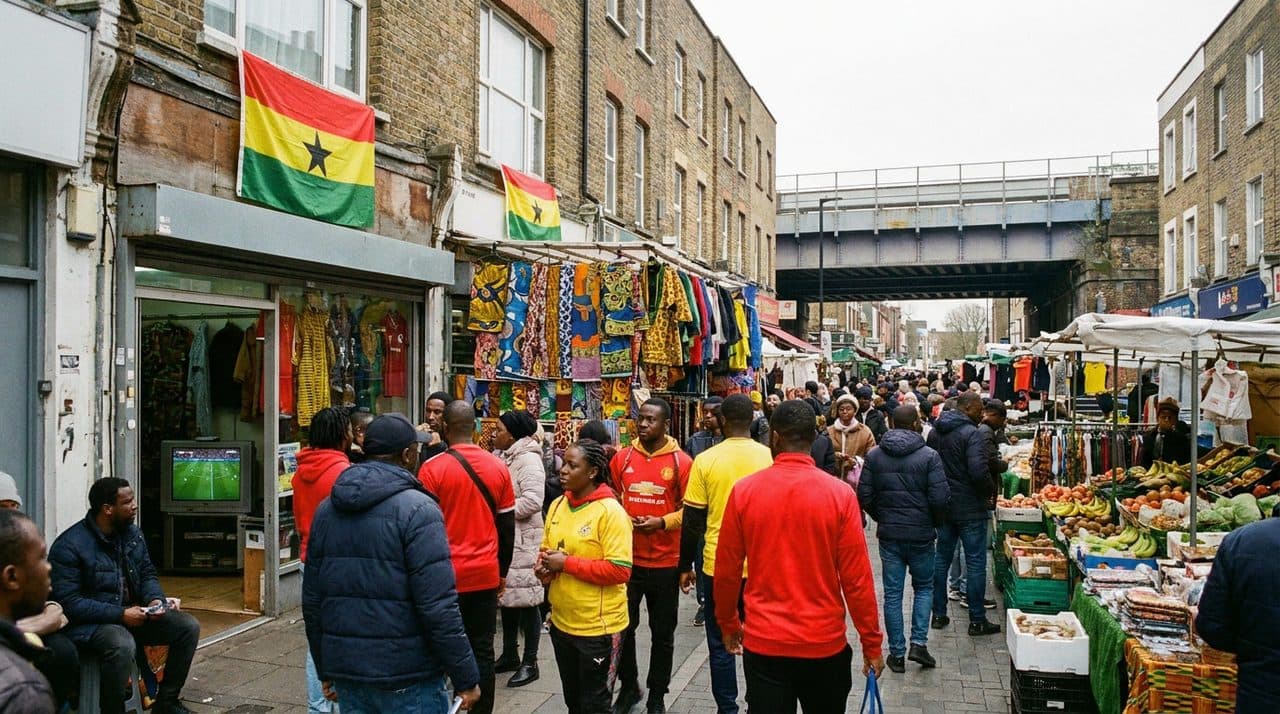
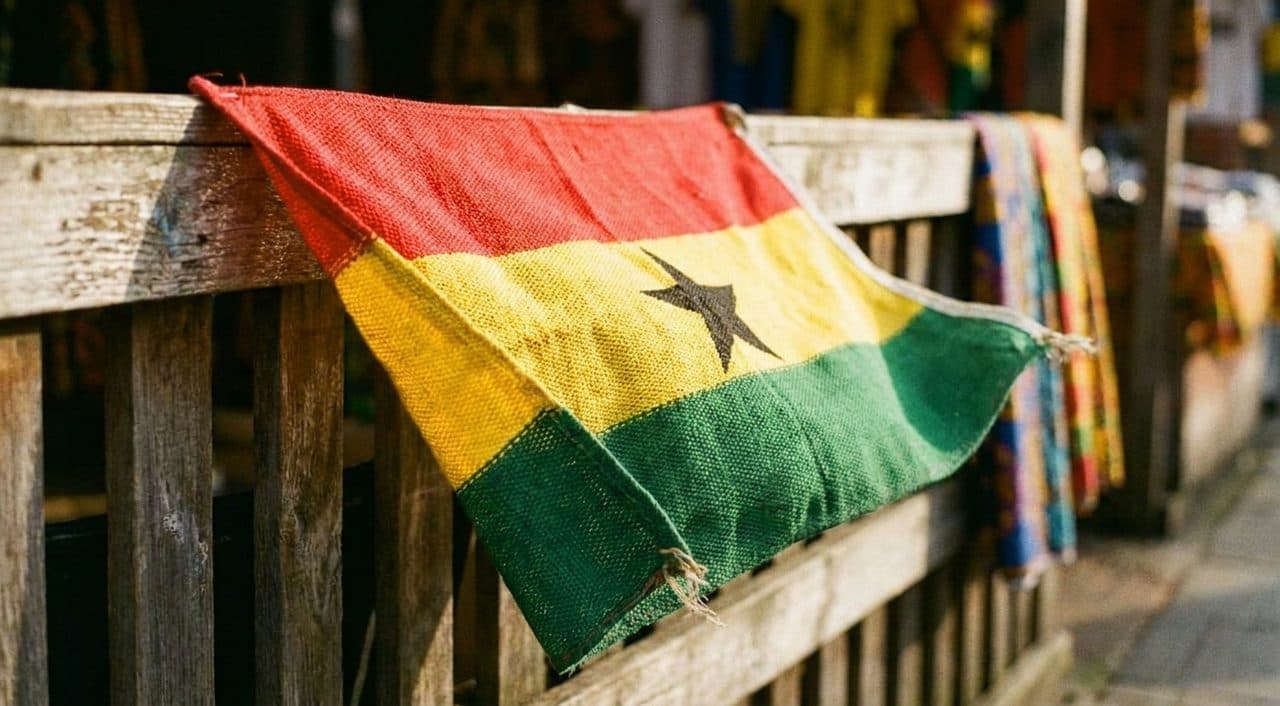
The morning Rye Lane wakes up on match day, something shifts in the air before the first whistle even sounds. Shopfronts that usually keep their TVs angled toward the till suddenly pivot them outward. Flags—gold, green, red, the black star centered—appear on balconies and draped across doorways, and the usual Saturday market hum takes on a different pulse entirely. When Ghana plays England, Peckham doesn't just watch. The neighborhood becomes the stadium.
Flags That Weren't There at Dawn
By mid-morning, the transformation is already underway. A woman in a fabric shop on Rye Lane pulls a stepladder to the window and tapes a flag to the glass. Two doors down, someone's rigged a portable speaker to a milk crate, testing the volume. The fruit seller who normally keeps to herself is wearing a jersey over her work coat. These aren't decorations put up days in advance—they materialize the morning of, like the neighborhood decided overnight. The chemist, the phone repair kiosk, the place that sells wigs and hair extensions—all of them suddenly dressed for the occasion. Walk the same stretch on a Sunday and none of it remains.
The Smell of Jollof Before Kickoff
The food vendors know the rhythm better than anyone. By late morning, the scent of jollof rice and grilled tilapia drifts from the covered market stalls and the takeaway spots tucked behind the main drag. One stall near the station usually does a modest lunch trade, but on match day the woman working the grill has already gone through two trays of plantain and is frying more. She's not taking orders for later—everything's for now, for the crowd that's gathering, for people who want to eat standing up with a plate in one hand and their phone in the other, checking lineups and texting friends about where to meet. The kelewele comes out hot enough to burn fingers, dusted with ginger and pepper, and it's gone before halftime.
Screens in Unexpected Places
The hardware store near the corner doesn't usually bother with a television, but today there's one propped on a paint can display, extension cord snaking back toward the office. A cluster of men in work boots stand in the doorway, half-watching, half-arguing about the midfield. The betting shop three blocks over has always had screens, but now they're all tuned to the same channel, and the usual solitary punters are joined by families, someone's uncle, a teenager in school uniform who should probably be somewhere else. The barbershop becomes a theater. Chairs fill early, but no one's really there for a cut—the clippers stay mostly idle while the barber and his clients watch, heads tilted toward the mounted screen. Someone brings in a round of drinks from the Caribbean takeaway next door. No one asks permission. No one needs to.
The Street as Living Room
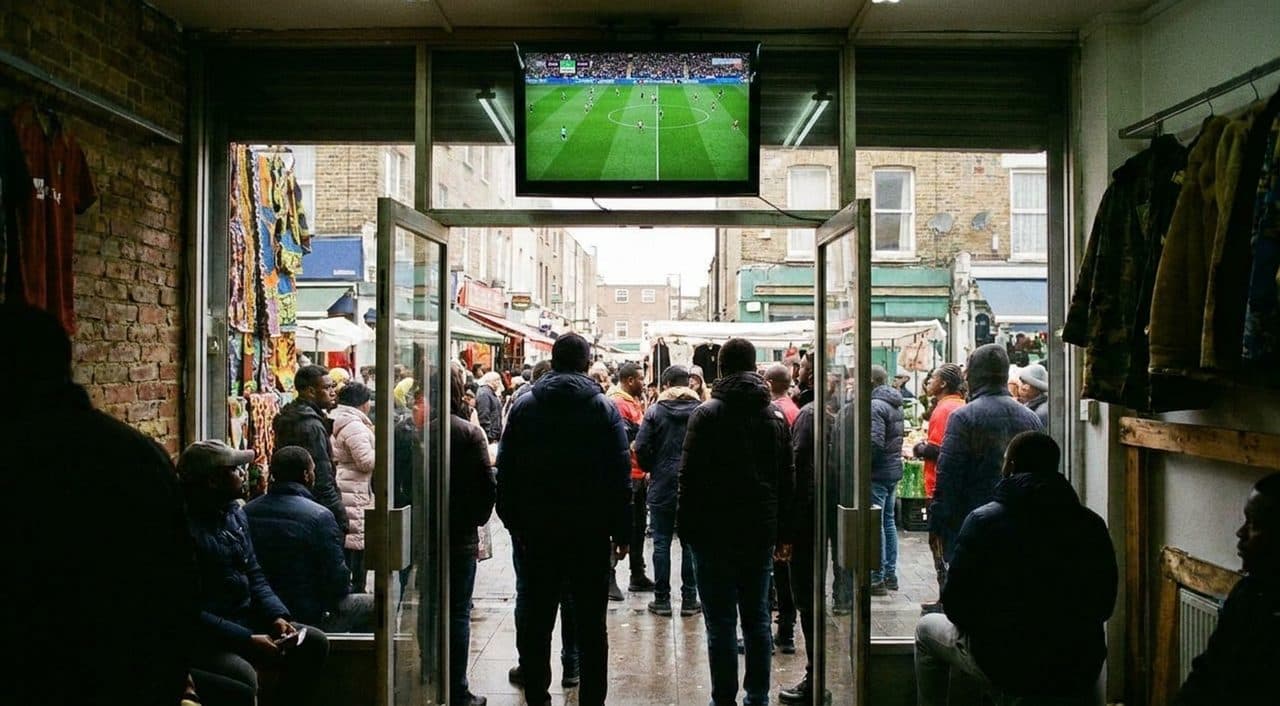
Rye Lane narrows with bodies as kickoff approaches. People spill from doorways onto the pavement, phones held up to capture the moment or FaceTime someone back in Accra. A father hoists his daughter onto his shoulders so she can see the screen in the grocery window. The bus stop becomes a viewing gallery. Strangers talk to each other like they've known each other for years—dissecting tactics, predicting substitutions, debating whether the ref's already made a bad call in the opening minutes. When something happens—a near miss, a tackle, a save—the reaction rolls down the block in a wave. Cheers from one shop trigger shouts from another, and for a moment the entire street is synchronized. The Ghanaian grocer who's usually reserved is shouting at the screen. The woman selling fabric is on her feet. The neighborhood sheds its everyday politeness and becomes loud, partisan, alive.
The Moment the Ball Hits the Net
If Ghana scores, the noise is immediate and total. It erupts from every doorway, every open window, every knot of people gathered on the pavement. Car horns start—not the irritated honking of traffic, but celebratory blasts, long and rhythmic. Someone sets off a vuvuzela. The sound is so loud it drowns out the commentary, and for thirty seconds no one can hear anything but joy. People who were inside come outside. People who were walking stop. The celebration doesn't stay contained—it spreads, pulls in passersby who weren't even watching, who just got caught in the current. A man in a England shirt walks through looking sheepish, grinning despite himself, and someone claps him on the back anyway. The moment stretches longer than it should, as if the neighborhood's holding onto it, refusing to let the match resume.
What Happens When It Ends
The final whistle doesn't disperse the crowd immediately. People linger in doorways, replaying the goals, the calls, the mistakes. The flags stay up through the evening. The food stalls keep serving, though the urgency has softened into something more social, less driven by the clock. Groups drift toward the pubs on Bellenden Road or the bars near Queens Road Peckham station, still wearing their jerseys, still talking. The street sweepers will come through later and find the detritus of the day—disposable plates, empty bottles, a single flag that slipped its tape. By Sunday, Rye Lane will look like itself again, the screens turned back inward, the balconies bare. But for those few hours on a Saturday, the neighborhood belonged entirely to the match, to the noise, to the feeling of being part of something that mattered beyond the final score.
Practical Notes
Match days are unpredictable by nature—check fixtures in advance, as the atmosphere only materializes when Ghana's playing, and especially when the opponent is England. Rye Lane is the heart of it, walkable from Queens Road Peckham or Peckham Rye stations, both on the Overground. The covered market and the stretch between the stations are where the energy concentrates. Food stalls and takeaways operate on their own schedules, but expect them to be busiest in the two hours before kickoff. Cash helps, though most places take card now. The barbershops and betting shops don't require a purchase to stand and watch, but buying something—a drink, a plate, a snack—is the unspoken entry fee. Arrive early if the goal is to claim a good sightline. The street fills fast, and by fifteen minutes before kickoff, the best spots are taken.
Tags: #PeckhamMatchDay #GhanaVsEngland #RyeLaneLondon #DiasporaEnergy #LondonFootballCulture #SouthLondonSaturdays #PeckhamCommunity #StreetFootball #JollofAndGoals #TheLongWayHome #LondonNeighborhoods #GhanaianLondon #MarketDayMagic #PeckhamRye #FootballFestival
Sources consulted: timeout.com · atlasobscura.com · nycgo.com
All trademarks are the property of their respective owners.
Ask Karpo first
Want to know where Peckham's Ghanaian community gathers for the biggest matches?
Ask Karpo for the market spots and screens with the best match-day atmosphere before you head out.