A New York slice shop is not really a restaurant. It is a small manufacturing operation with a display case at the front, and almost everything about the quality of what you are handed was decided before you walked in - by how many pies are sitting out, how long they have been there, and whether the person behind the counter is going to put your slice back in the oven. None of that is on the menu. All of it is visible from where you are standing, if you know what you are looking at.
The difference between the best and worst slice on the same block is usually about ninety seconds of oven time and one decision at the counter, and no review will ever capture it because it changes hourly. Ask Karpo which counters near you are actually turning pies over right now rather than which ones had a good year in 2019.
The economics that produce the slice
A slice shop makes whole pies, cuts them into eight, and sells them one at a time. That means it is constantly guessing how many pies the next hour will need. Guess low and you have queues and nothing in the case. Guess high and you have pies going stale under a lamp. Every slice counter in this city is running that forecast all day, and the state of the case at the moment you arrive is the visible output of it.
This is why the same shop can be excellent at half past twelve and mediocre at four. It is not inconsistency in the kitchen. It is the difference between a shop selling a pie every three minutes and a shop selling one every twenty. The best-run places manage the tail end by cutting production in the slow hours rather than letting stock sit, which is exactly the behaviour worth looking for.
Reading the case in five seconds
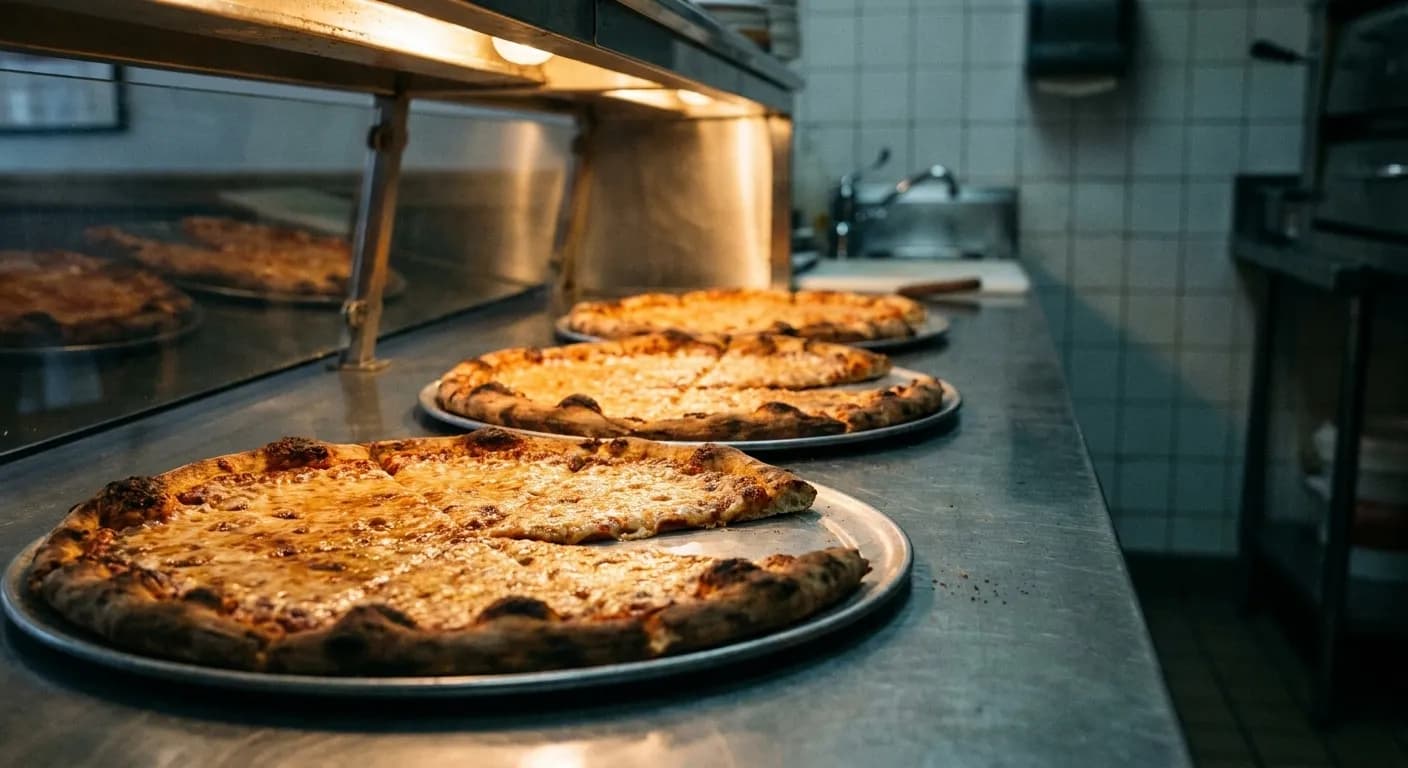
Look at the number of whole pies out. Two or three plain pies with visible gaps where slices have gone is a shop doing volume - good sign. Eight pies of eight different kinds all sitting untouched is a shop that has over-produced variety it cannot sell, and most of those slices have been out for a while.
Look at the cheese. A fresh pie has a slight sheen and the cheese still has some slump to it. A pie that has been out an hour has gone matte, and the surface has tightened into a slightly rubbery skin. Look at the cut edge of the slices - a fresh cut face is soft and slightly wet; an old one has dried into a firm crust.
And look at the crust underside if you can. The single most reliable indicator of a good slice shop is a bottom with actual colour on it - brown patches, a little char at the rim - rather than an even pale tan. A pale bottom means the oven is being run too cool or the pies are being pulled early to keep the case stocked.
The reheat is not a compromise
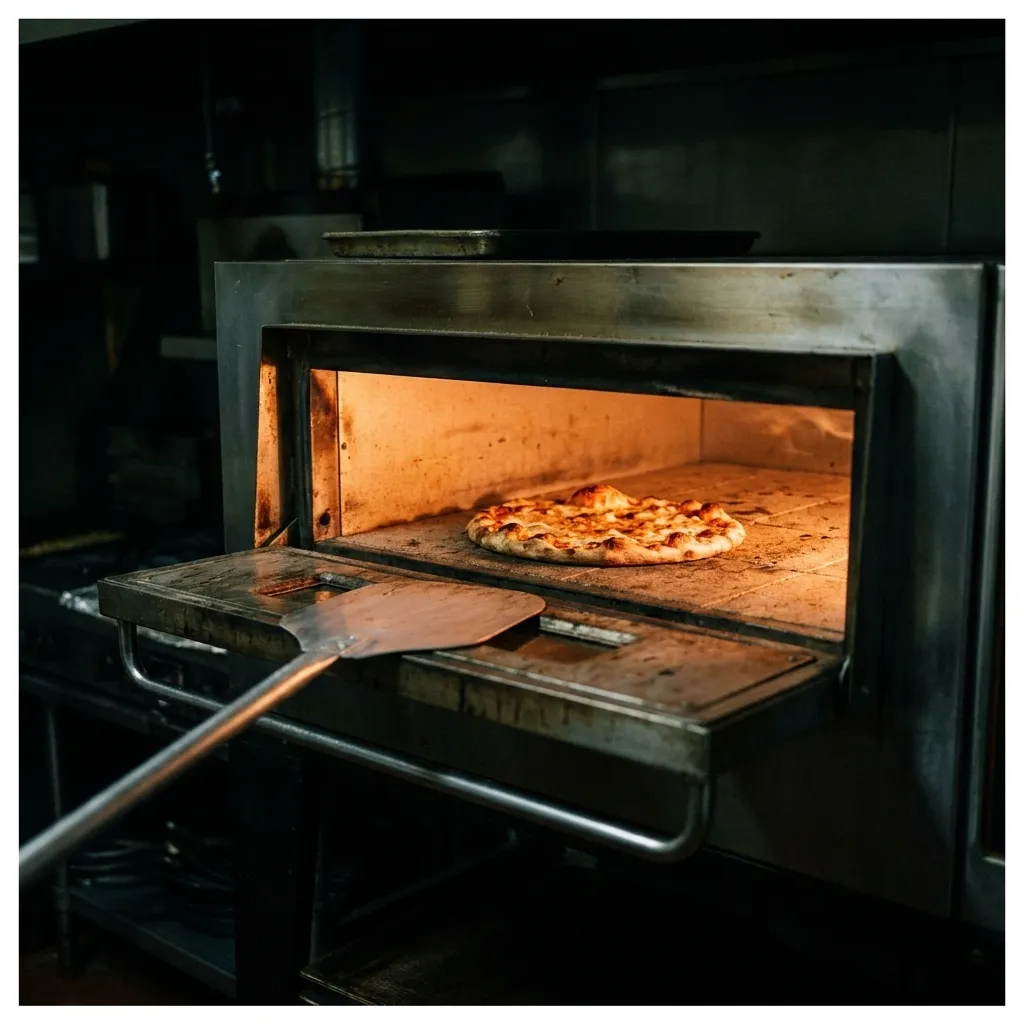
There is a persistent idea that asking for a slice to be reheated marks you as an outsider. The opposite is true. A New York deck oven runs somewhere around five hundred and fifty to six hundred degrees, and a ninety-second pass in it does something a microwave never can - it drives the moisture off the base and re-crisps it while the top merely warms through. A properly reheated hour-old slice is materially better than a lukewarm fresh one.
The tell for a good shop is that they do it without being asked when the slice needs it. If someone hands you a slice straight out of the case that has clearly been sitting, and does not offer, that tells you something about the place. If they slide it back in unprompted, that tells you more. Asking is entirely normal, and the phrase is simply: can you put it back in.
The three-minute rule and when to break it
The general rule is that a slice is at its best in the first three minutes after it comes out and acceptable for about the next forty with a reheat. Beyond that the base has dried too far to be rescued and the whole thing becomes an exercise in nostalgia.
The exception worth knowing is the square. Sicilian and grandma-style slices are thicker, more open-crumbed and carry more moisture in the dough, so they hold far better than a thin round slice and reheat much more forgivingly. If you have arrived at a slice counter in a dead hour and the round pies look tired, the square is very often the better order. This is the single most useful piece of counter knowledge in New York and almost nobody uses it.
Time of day, honestly
The reliably good windows are the ones where the shop is turning pies fastest: roughly noon to two, and again from six to eight. The reliably weak window is the middle of the afternoon, three to five, when production has slowed but the case is still being kept full for appearance's sake. Late at night, after about eleven, quality goes up again in the neighbourhoods that have late demand, because the shop is back to making pies to order rather than to stock.
If you are eating in a dead hour and the case looks tired, you have three options and they are all fine: order the square, ask for a reheat, or ask when the next plain pie is going in and wait four minutes for it. The last one is free and nobody minds.
Practical notes
A New York deck oven runs roughly 550 to 600 degrees Fahrenheit; a Neapolitan oven runs near 900 and cooks in under two minutes, which is why Neapolitan pizza does not survive sitting out and is almost never sold by the slice. Sicilian and grandma squares hold and reheat far better than thin rounds. A ninety-second reheat re-crisps a base; a microwave destroys it.
Fresh cheese has a sheen and some slump; an hour-old pie has gone matte and tight. A browned, slightly charred underside is the best single indicator of a well-run oven.
Tags: #PizzaNearMe #NYCPizza #NewYorkSlice #SliceShop #SicilianSlice #GrandmaSlice #DeckOven #NewYorkCity #NYCFood #PizzaGuide #WhereToEatNYC
All trademarks are the property of their respective owners.
Ask Karpo first
Good pizza in New York is a timing problem far more than a ranking problem. Ask Karpo which slice counters near you are busy right now, which ones run squares worth ordering in the quiet hours, and where the late-night ovens are still making pies to order rather than to stock.