 Haaland Has Seven Goals and Norway Runs Entirely Through Him
⚽️2026 FIFA WORLD CUP

The 6 A.M. Loop: World Cup Players' Recovery Jogs in Central Park
Dawn recovery runs, cold plunge studios, and stretching spots — mapping the Central Park and Hudson River Greenway circuits World Cup players use on rest days.
Before the City Wakes Up
At 6:07 a.m. on a rest day between World Cup group-stage matches, the Jacqueline Kennedy Onassis Reservoir in Central Park is almost empty. The cinder track that circles it — 1.58 miles of crushed gravel, flat and forgiving, suspended above the park's treeline with an unbroken view of the Midtown skyline — is populated by exactly the kind of people who run at that hour: a few retirees from the Upper West Side, a Columbia University cross-country runner doing intervals, and occasionally a professional athlete whose identity is obscured by a baseball cap, sunglasses, and the anonymity that Manhattan grants anyone moving fast enough.
During the 2026 World Cup, this track will become the unofficial recovery circuit for some of the most recognizable footballers on the planet. Recovery jogs — low-intensity runs at 50 to 60 percent of maximum heart rate, typically lasting 15 to 25 minutes — are a standard part of the day-after-match protocol for elite soccer players. The purpose is not fitness. It is circulation: moving blood through fatigued muscles to accelerate the removal of metabolic waste products, particularly lactate and hydrogen ions that accumulate during high-intensity sprinting.
The Reservoir Loop
The Reservoir track opens at 6 a.m. and closes at dusk. It is the only running surface in Central Park that is not shared with cyclists or vehicles, which makes it the safest option for an athlete recovering from a match. The surface — compacted cinder, similar to the material used on European training-ground warm-up tracks — absorbs impact more effectively than asphalt, reducing stress on joints that have already endured 90 minutes of cutting, sprinting, and decelerating on synthetic turf.
The track runs counterclockwise by convention, though there is no posted rule. Two laps equal approximately 5 kilometers, which falls within the standard recovery-jog distance prescribed by most World Cup team physiotherapists. The elevation change is negligible — a gentle rise of about 15 feet on the eastern side — and the footing is consistent except after heavy rain, when the cinder softens and pace drops by roughly 10 seconds per kilometer.
Entry points are at 90th Street on the west side and 86th Street on the east side. The 90th Street entrance is closer to hotels on Central Park West and involves a shorter walk from the park perimeter to the track surface. A player leaving the Mandarin Oriental at Columbus Circle at 6 a.m. would reach the track in approximately 22 minutes of walking, or eight minutes by car to the 90th Street drop-off.
The Hudson River Alternative
For players who prefer a linear route over a loop, the Hudson River Greenway offers five miles of uninterrupted waterfront path from Battery Park City to the George Washington Bridge. The section most relevant to World Cup teams based in Midtown runs from Pier 84 at 44th Street to Pier 45 at Christopher Street — a flat, four-mile out-and-back along the river's edge.
The Greenway is paved, which is harder on joints than the Reservoir's cinder, but it is wider — 12 feet in most sections — and the river breeze provides natural cooling during the June and July temperatures that coincide with the World Cup schedule. Average morning temperatures in late June hover around 68 to 72 degrees Fahrenheit at 6 a.m., rising to 80 or above by 10 a.m. Early starts are not optional for athletes managing heat exposure.
The section near Pier 45 includes a small grass area overlooking the river that is used informally for stretching and bodyweight exercises. By 7 a.m. on weekdays, yoga practitioners and bootcamp groups begin to arrive, but before that window, the space is quiet enough for a team physiotherapist to run a structured stretching session for three or four players at a time.
The Cold Plunge Circuit
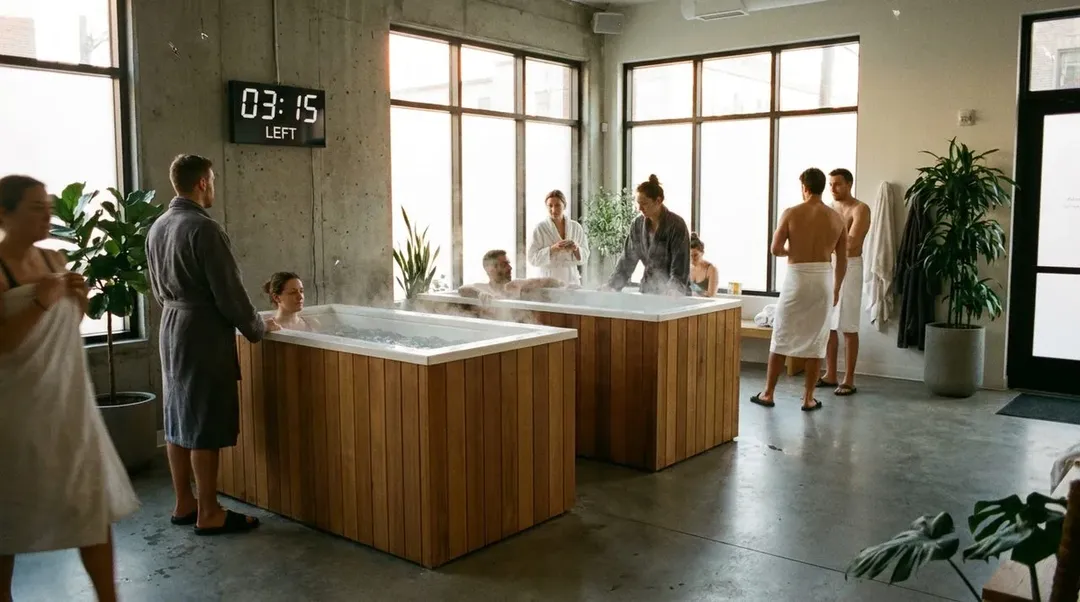
Cold water immersion — typically two to four minutes in water between 50 and 59 degrees Fahrenheit — has become a staple of post-match recovery for elite footballers. While team hotels often provide portable ice baths, Manhattan's growing network of dedicated recovery studios offers a more controlled environment with additional modalities.
Plunge on East 17th Street near Union Square operates a studio with six cold-plunge tubs maintained at 39 degrees Fahrenheit, along with infrared saunas set to 150 degrees. A single session — which includes 30 minutes of alternating cold and heat exposure — costs $55 for walk-ins and $45 for members. The studio opens at 6 a.m. on weekdays and has accommodated athletic teams by blocking three to four consecutive 30-minute slots for group bookings. The facility uses ozone filtration in the plunge tubs, which eliminates the chlorine smell that some athletes find aggravating to the respiratory system.
Bathhouse on the Bowery in the East Village offers a more traditional approach: a Russian-style banya with steam rooms, cold pools, and heated stone platforms. The cold plunge pool is maintained at 45 degrees and is large enough for two people simultaneously. Day passes cost $65 and include access to all facilities. The building — a restored 19th-century bathhouse — has been operating in various forms since 1892 and retains the tile work, iron fixtures, and cavernous atmosphere of its original construction.
The Science of the Day After
World Cup recovery protocols have evolved significantly since 2018, when GPS tracking and biometric monitoring became standard across all 32 teams. Each player now wears a vest containing an accelerometer, gyroscope, and heart-rate monitor during training and matches, producing data that team analysts use to calculate individual recovery loads. A player who covered 12 kilometers and executed 35 high-intensity sprints during a match will receive a different recovery prescription than one who covered 9 kilometers with 18 sprints.
The typical rest-day schedule for a starter looks like this: 6 a.m. wake, light breakfast in-room, 7 a.m. recovery jog (20 minutes, heart rate below 130 bpm), 8 a.m. cold plunge or pool session, 9 a.m. team breakfast, 10 a.m. physiotherapy, 11 a.m. free time. The afternoon is unstructured, which is when players typically explore the city, sleep, or engage in the video-game tournaments that have become a fixture of World Cup camp culture.
The Invisible Hours
The World Cup that fans see — the matches, the celebrations, the press conferences — occupies roughly three hours of a player's day. The other 21 hours are recovery. And recovery, at its best, is invisible. A 20-minute jog on a gravel track. A four-minute submersion in water cold enough to make breathing difficult. A plate of eggs and salmon in a quiet hotel room.

These are the hours where the tournament is won. Not in the dramatic sense — not with goals or saves or last-minute headers — but in the biological sense: muscles repaired, inflammation reduced, sleep quality optimized, mental fatigue managed. Central Park at dawn, the Hudson at first light, a cold tub in a basement on 17th Street. The World Cup's quiet infrastructure, hiding in plain sight.
Tags: #WorldCup2026 #CentralPark #RecoveryJog #Reservoir #HudsonRiverGreenway #ColdPlunge #PlayerRecovery #SportsScience #RestDay #NYCRunning #DawnJog #Bathhouse #GPSTracking
Sources consulted: Jacqueline Kennedy Onassis Reservoir · Hudson River Greenway · Central Park · FIFA World Cup 2026 · Cold water immersion therapy
All trademarks are the property of their respective owners.
Ask Karpo for more information.
Keep reading
- Haaland Has Seven Goals and Norway Runs Entirely Through Him
 World Cup Trophy Ceremony Timing Medals and Postmatch Celebrations
 Olise and France's Attack: The Semifinal Tactical Question