 Haaland Has Seven Goals and Norway Runs Entirely Through Him
⚽️2026 FIFA WORLD CUP

Wirtz and Musiala Hit the East Village: Germany's Young Stars Off-Pitch
Germany's Gen-Z midfield duo Florian Wirtz and Jamal Musiala explore NYC's East Village — from Third Avenue beer gardens to St. Marks coffee shops.
Two Kids, One Neighborhood
Florian Wirtz is 23. Jamal Musiala is 23. Together, they form the creative axis of a German national team that has spent the past two years rebuilding itself around youth, speed, and an almost unreasonable amount of technical skill. Wirtz, the Bayer Leverkusen playmaker who led his club to an unbeaten Bundesliga season in 2024, plays like he is solving equations in real time. Musiala, Bayern Munich's dribbling savant who holds dual German-English citizenship, plays like the ball is a part of his body that he occasionally lets the grass borrow. When Germany arrives in New York for the 2026 World Cup, these two will not spend their off-days in a hotel conference room. They will go where every 23-year-old with taste and curiosity goes: the East Village.
The neighborhood — bounded roughly by 14th Street to the north, Houston Street to the south, the Bowery to the west, and Avenue D to the east — has been Manhattan's unofficial district for young creatives, musicians, and people who think a good day involves three coffees and a vintage find since at least the 1960s. It is where the Ramones played their first gig. Where Jean-Michel Basquiat tagged walls before galleries knew his name. And where, on any given summer afternoon in 2026, you might find two of the best footballers on Earth browsing a rack of secondhand band tees.
The Beer Garden Start
For a German footballer, the instinct toward a beer garden is cultural, not recreational. Zum Schneider on Avenue C at 7th Street has been operating a Bavarian-style biergarten since 2000, and its outdoor seating — long communal wooden tables under a canopy of string lights — fills with German expats, Europhiles, and soccer fans during every major tournament. During the 2024 Euros, the bar installed a projector screen visible from the sidewalk and served over 400 liters of Hofbrau on Germany's opening match day alone. A liter of draft Paulaner Hefe-Weizen costs $14. The pretzels, imported from a Munich bakery and baked on-site, are $7 each and roughly the size of a steering wheel.
Loreley Beer Garden on Rivington Street, just south of the East Village border, offers a broader European draft list — 12 taps that rotate between German, Belgian, and Czech selections — and a backyard space that seats 150. The vibe is louder and younger than Zum Schneider, with DJs on weekends and a crowd that trends toward late-twenties downtown professionals. For Wirtz and Musiala, who have both been photographed at Munich nightlife spots, Loreley's energy would feel familiar without the obligation of a celebrity appearance.
The Coffee Circuit
Musiala has mentioned in interviews that coffee is his pre-match ritual — a flat white, specifically, consumed exactly 90 minutes before kickoff. The East Village is arguably the densest specialty coffee neighborhood in Manhattan, and the options reflect the area's character: independent, particular, and slightly obsessive about process.
Abraco on East 7th Street between First Avenue and Avenue A is a 200-square-foot espresso bar that has been pulling shots since 2008. There are no seats inside — you stand at a narrow wooden counter or take your drink to the sidewalk. The olive oil cake, baked daily in a kitchen smaller than most hotel bathrooms, costs $5 and is widely regarded as one of the best pastries in downtown Manhattan. A cortado runs $4.50. The baristas work a two-group La Marzocca Linea and manage a line that snakes out the door by 9 a.m. on weekends.
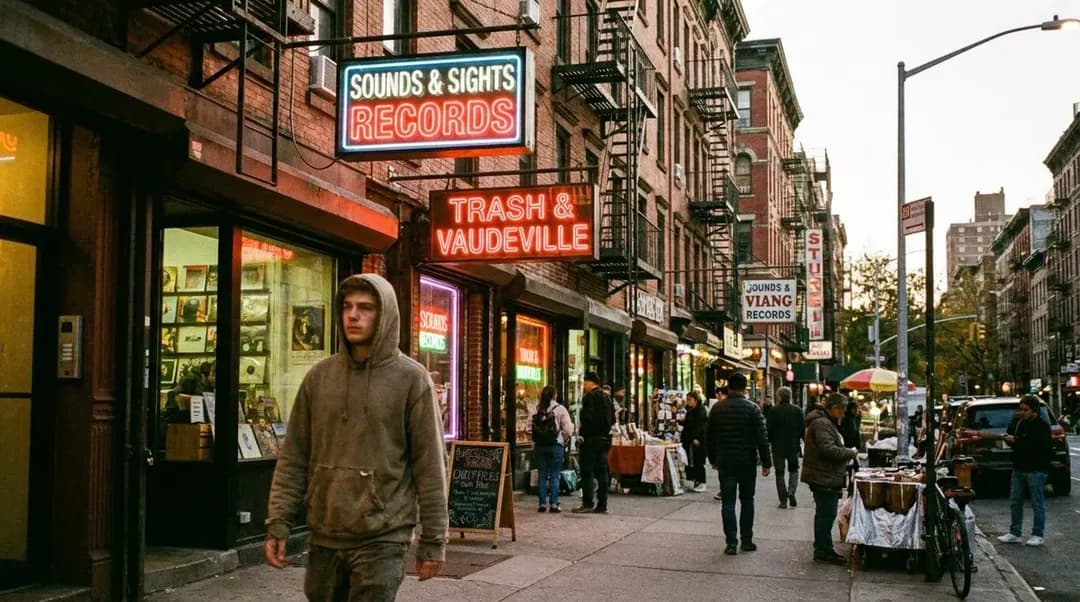
Seventh Street Cafe, three blocks east on Avenue A, offers more space and a full breakfast menu that includes a German-influenced item: a soft pretzel with mustard butter and a side of scrambled eggs, priced at $13. The cafe opens at 7 a.m. and its corner location catches morning light from two directions, making it the kind of place where a footballer recovering from a late kickoff might sit for 45 minutes with a newspaper and a double espresso without being recognized.
The St. Marks Wander
St. Marks Place — technically East 8th Street between Third Avenue and Avenue A — is the East Village's main drag, and it operates as a sensory corridor. In the span of four blocks, you pass a Japanese izakaya, a tattoo parlor, a bookstore specializing in radical political theory, a vintage sneaker shop, three bubble tea spots, and a store that sells nothing but hot sauce. The strip has been a destination for alternative culture since the 1970s, and while gentrification has softened some edges, the density of independent storefronts remains remarkable.
Search & Destroy at 25 St. Marks Place sells punk and metal merchandise — band patches, studded belts, vintage concert tees — in a space that has not been renovated since approximately 1983. Trash and Vaudeville, the legendary shop that dressed Debbie Harry, the New York Dolls, and Joey Ramone, operated at 4 St. Marks for decades before moving to a new location on East 7th Street. The new space is cleaner but retains the same inventory philosophy: leather jackets, platform boots, and an attitude that Manhattan's luxury retail corridors cannot replicate.
For Wirtz, whose off-pitch style leans toward minimalist streetwear — clean sneakers, oversized hoodies, no logos — the vintage shops on East 9th Street between First and Second Avenues offer a more curated hunt. Tokio 7, a consignment boutique at 83 East 7th Street, stocks secondhand designer pieces — Comme des Garcons, Issey Miyake, Raf Simons — at roughly 40 to 60 percent of retail. The store operates on a first-come basis with no appointments, and the racks turn over weekly.
Evening Wind-Down
By evening, the East Village transitions from browsing to eating. For a low-key team dinner that does not require a private room or a reservation system, Xi'an Famous Foods on St. Marks serves hand-pulled noodles — the cumin lamb variety, specifically, which arrives in a bowl the size of a small basin — for $12.50. The spice level is aggressive and the portions are designed for carbohydrate loading, which makes it accidentally perfect for professional athletes. There are 14 seats. The wait at peak dinner is 20 minutes. You eat standing if the seats are full.
For something quieter, Veselka on Second Avenue at 9th Street has been serving Ukrainian comfort food since 1954. The pierogi — filled with potato and farmer cheese, pan-fried in butter — cost $16.95 for a plate of seven and arrive with a side of caramelized onions and sour cream. The restaurant is open 24 hours on weekends and until midnight on weekdays, and its large front windows make it one of the best people-watching spots in the neighborhood. A table for two by the window on a summer evening, with the East Village sidewalk parade passing outside, is the kind of moment that makes an off-day feel earned.
Why This Neighborhood
The East Village works for Wirtz and Musiala because it operates on their wavelength: young, curious, unpretentious, and deeply specific about its tastes. It is not the VIP-section Manhattan of bottle service and velvet ropes. It is the Manhattan of $4.50 cortados and $7 band patches and the best hand-pulled noodles you will eat standing up. For two 23-year-olds who happen to be among the most talented footballers alive, that is exactly the right speed.
Tags: #WorldCup2026 #FlorianWirtz #JamalMusiala #Germany #EastVillage #StMarksPlace #ZumSchneider #BeerGarden #NYCCoffee #VintageShops #Abraco #Veselka #BayerLeverkusen #BayernMunich
Sources consulted: Florian Wirtz · Jamal Musiala · East Village, Manhattan · Germany national football team · Veselka restaurant · FIFA World Cup 2026
Please drink responsibly. You must be 21 or older to purchase or consume alcohol in New York.
All trademarks are the property of their respective owners.
Ask Karpo for more information.
Keep reading
- Haaland Has Seven Goals and Norway Runs Entirely Through Him
 World Cup Trophy Ceremony Timing Medals and Postmatch Celebrations
 Olise and France's Attack: The Semifinal Tactical Question