 Haaland Has Seven Goals and Norway Runs Entirely Through Him
⚽️2026 FIFA WORLD CUP
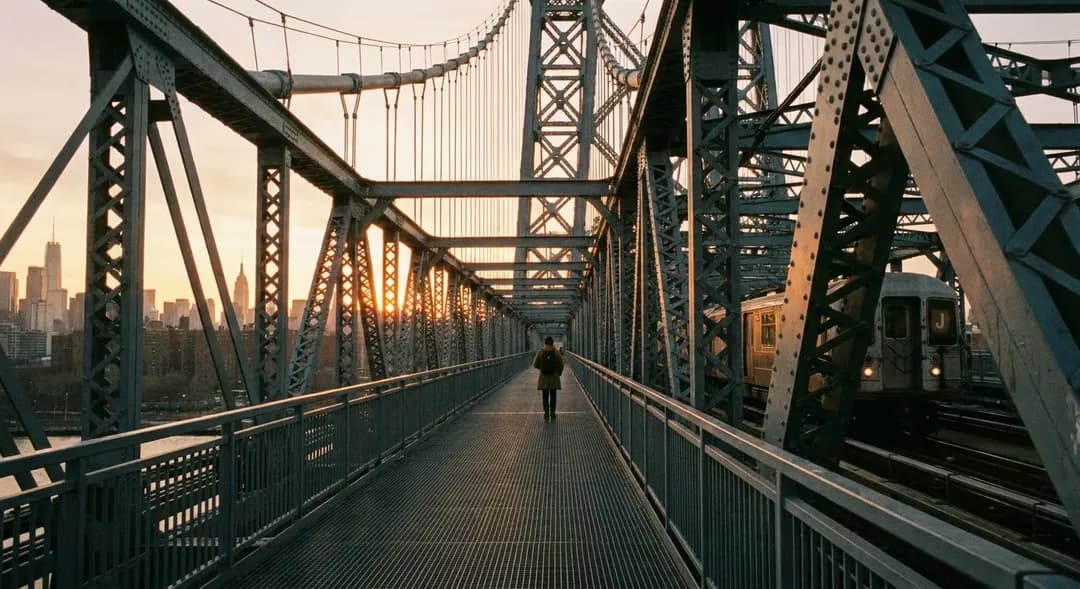
The Saxophone and the Stadium: Sonny Rollins and the Soundtrack of a World Cup Summer
Sonny Rollins practiced on the Williamsburg Bridge for three years, alone, playing against the sky. He died yesterday at 95. This is about the sounds New York makes when it has something to prove.
Sonny Rollins died on Sunday. He was 95. The news arrived the same week New York began its loudest summer in decades — the vuvuzelas already audible at World Cup fan zones, the memorial day weekend fireworks still echoing off the East River, the construction hammering at temporary stages in Hudson Yards and Brooklyn Bridge Park. Rollins would have appreciated the irony. He spent three years practicing saxophone on the Williamsburg Bridge specifically because New York was too loud for him to hear himself think, and too judgmental for him to play badly in front of anyone. So he went where only the J train and the wind could hear him.
The bridge, 1959 to 1961
In the summer of 1959, at 28 years old and at the peak of a career that had already produced 'Saxophone Colossus,' Rollins disappeared. No recordings. No performances. No public appearances. For almost three years, he walked from his Lower East Side apartment to the pedestrian walkway of the Williamsburg Bridge and practiced — sometimes 16 hours a day, next to the subway tracks, facing the sky. He later said: 'Playing against the sky really does improve your volume, and your wind capacity.' The album he recorded upon his return, in 1962, was called 'The Bridge.' It featured guitarist Jim Hall, drummer Ben Riley, and bassist Bob Cranshaw. It became one of his best-selling records and was inducted into the Grammy Hall of Fame in 2015.
The pedestrian walkway where Rollins practiced is still there. It's 7,308 feet long, shared with cyclists, and runs along the south side of the bridge between Delancey Street in Manhattan and Broadway in Williamsburg. On any given morning, you'll find joggers, commuters on e-bikes, and occasionally a busker with a guitar case. But the walkway's acoustic quality — the way the open-air span amplifies brass instruments against the river and the subway rumble — hasn't changed. Rollins knew this. He wasn't hiding on the bridge. He was using it as a practice room with infinite ceiling height.
The sonic landscape of a World Cup city
Walk through midtown Manhattan on a World Cup matchday and the sound profile shifts block by block. At the FIFA Fan Festival in Hudson Yards, the PA system carries play-by-play at a volume calibrated for 15,000 standing spectators. The crowd noise — multinational, polyphonic, surging with every near-goal — bleeds across Hudson Boulevard and reaches the High Line, where tourists stop mid-stroll to figure out what they're hearing. On Eighth Avenue, the vuvuzela vendors have set up near Penn Station's entrance. The instruments cost $12 and produce a sound measured at 116 decibels at the bell — louder than a chainsaw, roughly equivalent to a rock concert at close range.
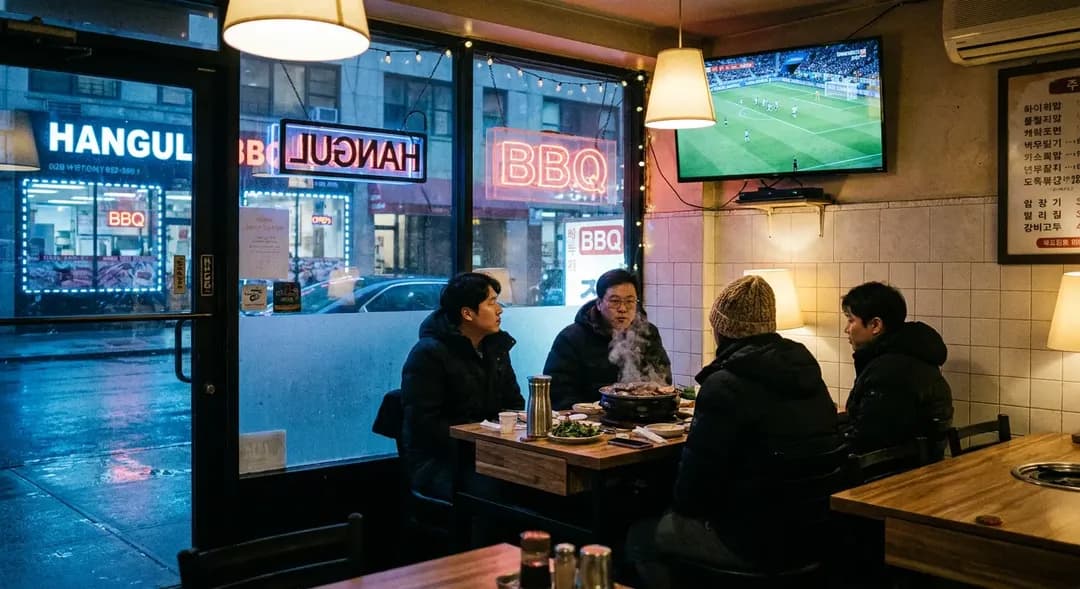
Three blocks south, in Korea Town on 32nd Street, restaurants screening early-morning Asian group-stage kickoffs — 6 AM Eastern for matches in the Asian broadcast window — produce their own acoustic signature. The sound of 40 people in a BBQ restaurant watching a penalty shootout at dawn, filtered through plate glass, is nothing like the Fan Festival's stadium-scale roar. It's compressed, intimate, and strangely intense — like hearing a symphony through a wall.
The drum circles and the singing walks
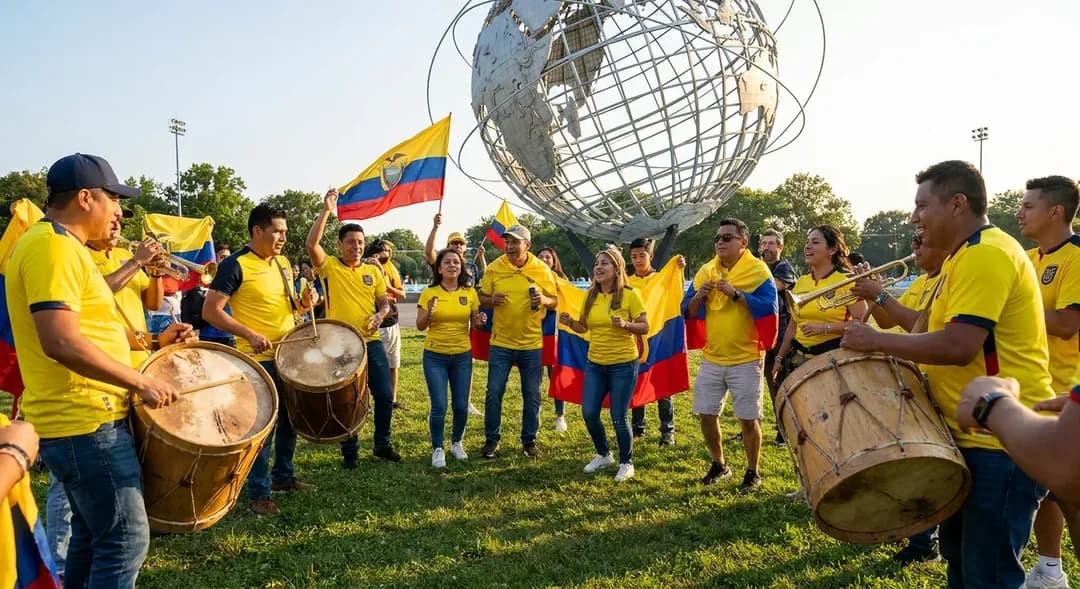
Corona Park in Queens has been the site of informal football drum circles for decades, long before the World Cup. But this summer, the percussion has a schedule. On weekends, Ecuadorian fan groups gather near the Unisphere with bombo drums and brass instruments starting around noon, playing until the sun sets. The rhythms are cumbia-inflected and competitive — different groups representing different regions of Ecuador, trying to outplay each other while nominally supporting the same national team.
In Astoria, Greek and Cypriot fans have organized what they're calling a 'singing walk' — a procession from Athens Square Park on 30th Avenue to Bohemian Hall & Beer Garden on 29th Street, covering six blocks while singing national football chants in Greek. The first one drew roughly 200 participants on a Saturday afternoon in late May. It's not sanctioned. There's no permit. The participants just walk, sing, and stop traffic on 31st Street for four minutes at a time. The NYPD has been present but unengaged — standing on the corner, watching, occasionally nodding along.
What Rollins heard, and what we hear now
When Rollins went to the Williamsburg Bridge in 1959, he was trying to strip away everything between himself and his instrument. The city was too noisy, too social, too full of other musicians' opinions. The bridge gave him wind, vibration, solitude, and the faint rattle of the J train — a metronome he didn't ask for but learned to play against. He emerged in 1962 with a sound that was leaner, more rhythmically complex, and utterly his own.
New York's World Cup summer is the opposite of Rollins' bridge: maximal, communal, and unignorable. But both are about what a city sounds like when something enormous is happening. The World Cup brings 82,000 voices to a stadium in East Rutherford and a million more scattered across five boroughs, watching on screens, banging drums, blowing plastic horns, singing in languages that most of their neighbors don't speak. It's joyful, chaotic, occasionally annoying, and entirely human.
Rollins' music was always about conversation — call and response, improvisation over structure, the tension between a melody everyone knows and the moment a soloist decides to leave it behind. The World Cup's soundscape works the same way. There's a structure — the match, the whistle, the crowd's predictable roar at a goal — and then there's everything that happens around it: the prayer in Farsi at an Iranian watch party in Sunnyside, the accordion player at the Argentine empanada stand on Roosevelt Avenue, the teenager on the Williamsburg Bridge playing saxophone at sunset, not because anyone asked him to, but because someone once showed him it was possible.
Sonny Rollins played against the sky for three years and came back with 'The Bridge.' This summer, New York is playing against the world. The album isn't recorded yet.
Tags: #SonnyRollins #WorldCup2026 #NYCJazz #WilliamsburgBridge #FIFAWorldCup #JazzLegend #NYCSummer2026 #TheBridge #SaxophoneColossus #NYCMusic #SummerSoundtrack #BrooklynJazz #LiveMusic #NYCCulture #KarposFinds
All trademarks are the property of their respective owners.
Ask Karpo for more information.
Keep reading
- Haaland Has Seven Goals and Norway Runs Entirely Through Him
 World Cup Trophy Ceremony Timing Medals and Postmatch Celebrations
 Olise and France's Attack: The Semifinal Tactical Question