 Haaland Has Seven Goals and Norway Runs Entirely Through Him
⚽️2026 FIFA WORLD CUP
Son Heung-min's Koreatown: Where South Korea's Squad Eats After Training
South Korea's World Cup stars descend on 32nd Street — the KBBQ joints, tofu houses, and pojangmacha-style bars where the squad unwinds after matches.
32nd Street Belongs to Them Now
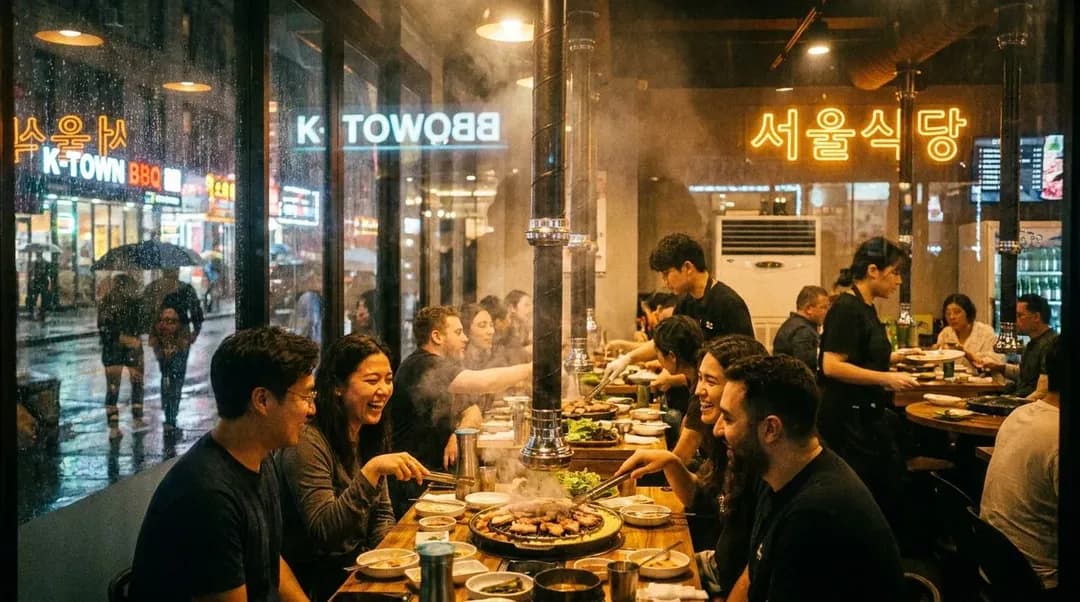
When South Korea's national football team arrives in New York for the 2026 World Cup, they will not need a concierge. They will need a reservation at Jongro BBQ. The stretch of West 32nd Street between Fifth Avenue and Broadway — Manhattan's Koreatown, a single compressed block that packs more Korean restaurants per square foot than anywhere outside Seoul — has been feeding homesick Korean athletes, musicians, and businesspeople for decades. Now it is about to become the unofficial dining room of one of Asia's most decorated World Cup squads.
Son Heung-min, the captain and the most recognizable Korean athlete on the planet, has spoken publicly about the comfort of Korean food during long European seasons. His Tottenham Hotspur teammates have documented him eating kimchi jjigae from a thermos in the Hotspur Way cafeteria. When the World Cup brings him to a city with a fully operational Koreatown — one that stays open until 4 a.m. on weeknights — the gravitational pull will be undeniable.
The KBBQ Anchors
Jongro BBQ at 22 West 32nd Street operates 24 hours a day, seven days a week. This is not marketing — the grill stations are literally always on. The restaurant occupies a below-street-level space accessed by a narrow staircase, and the dining room seats roughly 120 across tight rows of tables, each fitted with a gas-fired grill recessed into the surface. The signature order is the combo for two: chadol bagi (thinly sliced beef brisket), samgyeopsal (pork belly), and yangnyeom galbi (marinated short rib), served with 12 to 14 banchan dishes that arrive before the meat. The total runs about $45 per person before drinks. At 1 a.m. on a Saturday, there is still a 20-minute wait.
Two doors down, Kang Ho Dong Baekjeong — named after the Korean comedian and former wrestler who founded the chain — offers a more theatrical experience. The staff slice and grill the meat for you, and the signature egg mixture, poured into a ring-shaped channel around the grill, puffs into a savory custard while your galbi cooks at center stage. Baekjeong operates eight locations worldwide, but the 32nd Street original, which opened in 2014, remains the busiest. The private room in the back, which seats 12, has hosted K-pop groups, Korean baseball players during MLB exhibitions, and at least two Korean national team gatherings during past friendlies at MetLife.
Beyond the Grill
Korean food culture extends well beyond barbecue, and Koreatown's depth is what makes it genuinely useful as a team dining district. For recovery meals — high-protein, broth-heavy, easy on the stomach after a match — the tofu houses are the move.
BCD Tofu House at 5 West 32nd Street has been the Koreatown anchor for soft tofu stew since 1996. The soondubu jjigae arrives in a stone pot, still violently bubbling, with a raw egg cracked on top that cooks in the residual heat. The seafood version — packed with shrimp, clams, and squid — runs $16.95 and comes with rice, banchan, and a small bowl of nurungji, the crispy rice-bottom tea that Koreans drink as a digestive. BCD stays open until midnight on weekdays and 1 a.m. on weekends, making it viable for post-match meals even after late kickoffs.
For noodle-focused recovery, Wonjo on 23 West 32nd Street serves naengmyeon — cold buckwheat noodles in an icy beef broth — that is considered among the best in the city. The broth is made from a 24-hour beef bone stock that is frozen and shaved into the bowl, so it arrives at near-freezing temperature. During summer months, which coincide with the World Cup schedule, naengmyeon consumption in Koreatown spikes. Wonjo's version costs $18 and arrives with a pair of scissors for cutting the noodles, a detail that confuses first-timers but is standard Korean practice.
The Late-Night Layer
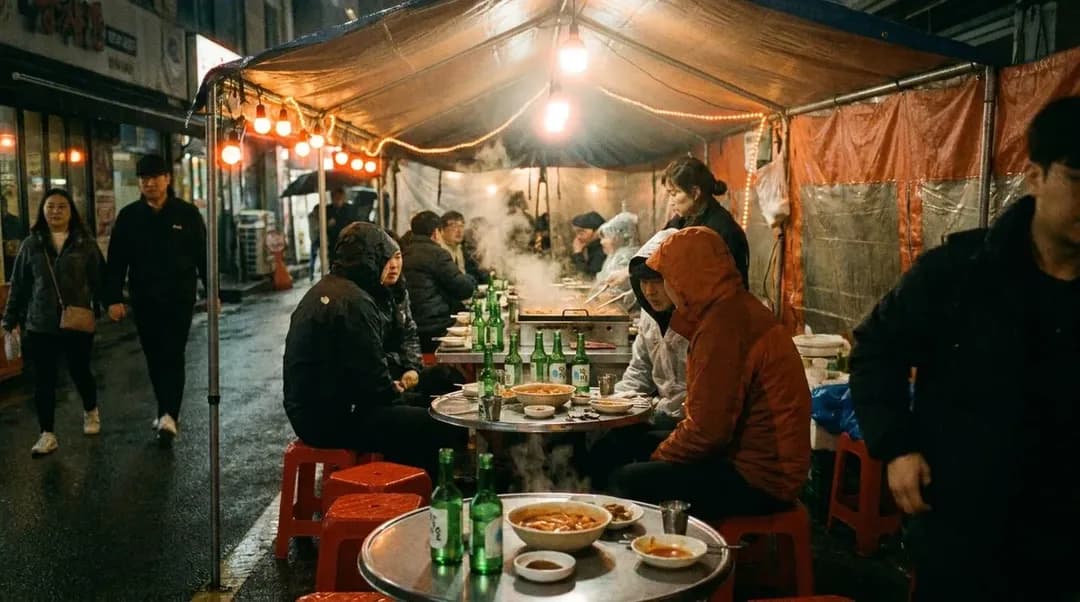
After the food comes the drinking, and Koreatown's after-hours scene is where the squad dynamic shifts from professional to personal. Pocha 32 on the second floor of 15 West 32nd Street recreates the pojangmacha — the orange-tented street food stalls that line Seoul's Jongno district after dark. The interior is deliberately rough: plastic stools, folding tables, paper lanterns, and a menu of anju (drinking snacks) designed to pair with soju and beer. The corn cheese — a cast-iron skillet of buttered sweet corn blanketed in melted mozzarella — costs $14 and has become the single most Instagram-documented dish in Koreatown.
Soju consumption at these establishments is measured not in glasses but in bottles. A 360ml bottle of Chamisul Fresh runs $8 to $12 depending on the venue, and the Korean drinking tradition of filling each other's glasses — pouring for the person next to you, never for yourself, and receiving with two hands from an elder — transforms a simple dinner into a structured social ritual. For a national team under the pressure of a World Cup, these rituals are not incidental. They are the fabric that holds a squad together.
The Support Ecosystem
Koreatown is not just restaurants. The block also contains H Mart — the Korean-American supermarket chain whose 32nd Street location is one of its original Manhattan outposts — where team chefs can source gochugaru (Korean chili flakes), doenjang (fermented soybean paste), and perilla leaves that are difficult to find in standard American grocery stores. The store is open until 10 p.m. and stocks over 200 Korean-specific ingredients, making it a practical commissary for a delegation whose private chef needs to replicate team-camp meals in a hotel kitchen.
There are also the noraebang rooms — Korean karaoke — stacked into the upper floors of several 32nd Street buildings. Gagopa Karaoke at 28 West 32nd Street charges $35 per hour for a private room that fits eight, with a songbook that includes the latest K-pop releases updated monthly. Son Heung-min's karaoke abilities are well-documented in Tottenham's social media content; his go-to track is reportedly a Korean ballad by Yoon Jong-shin, though teammates have also captured him attempting BTS songs with varying degrees of success.
A Block That Holds
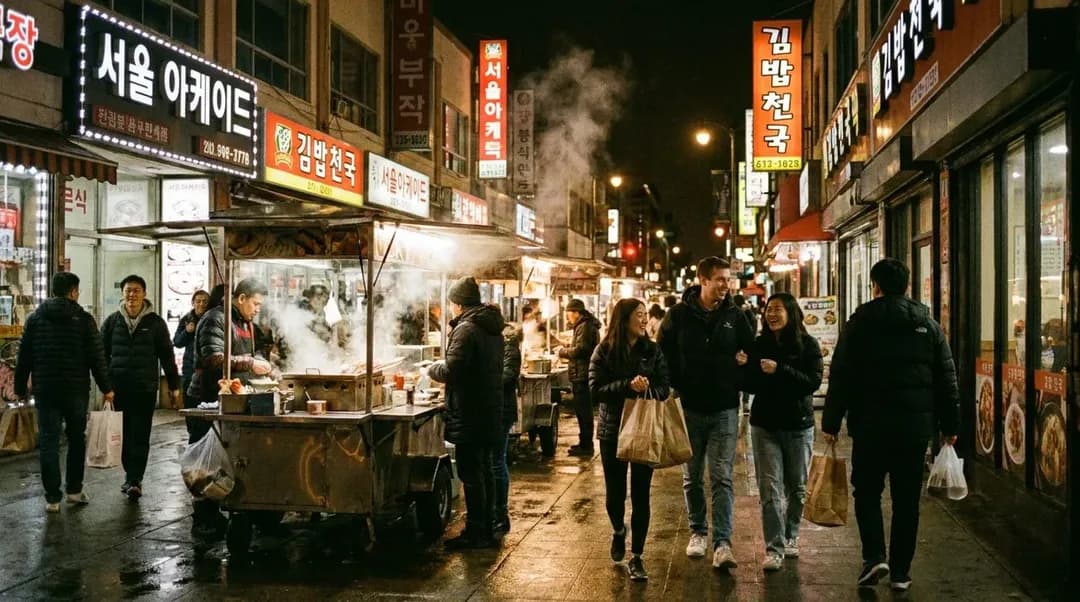
What makes Manhattan's Koreatown unusual — and unusually suited to a World Cup delegation — is its density. You can eat, drink, shop, sing, and return to your hotel without ever walking more than 300 meters. The block operates on Seoul time: lunch crowds peak at 1 p.m., dinner service begins at 6, and the real energy arrives after 10 p.m., when the neon signs along 32nd Street compete for brightness and the smell of grilling meat drifts up through sidewalk grates.
For South Korea's World Cup squad, this is not tourism. This is infrastructure. A single block in Midtown Manhattan that can feed 30 athletes, keep them entertained past midnight, and send them back to their hotel with the taste of home still on their tongues. Son will lead the walk. The rest of the squad will follow. And Koreatown, as it always does, will keep the grills on.
Tags: #WorldCup2026 #SonHeungMin #SouthKorea #Koreatown #Manhattan32ndStreet #KBBQ #JongroBBQ #Baekjeong #BCDTofuHouse #KoreanFood #SojuCulture #HMart #Noraebang
Sources consulted: Son Heung-min · South Korea national football team · Koreatown, Manhattan · FIFA World Cup 2026 · H Mart
Please drink responsibly. You must be 21 or older to purchase or consume alcohol in New York.
All trademarks are the property of their respective owners.
Ask Karpo for more information.
Keep reading
- Haaland Has Seven Goals and Norway Runs Entirely Through Him
 World Cup Trophy Ceremony Timing Medals and Postmatch Celebrations
 Olise and France's Attack: The Semifinal Tactical Question