 Haaland Has Seven Goals and Norway Runs Entirely Through Him
⚽️2026 FIFA WORLD CUP
When Ferrari Luce Meets FIFA: The Design Spectacle NYC Didn't Know It Needed
Ferrari's $640,000 electric sedan and FIFA's citywide visual takeover arrived in the same week. One was designed by Jony Ive. The other was designed by committee. Both are reshaping how New York looks this summer.
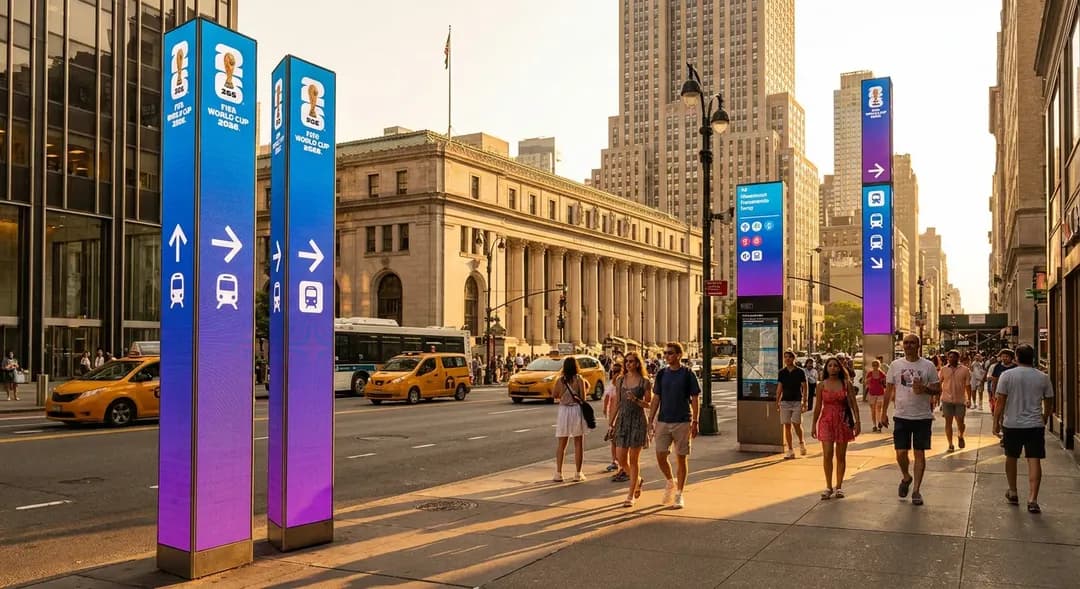
On the same day FIFA's 2026 World Cup transit banners went up along Eighth Avenue, Ferrari debuted the Luce — its first electric vehicle, priced at $640,000, designed by Jony Ive's studio LoveFrom. Neither event has anything to do with the other. But standing on West 34th Street watching city workers bolt FIFA route-finding pylons into the sidewalk while a ferrari luce display rotates on the digital billboard above the Farley Building, the overlap becomes impossible to ignore. New York is being visually redesigned by two forces at once, and neither asked the other's permission.
The FIFA layer: route markers, wraps, and stadium branding
FIFA's visual footprint across Manhattan began appearing in mid-May. The most visible elements are the transit wayfinding pylons — tall, narrow signage columns in FIFA's branded blue and purple, positioned at subway exits and bus stops along the Penn Station-to-Port Authority corridor. They're bilingual (English and Spanish), with QR codes linking to the NJ Transit matchday app. The pylons are functional, not decorative, but they've turned a six-block stretch of midtown into something that looks like it belongs to an international sporting body rather than the City of New York.
The subway itself has undergone a quieter transformation. The 1/2/3 platforms at 34th Street–Penn Station have full-wall wraps promoting the host committee's 'Welcome to NYNJ' campaign. The A/C/E mezzanine at 42nd Street–Port Authority has floor decals directing fans toward the shuttle bus pickup. At Herald Square, a temporary FIFA Fan Festival ticketing kiosk sits in the pedestrian plaza where the holiday market usually goes — a steel-and-glass box that looks permanently installed despite its two-month lifespan.
The Luce layer: automotive design as cultural event
The Ferrari Luce is not a car that disappears into traffic. It's a four-door, five-seat liftback with 1,035 horsepower from four electric motors, a 122-kilowatt-hour battery, and a range of 323 miles. But the specs are almost beside the point. The Luce was designed by Sir Jony Ive and Marc Newson at LoveFrom — the same studio responsible for Apple's most iconic hardware — and its design language is deliberately anti-Ferrari. No aggressive creases. No red-and-black interior theater. Instead: expansive glass, anodized aluminum surfaces, leather that looks more like bookbinding than dashboarding, and physical controls where Tesla would put a touchscreen.
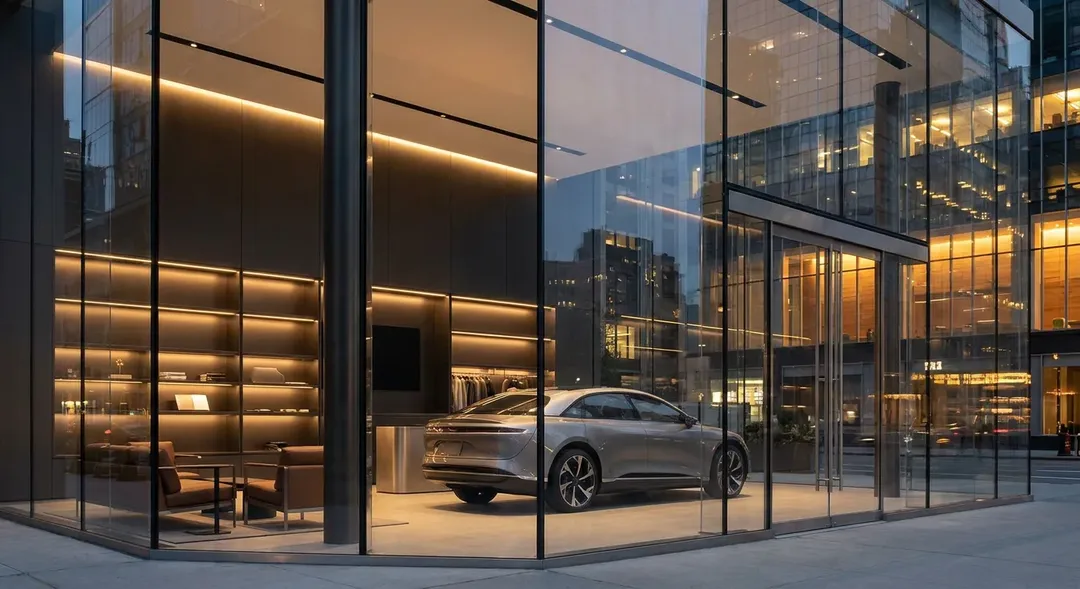
Ferrari chose to reveal the Luce globally on May 26, which means its media saturation coincides exactly with the World Cup's visual buildup. The Hudson Yards experiential space — a temporary pop-up at 20 Hudson Yards, Level 5, open through July — features the Luce in a glass pavilion surrounded by the car's design sketches and material samples. Admission is free but requires a timed reservation through Ferrari's website. On opening day, the reservation system crashed within 40 minutes of going live. The waitlist currently extends into mid-June.
The Luce's interior philosophy is worth noting because it's the inversion of everything FIFA's design approach represents. Where the World Cup's visual identity optimizes for maximum reach and instant recognition — bold colors, large type, QR codes at every touchpoint — the Luce's cabin eliminates screens almost entirely. The dashboard is a single strip of anodized aluminum with physical dials. The center console has three rotary controls and nothing else. Ive reportedly spent eight months on the tactile resistance of the climate knob. In a city saturated with FIFA's digital-first signage, the Luce's analog interior feels less like a car and more like a philosophical position.
Where the two visual systems collide
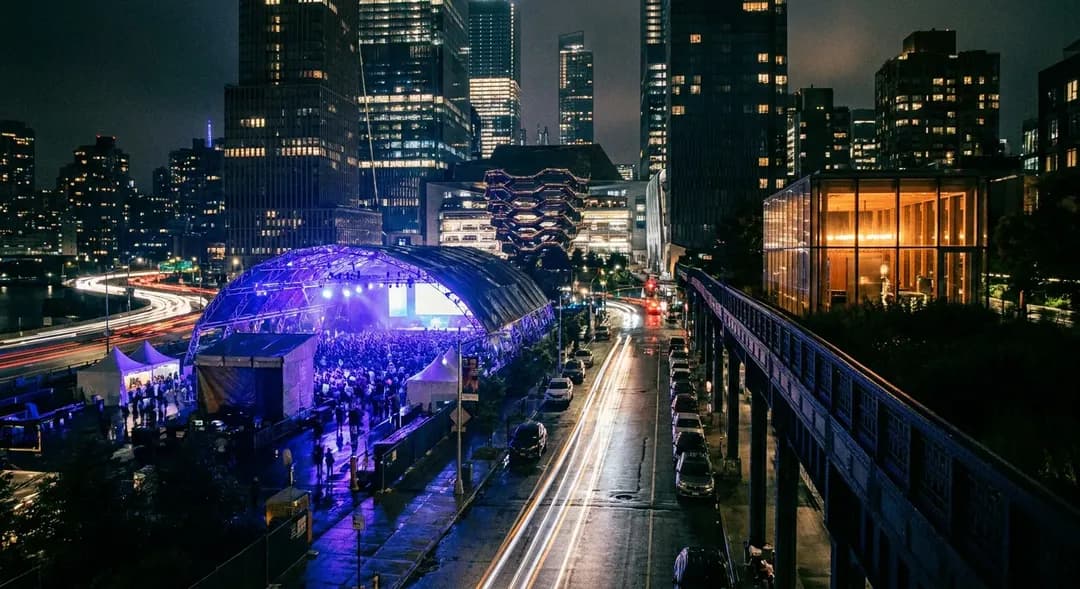
Walk south on Tenth Avenue from the Javits Center and you hit both layers within 300 yards. The FIFA Fan Festival zone occupies the west side of Hudson Boulevard Park with its temporary stage, sponsor pavilions, and a 40-foot LED screen for match simulcasts. Directly east, the Luce pop-up at Hudson Yards is visible through the glass facade, rotating slowly on its display platform. The two experiences share foot traffic but inhabit different design universes: FIFA's branding is bold, saturated, and crowd-scaled; Ferrari's is minimal, quiet, and invitation-only.
The contrast is instructive. FIFA's visual system was designed for legibility at 50 feet by a committee navigating 211 member associations' expectations. The result is effective but generic — the same modular system deployed in every host city, swapping 'NYNJ' for 'Mexico City' or 'Toronto.' The Luce pop-up was designed by a studio that spent three years on the curvature of an aluminum dashboard inlay. It's bespoke, obsessive, and completely indifferent to crowd flow or wayfinding efficiency.
The light installations nobody planned
The most arresting visual collision isn't branded. It's the light. FIFA's LED screens at the Fan Festival zone cast a shifting blue-purple glow across the west side of Hudson Yards after dark. The Luce pop-up runs a timed lighting sequence — warm amber to cool white — that pulses through the glass pavilion every 12 minutes. Neither installation was designed to interact with the other, but from the High Line at 30th Street, the combined effect is a slowly cycling chromatic field that makes the entire district look like it was art-directed.
This is what happens when a city hosts a global event and a global luxury launch simultaneously without coordination: accidental beauty. The FIFA pylons catch the Luce pop-up's amber cycle and glow warm for six minutes before shifting back to their native blue. The Luce's glass walls reflect the Fan Festival's match highlights in real time, turning a $640,000 electric sedan into an unintentional screen. On matchdays, when the Fan Festival crowd swells to capacity and the ambient noise spills across Hudson Boulevard, the Luce pavilion becomes a surreal quiet room — climate-controlled, reservation-only, displaying an object most visitors will never own, soundtracked by muffled goal celebrations from 200 feet away.
What it means for the summer
New York has always been a city where visual systems compete — billboards, construction scaffolding, gallery openings, transit ads, street art — and the result is a kind of designed chaos that residents navigate instinctively. Summer 2026 adds two unusually coherent layers: one global and democratic, one rarefied and by-appointment. The World Cup's visual system will be dismantled by August. The Luce will enter production in Q4 and start appearing on city streets by winter. But for this narrow window — June and July 2026 — both exist in the same ten-block radius, reshaping how a stretch of the far west side looks, feels, and glows after dark.
Neither Ferrari nor FIFA set out to create a design spectacle together. The city did that part on its own.
Tags: #FerrariLuce #FIFAWorldCup #WorldCup2026 #NYCDesign #HudsonYards #JonyIve #LoveFrom #AutomotiveDesign #NYCSummer2026 #ItalianDesign #DesignSpectacle #LuxuryCars #FerrariFanZone #NYCArt #KarposFinds
All trademarks are the property of their respective owners.
Ask Karpo for more information.
Keep reading
- Haaland Has Seven Goals and Norway Runs Entirely Through Him
 World Cup Trophy Ceremony Timing Medals and Postmatch Celebrations
 Olise and France's Attack: The Semifinal Tactical Question