 WORD Bookstore in Greenpoint Remains a Community-Focused Indie Bookstore Near Me
Hidden Gems & Odd Finds
The Speakeasy Under a Working Boxing Gym
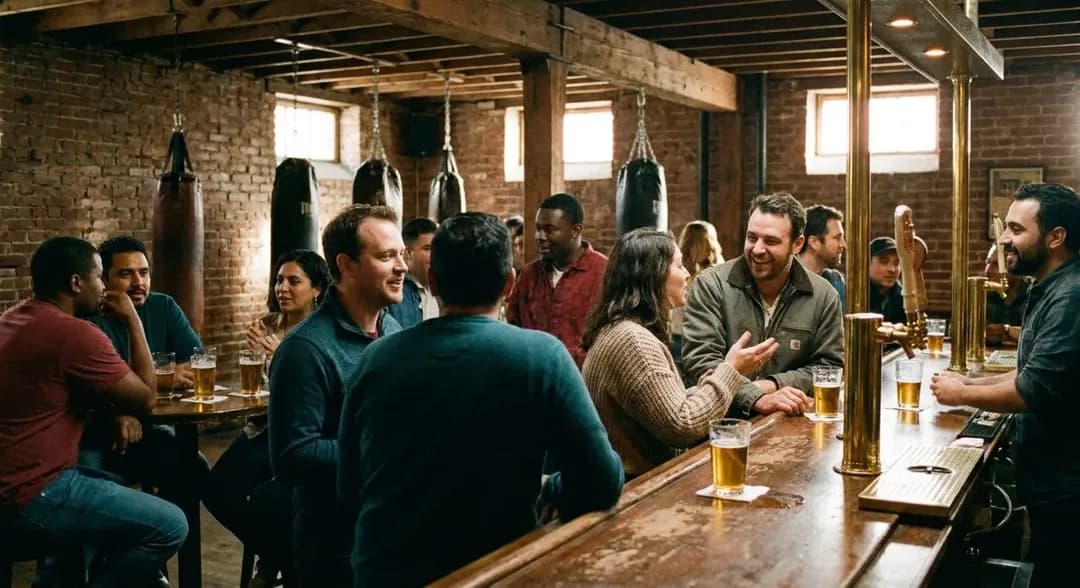
At Gleason's basement bar, the ceiling shakes with every jab. The bourbon list runs deeper than the gym's history, and fighters who win drink on the house.
The entrance ritual
You walk past Gleason's Gym on Front Street in DUMBO, where the plate glass windows reveal a forest of heavy bags and speed bags, all in motion. The entrance to the bar isn't through the gym's front door. You continue around the corner to the loading dock, where a single door marked "Equipment Storage" stands between you and what lies below. Push it open. Descend the metal stairs. At the bottom, a cage door—the kind that usually guards spare gloves and headgear—swings inward. Beyond it, leather booths and low amber light. The ceiling is low enough that you notice it, industrial enough that you hear everything happening above. Every thud of a body hitting canvas, every rhythmic smack of gloves on leather, filters down through the floorboards. The sound becomes the bar's pulse.
The space opened in 2019, though Gleason's itself has occupied this building since 2016, and before that, decades in Manhattan. The bar's owners wanted something that felt like an extension of the gym's ethos: no pretense, no velvet ropes, just a place where effort is respected and victory earns you a drink.
The aesthetic of impact
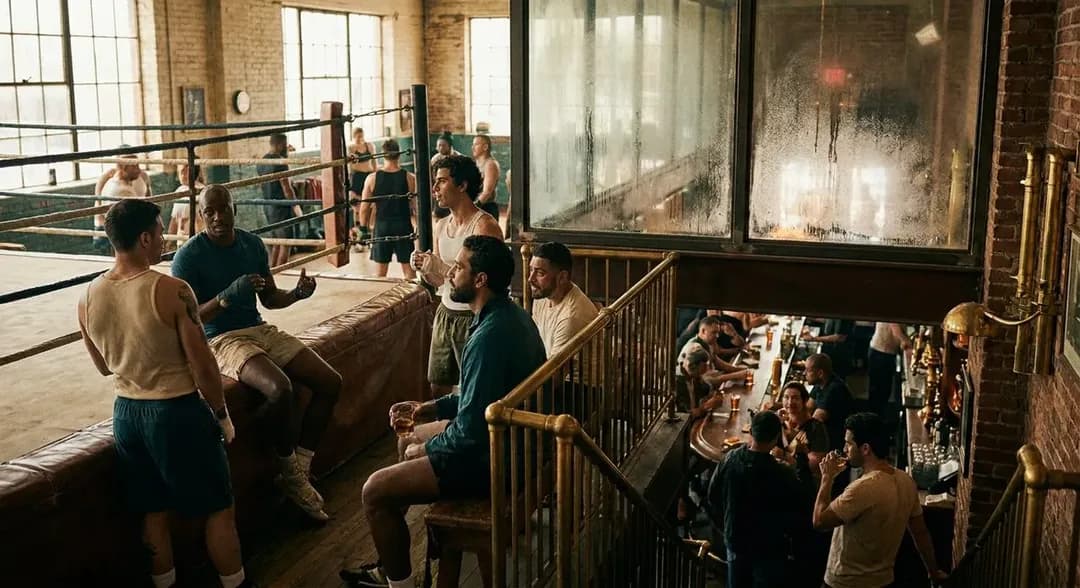
The décor doesn't try to be a museum. It's functional, borrowed. Two heavy bags hang in the back corner, not for show—regulars use them, sometimes mid-drink, sometimes to settle an argument. The bar top is reclaimed wood from the gym's old ring platform, scarred and unvarnished. Stools are mismatched, some with duct tape over split vinyl. Black-and-white prints line the brick walls: not famous fighters, but sparring sessions from the gym above, caught in mid-motion by a photographer who trains there. You see the same faces in the photos when you look around the room.
The lighting comes from old industrial fixtures, the kind with metal cages around the bulbs. It's dim enough to feel private, bright enough to read the drinks menu—a single laminated card that lists twenty whiskeys and ten cocktails. The card is smudged with fingerprints and what might be liniment. No one seems to care.
The house rule
Fighters who win their bouts drink free the night of the fight. It's not advertised. You learn it by watching. A boxer walks in still carrying the adrenaline and the swelling, orders a rye, and the bartender waves away the credit card. Sometimes a small crowd forms, toasting the winner. Sometimes the fighter sits alone, icing a hand, staring at nothing. Both scenes feel equally right here. The bartender—ask for Dmitri on weeknights, Cara on weekends—knows the gym's schedule better than most trainers. They know who fought, who won, who should probably go to urgent care instead of ordering another round.
The policy extends to sparring partners who take a beating for the sake of someone else's training. If a trainer vouches for you, you drink at cost. It's a small economy of respect, measured in bruises and bourbon.
The cocktail list and its logic
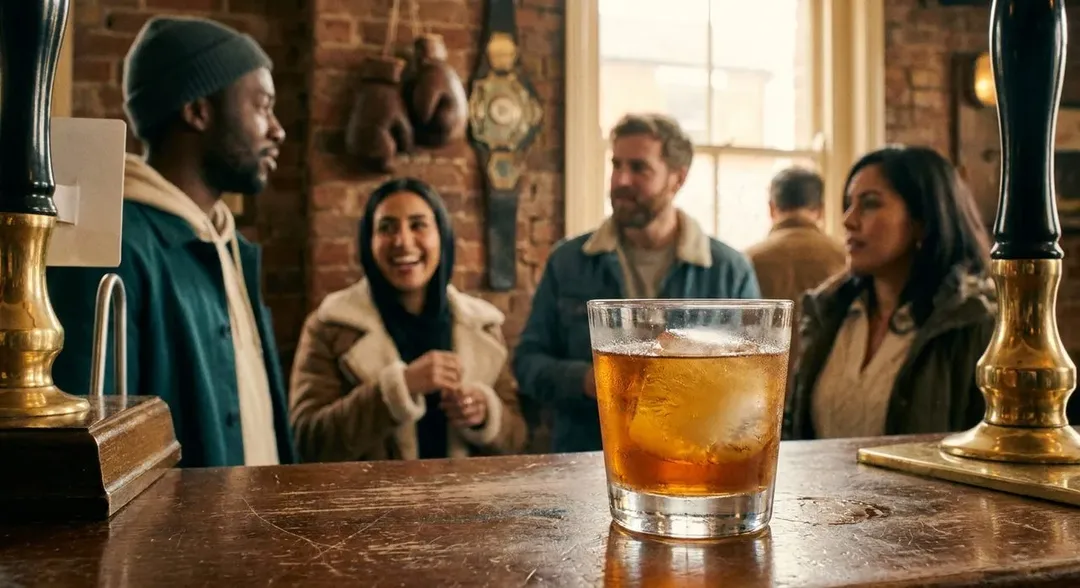
The menu leans into brown spirits and bitter profiles. The signature drink, called "The Standing Eight," combines rye, Averna, and a dash of mole bitters. It tastes like leather smells—earthy, worn-in, slightly sweet. The "Cutman" is gin, Campari, and grapefruit, served over a single large cube. It's the only drink on the menu that feels refreshing, which is probably why no one orders it in winter.
The whiskey selection focuses on bottles between forty and eighty dollars—nothing so precious you'd hesitate to order it after a long day, nothing so cheap it tastes like regret. The bartenders will build you an old-fashioned with your choice of base and bitters. Specify "gym style" and they'll add a splash of cold brew, a trick Dmitri learned from a trainer who swore it helped with focus. It doesn't, but it tastes better than it should.
Beer comes in cans, not craft, not imported. Budweiser, Tecate, Miller High Life. You drink it from the can.
The crowd and its rhythms
Early evening, before seven, you'll find trainers and corner men, still in their gym clothes, debriefing the day. They talk strategy and conditioning, voices low, hands miming combinations in the air. After eight, the crowd shifts. People from the neighborhood, some who box recreationally, some who just like the atmosphere. You'll see finance types in loosened ties sitting next to someone in hand wraps and slides. The gym's proximity enforces a kind of egalitarianism—everyone here has either been hit or thought seriously about learning how.
Late night, past eleven, it gets quieter. The gym above closes at ten, so the ceiling stops shaking. The bar stays open until two on weekends, midnight on weeknights. The last-call crowd tends toward solo drinkers, reading or sketching or just watching the room. There's a regular who sits in booth four every Thursday, working through a bottle of Jameson over five hours, writing in a notebook. No one bothers him. His name is printed on a reserved placard that appeared one day and never left.
The unspoken etiquette
You don't talk about your office job unless someone asks directly. You don't use your phone for calls—texts only, screen dimmed. If someone's sitting alone and looks like they want to stay that way, you let them. If a fighter walks in, you make space at the bar. Tipping is expected, generous tipping is noticed. Dmitri keeps a mental list of good tippers and bad ones. Good tippers get poured with a heavier hand.
The bathroom is down a narrow hallway, past a storage area where you can see stacks of gloves and rolls of hand tape. The mirror is cracked in one corner. Someone wrote "Stay hungry" in Sharpie on the wall. It's been there since the bar opened.
Practical notes
The bar operates at 77 Front Street, basement level, accessible via the side entrance near the loading dock. Open Tuesday through Saturday, 5 p.m. to midnight (2 a.m. Fridays and Saturdays). Closed Sunday and Monday. No reservations, no cover charge. Cocktails run twelve to sixteen dollars, whiskey pours eight to twenty depending on selection. Cash and card accepted, though the card reader sometimes acts up—bring cash as backup. Nearest subway is York Street (F train), three blocks west. The High Street stop (A/C) is a seven-minute walk. Street parking is scarce; the dock parking lot meters run until 10 p.m.
Dress code is nonexistent, but you'll feel out of place in anything too polished. The space is not wheelchair accessible due to the stairs. No food menu, though the bartenders keep a list of nearby delivery spots that deliver to the bar. The crowd skews late twenties to mid-forties. It's loud when the gym is active overhead, quieter after ten.
Tags: #NYCNightlife #DUMBOBars #SpeakeasyNYC #BoxingCulture #GleasonGym #BrooklynBars #HiddenBarsNYC #WhiskeyBar #TheOddEdit #NYCInsider #UndergroundBar #AuthenticNYC #FrontStreetDUMBO #NYCCocktails #LocalsOnly
Sources consulted: Atlas Obscura · The Infatuation · Time Out New York
Please drink responsibly. Must be of legal drinking age.
All trademarks are the property of their respective owners.
Ask Karpo for more information.
Keep reading
- WORD Bookstore in Greenpoint Remains a Community-Focused Indie Bookstore Near Me
 The Corner Bookstore on Madison Avenue Is Carnegie Hill's Indie Bookstore Near Me
 192 Books in Chelsea Brings Art and Fiction to Indie Bookstore Near Me