 Brickell Tailor Alteration Shop Finder: First Work Suit Fit
Neighborhood Guides

Miami Transit Station Pitstop Finder: 15-Minute Lunch Plan
Plan a Government Center lunch pause in Miami around your onward transit connection, a portable meal, and a fifteen-minute allowance you set yourself.
A lunch stop at Government Center begins with a decision about your next ride. You might be arriving on Metrorail and continuing on Metromover, or finishing the rail journey and heading to an office. Those plans leave different amounts of room for food. Use the Karpo APP to describe the connection you are making, what you can carry, and a personal fifteen-minute lunch allowance. Ask for suggestions that respect those conditions, with the transit connection remaining the fixed part of the trip.
Name the journey after lunch
Government Center appears as a connection between Metrorail and Metromover on Miami-Dade's official transit map. That makes it a useful place to anchor the request. It does not make every nearby lunch counter part of the interchange. Keep a purchase outside the station, movement between transit systems, and the final ride as separate pieces of your plan. A suggestion across the street still needs an outward walk and a return route.
Write down the destination you are trying to reach after eating. An office address is more informative than “downtown,” and the next transit stop is more informative than “the mover.” If you are continuing on foot, food along that direction may be preferable to food that sends you back toward the platform. If another person is meeting you after the ride, include that commitment in the request. The lunch decision should support that appointment rather than quietly moving it.
Treat fifteen minutes as your limit
A fifteen-minute window is a budget you choose. It is not a measured journey time, a prediction of a queue, or a promise that a meal will be ready. Decide which activities belong inside it before looking at food. Street crossings, ordering, receiving the bag, and returning to the correct boarding area all count if they are part of your detour. Do not spend the entire allowance on the eating portion and leave the movement unaccounted for.
For a sample calculation, you could reserve five minutes for movement, five for the purchase, and five for getting settled and keeping some margin. These are hypothetical allocations. Your actual position, walking pace, and onward commitment may call for something smaller. If movement takes most of the allowance, ask about a stop near your final destination instead. That is a change in where lunch happens, and it can preserve the connection that matters more.
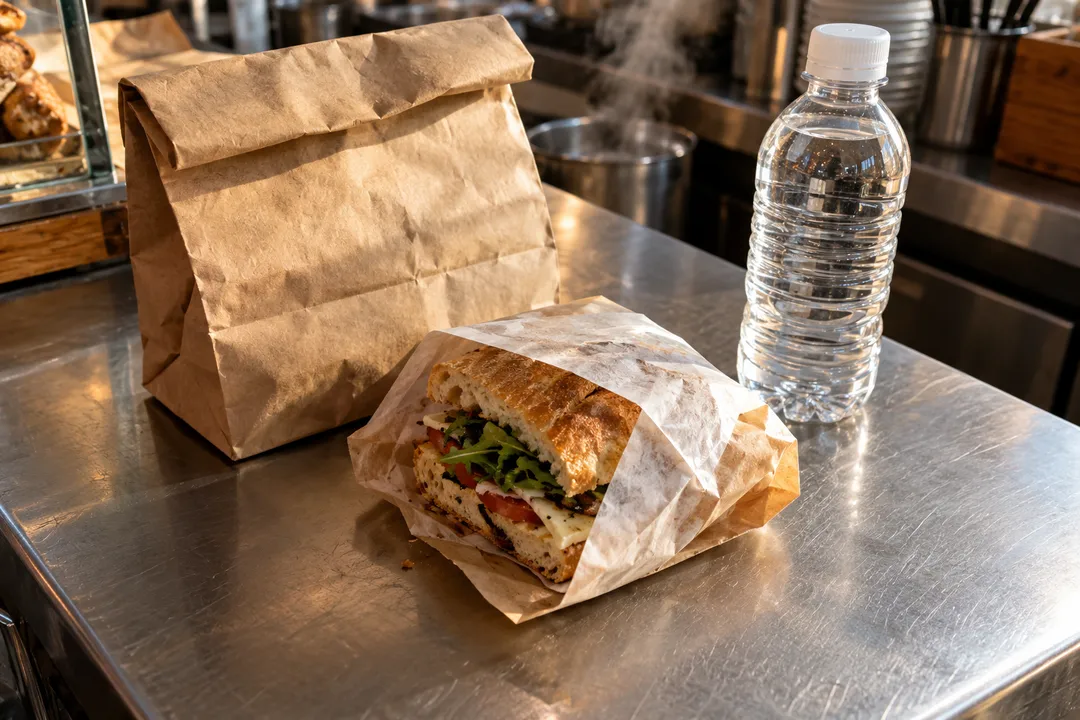
AI-generated downtown transit and packed-lunch illustrations; no particular counter, station route, available meal, or queue is documented.
Make the meal fit the bag
For this particular transfer, packaging is a useful first filter. A wrapped sandwich and a tightly closed container create fewer carrying decisions than a tray, an uncovered drink, and several loose sides. Tell Karpo how many hands you have free and whether you are managing a work bag or luggage. You are describing the kind of recommendation that would help, without assuming that any vendor has a particular package in stock.
A dietary restriction deserves equally clear wording. State the ingredient you need to avoid and whether a possible substitute is acceptable. Keep that requirement ahead of a general wish for variety. If the food you encounter does not meet it, the practical alternative can be postponing the purchase until the destination. A short transfer is a poor time to turn an uncertain ingredient question into a complicated order involving several counters.
Ask for a compact comparison
A useful opening message might read: “I am transferring at Government Center in Miami and want lunch before continuing to my next stop. I have set aside fifteen minutes for the whole detour. Suggest one simple takeaway possibility in my direction and a destination-side alternative. I need a meal I can carry in one bag, and I prefer fewer crossings.” Add the actual next stop and any dietary condition before sending the message.
The next question should narrow the choice. Ask which suggestion adds less movement relative to your onward journey, and which is better suited to carrying until arrival. If the response describes a long seated meal, explain that you need a brief pickup. If it lists several places on opposite sides of downtown, reduce the search to one direction. Conversational refinement is useful here because the constraint is personal, and the answer changes when your destination changes.
Leave the concourse without losing the connection
Before stepping away from transit, decide where the group will reunite and who is responsible for keeping the onward destination clear. Sending two people toward different counters can produce two separate waits and an awkward reunion. One buyer and one agreed meeting point may be easier when traveling together. Avoid describing an unspecified “station entrance” as the meeting place if your group has already used different levels or approaches.
The county transit map can establish the systems that connect, while operator information belongs with the actual ride. A lunch recommendation does not establish the condition of a lift or escalator, and a shaded photograph cannot establish an accessible path. If step-free movement is essential, include it as a requirement in your request and retain the operator's access information separately. Do not let an appealing meal suggestion become a reason to choose an unsuitable station approach.
Give the detour an ending
Choose a visible stopping rule before starting the purchase. You might decide that an unexpectedly long line ends the search, or that reaching the edge of your chosen block without finding a suitable counter means continuing the journey. These are rules you can apply yourself. They prevent a modest lunch stop from becoming a second search that consumes the same allowance all over again.
Once you have the bag, put payment items away and settle the packaging before returning to the boarding area. Leave eating for a place where you can manage it comfortably and follow the transit operator's rules. The purchase is only one part of the stop. Recovering your route, organizing your belongings, and orienting toward the next ride are part of the same small task, even when none of them appears in a menu description.
Keep lunch useful when the plan changes
If the connection becomes your immediate priority, send a short update in the Karpo APP: “Move lunch to my arrival area and keep the same food requirements.” Include the destination again so the new request has a clear anchor. There is no need to preserve the Government Center detour after it stops serving the journey. A useful lunch plan can finish with a later purchase and an easier transfer.
For the next trip, keep a reusable brief with the starting system, onward stop, carrying needs, and the allowance you personally choose. Change those details as the journey changes. You are asking for help arranging a decision, while ordering food, making payments, and boarding remain your own actions. The useful result is a compact choice you understand: pick up along the connection, buy after arrival, or carry lunch from the start.
Ask Karpo for more information.
Keep reading
- Brickell Tailor Alteration Shop Finder: First Work Suit Fit
 Coconut Grove Tailor Alteration Shop Finder: Heat-Proof Fits
 Little Havana Tailor Alteration Shop Finder: Guayabera Fits