 Brickell Tailor Alteration Shop Finder: First Work Suit Fit
Neighborhood Guides
Coral Gables Neighborhood Historical Walking Tour Route
Explore Coral Gables on foot from Merrick House to the Venetian Pool, De Soto Fountain, Biltmore Hotel and City Hall, with plaza stops and a shorter route.
Coral Gables is one of the few places in the United States where an entire 1920s city plan can still be walked almost intact. Developer George Merrick laid it out on his family's citrus and avocado land, sold lots in a feverish land boom and saw it incorporated as a city in 1925. This neighborhood historical walking tour follows the plan rather than the shops, linking a family farmhouse, a quarry turned pool, grand fountains and a hotel tower over roughly four miles of shaded streets.
Merrick House and the Name
Start where the story starts, at Merrick House on Coral Way. George Merrick's father, a Congregational minister, moved the family here from New England at the end of the 1890s to farm. They built a house of local oolite with a gabled roof, and that coral rock home gave the future city its name. The house is run by the city as a museum, so check the city website for tour days if you want to see inside. From the garden you can still picture the groves that covered this ground.
Look along Coral Way itself. The wide road with its tree-shaded median was one of the original axes of Merrick's plan, and its gentle curve was intended to slow traffic and show off the homes behind it.
Merrick was not only a developer but also a published poet, and his sales campaigns leaned heavily on romance. Buses brought prospective buyers down from northern cities, bands played on the lots, and brochures promised a dream city in the tropics. Keep that marketing in mind as you walk, because much of what looks like old Spain was designed in the early 1920s to sell land.
The Quarry That Became the Venetian Pool
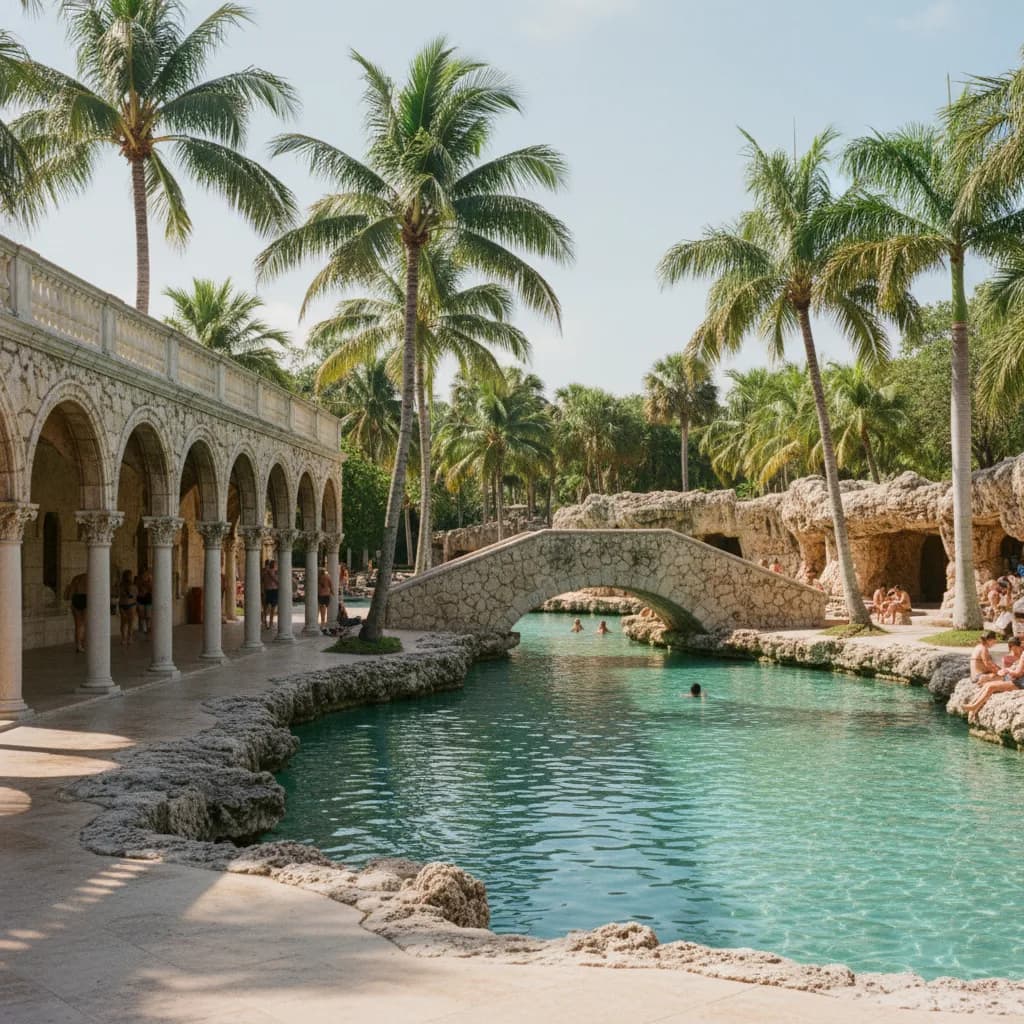
Walk to the Venetian Pool on De Soto Boulevard. When Merrick needed coral rock to build his new city, workers quarried it from this spot. Rather than leave a scar, he and his designers turned the pit into a lagoon pool, opened in 1924, with loggias, a stone bridge, caves and a small waterfall. It is listed on the National Register of Historic Places and still fills with water from the aquifer below.
Even if you do not plan to swim, view it from the entrance area, then walk the fence line to see how the old quarry walls frame the water. Swimming requires a timed entry, and opening seasons and residency rules change, so look at the official city page first.
Fountains, Plazas and Grand Entrances
From the pool, walk south to the De Soto Fountain, a 1925 plaza fountain set in a traffic circle and designed to look like an old-world square. Merrick and his team placed fountains, plazas and monumental entrances at key junctions across the city to signal that you had arrived somewhere planned. The Granada Entrance and the Douglas Entrance on the northern edge are the largest, and they are worth a separate drive or bike ride.
Notice the street names as you go. Avenida, Calle and place names from Spain and Italy were chosen to match the Mediterranean Revival style, which Merrick imposed through strict design rules. Barrel tile roofs, stucco walls and arched windows were required for most early houses. Those rules still shape what owners may build today.
The Biltmore and Its Giralda Tower
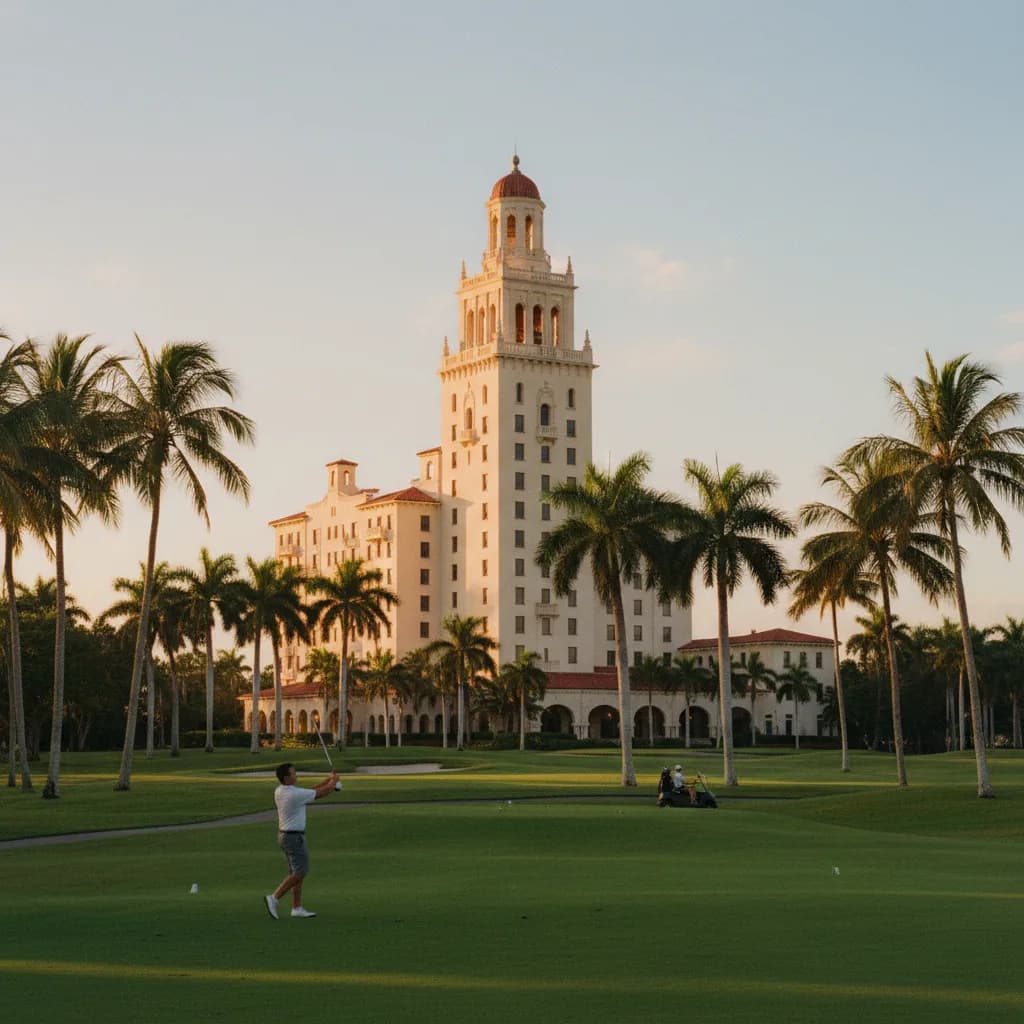
Continue to the Biltmore Hotel, which opened in 1926 at the peak of the boom. Its central tower was modeled on the Giralda bell tower of Seville Cathedral, and it is visible across much of the city. During the Second World War the building was converted into an army hospital and later served veterans for years before it was restored as a hotel. It is now a National Historic Landmark.
Across the road, the Coral Gables Congregational Church, built in 1924 on land donated by Merrick in honor of his father, is one of the city's earliest churches. Its bell tower and Spanish Colonial details echo the hotel. Walk the public grounds and the sidewalks around the golf course for the best views of the tower in late afternoon light.
The hotel and the church sit at the edge of the residential grid, and the streets between them are a good place to study the houses up close. Look for chimneys, wrought iron balconies and small courtyards visible behind gates. Many homes from the boom years were built by the same group of architects working under Merrick, so you will start to recognize repeating details such as rounded doorways and thick window surrounds. Photograph them from the sidewalk only, since nearly all are private homes.
A Detour to the Water Tower and Villages
If you have energy, head north to the Alhambra Water Tower, a 1931 structure disguised as a Mediterranean lighthouse at Alhambra Circle and Greenway Drive. It shows how even utility buildings were dressed up to fit the plan. Further south, small themed residential enclaves from the late 1920s, including Chinese, French Normandy and Dutch South African styles, show the city experimenting before the 1926 hurricane and the bust slowed everything down.
The plan also reserved land for a university. Merrick donated acreage south of the Biltmore toward the founding of the University of Miami, chartered in 1925, though the hurricane and the collapse of the boom delayed its campus for years. Seeing the gap between the original ambition and what was actually finished is part of understanding the city.
City Hall and the Miracle Mile
Finish at Coral Gables City Hall, completed in 1928 at the head of the Miracle Mile. Its semicircular facade and clock tower anchor the commercial heart of the city. The nearby Coral Gables Museum occupies the 1939 former police and fire station, a later stone building with sculpted firefighter figures that shows how the style evolved into the Depression years. Walk the Miracle Mile to see later storefronts layered over the original plan.
Pacing, Heat and the Short Route
The full loop is long, so treat it as half a day with breaks. Morning and late afternoon are cooler, and shade is good on the residential streets but thin on the plazas. For a ninety-minute version, do Merrick House, the Venetian Pool, De Soto Fountain and the Biltmore, then save City Hall for another visit. The free city trolley can help on the commercial corridor. Use Karpo APP to arrange the stops around your starting point and how far you want to walk.
Ask Karpo for more information.
Keep reading
- Brickell Tailor Alteration Shop Finder: First Work Suit Fit
 Coconut Grove Tailor Alteration Shop Finder: Heat-Proof Fits
 Little Havana Tailor Alteration Shop Finder: Guayabera Fits