 Brickell Tailor Alteration Shop Finder: First Work Suit Fit
Neighborhood Guides
Coconut Grove Neighborhood Historical Walking Tour, Miami
A self-guided Coconut Grove walk past the Barnacle, Peacock Park, Dinner Key, Charles Avenue and Plymouth Church, with timing tips and a shorter loop option.
Coconut Grove was a settled bayfront village years before the city of Miami was incorporated in 1896, and much of that early story can still be read from the sidewalk. Two communities built it side by side: New England and Midwestern sailors and naturalists along the bay, and Bahamian workers and builders on the ridge to the west. This neighborhood historical walking tour links both, plus the seaplane era at Dinner Key, in a loop of roughly three miles on public streets and parks.
Begin at Peacock Park and the First Hotel
Start at Peacock Park, the open green that slopes down to Biscayne Bay at the end of McFarlane Road. It takes its name from Charles and Isabella Peacock, English settlers who opened the Bay View House here in 1882. Later known as the Peacock Inn, it is often described as the first hotel on the South Florida mainland, and it drew yachtsmen, writers and winter visitors at a time when the only practical way in was by boat.
Nothing of the inn remains, but the shape of the shoreline helps. Face the water and you are looking at the same harbor that made the Grove possible. The Peacocks hired many of their staff from the Bahamas, and those workers and their families became the core of the West Grove community you will visit later on this route.
The Barnacle and Commodore Munroe
Walk south along Main Highway to the Barnacle Historic State Park. The house at its center was built in 1891 by Ralph Middleton Munroe, a yacht designer and photographer who helped found the Biscayne Bay Yacht Club in 1887. It is widely cited as the oldest house in Miami-Dade County still standing on its original site. Munroe raised it on posts and designed it to catch the bay breeze, a practical answer to heat that predates air conditioning by decades.
The grounds keep a stretch of hardwood hammock between the road and the lawn, so even the walk in from the gate feels like a step back. Check the Florida State Parks page for current hours, fees and house tour times before you go, since they are set by the park. Commodore Plaza and the Commodore Trail nearby both borrow Munroe's old yacht club title.
Main Highway Under the Banyans
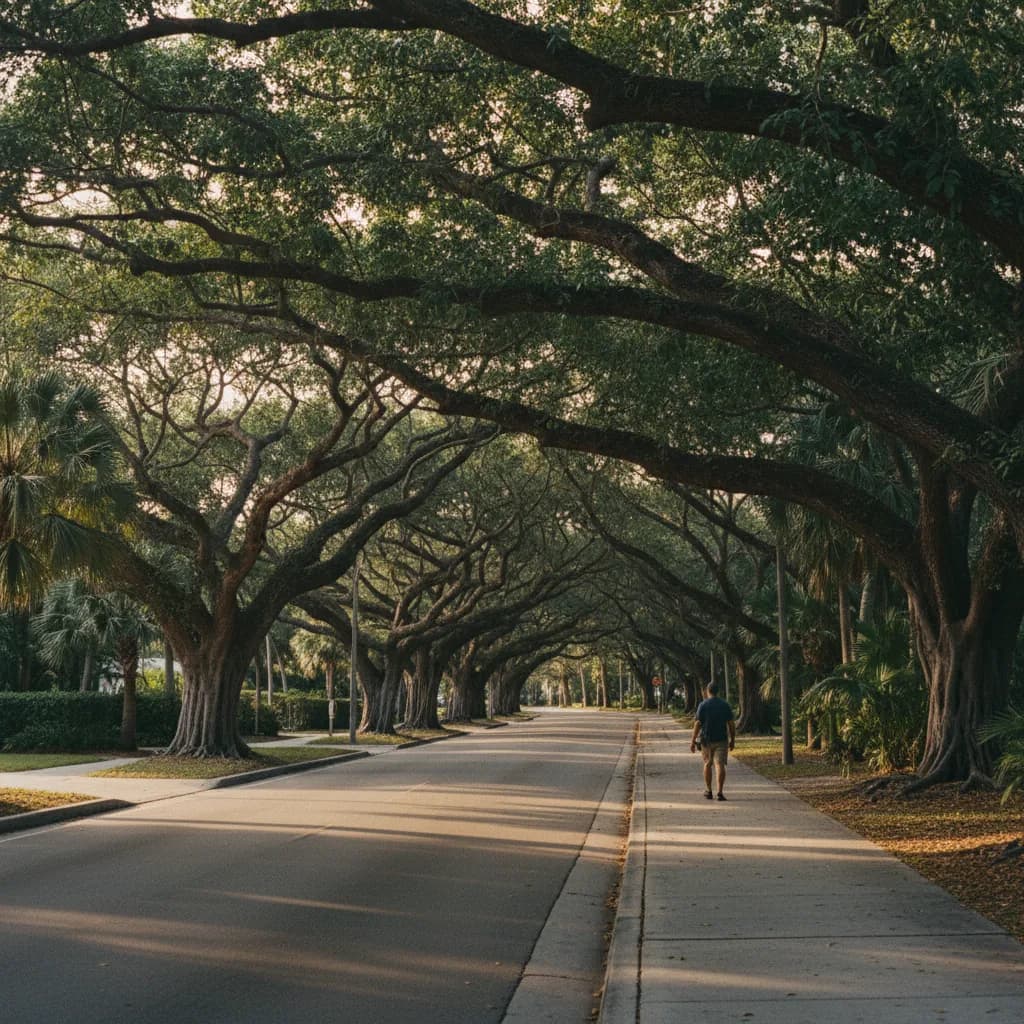
Continue along Main Highway. Look above you rather than at the shop windows. The banyans, live oaks and gumbo limbos here form one of the most photographed canopies in Miami, and many residents have fought to keep the road narrow because of it. Notice how some walls and garden borders are built from oolite, the local coral rock that early builders quarried right from the ridge.
Pause near the corner of Charles Avenue to see the Coconut Grove Playhouse. It opened in 1927 as a movie theater and later became a live stage, famous for hosting the American premiere of Waiting for Godot in 1956. It has been closed since 2006, and plans for its future have been argued over for years. Treat it as an exterior stop and look at the Mediterranean details from the sidewalk.
Charles Avenue and the Bahamian Grove
Turn west onto Charles Avenue, the spine of the historic Black community. Bahamian settlers built here from the 1880s onward, and their wood frame houses with steep roofs and deep porches were designed for hurricanes and heat. The E.W.F. Stirrup House, built in the 1890s by Ebenezer Stirrup, a Bahamian carpenter who went on to build and rent dozens of homes, is one of the key surviving examples.
Farther along you reach the historic Coconut Grove Cemetery, the resting place of many founding Bahamian families. Walk quietly and keep to the street side. This short stretch is the part of the Grove most easily missed by visitors, yet it explains who did much of the physical work of building the village. If you visit in early summer, you may also catch the Goombay festival tradition that celebrates this heritage.
A Coral Rock Church on Devon Road
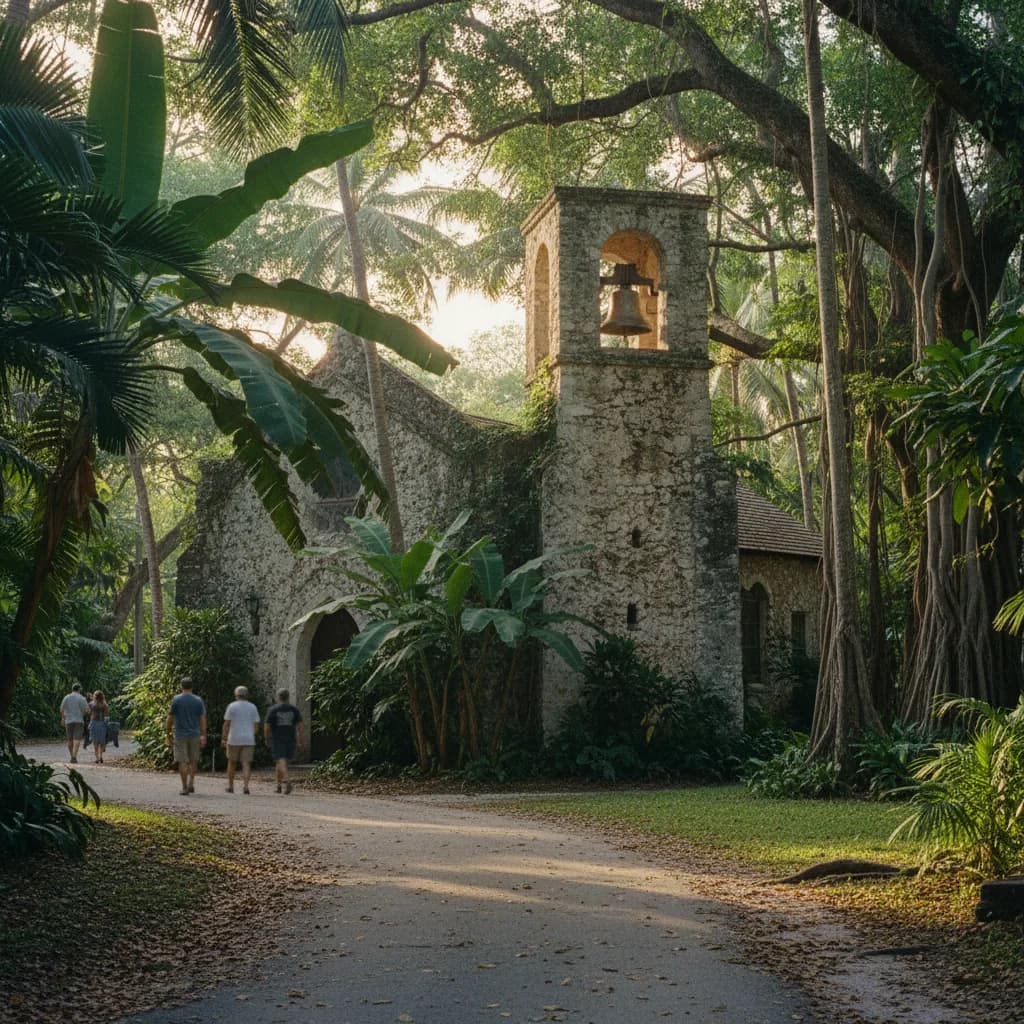
Head north and east into the leafy lanes to find Plymouth Congregational Church on Devon Road. Completed in 1917, the Mission-style church was built from coral rock, largely by the hand of a single Spanish stonemason, Felix Rehbolz. Its bell tower, heavy wooden door and rough stone walls look far older than they are. The grounds also hold a small wooden schoolhouse from the 1880s that is often called the first in Dade County.
If you want one more botanical detour, the Kampong on Douglas Road was the home of plant explorer David Fairchild, who introduced many of the tropical fruits and trees now common across South Florida. It belongs to the National Tropical Botanical Garden and opens only for scheduled visits, so look up the current arrangements on its website rather than turning up at the gate.
Finish at Dinner Key
End the loop by walking back toward the bay at Dinner Key. In the 1930s Pan American Airways ran flying boat services to Latin America from here, and its 1934 terminal building now serves as Miami City Hall. Stand on the waterfront and picture the big Clippers taxiing across the same water that the Peacocks once watched for supply boats.
On the way, the marinas and mooring fields around Dinner Key are a reminder that the Grove has always been a boating town first. Sailors anchored here long before the roads were paved, and many residents still live aboard. Look for the small public piers, where you can watch the tide come in over the grass flats and see how low and open the original shoreline must have felt.
Timing, Shade and a Shorter Loop
Start early. The Grove is shadier than most of Miami, but the bayfront stretches are exposed by late morning. Wear shoes that handle uneven sidewalks, as tree roots have lifted many slabs. For a ninety-minute version, combine Peacock Park, the Barnacle, Main Highway and the Playhouse, then save Charles Avenue and Devon Road for a second visit. Open Karpo APP to sequence the stops around your start point and pace, and to keep a note of which sites you want to see inside on another day.
Ask Karpo for more information.
Keep reading
- Brickell Tailor Alteration Shop Finder: First Work Suit Fit
 Coconut Grove Tailor Alteration Shop Finder: Heat-Proof Fits
 Little Havana Tailor Alteration Shop Finder: Guayabera Fits