 Brickell Tailor Alteration Shop Finder: First Work Suit Fit
Neighborhood Guides
Miami Neighborhood Audio Walk: Free Coral Gables Loop
Take this self-guided Coral Gables neighborhood audio walk to explore Mediterranean Revival plazas, historic coral rock landmarks, and leafy banyan avenues.
Commencing your Coral Gables neighborhood audio walk at the intersection of Biltmore Way and LeJeune Road introduces you to one of the nation's earliest and most meticulously planned garden communities. Conceived in the early 1920s by visionary developer George Edgar Merrick and officially incorporated in 1925, Coral Gables was envisioned as an American Mediterranean city, borrowing romantic design elements from Spanish plazas, Italian palazzos, and Moorish courtyard gardens. As you place your earbuds in and set out down wide, tree-canopied boulevards, the ambient soundscape blends cascading plaza fountains with the rustle of weeping banyans, creating an unhurried atmosphere of classical architectural elegance.
Civic Splendor at Coral Gables City Hall
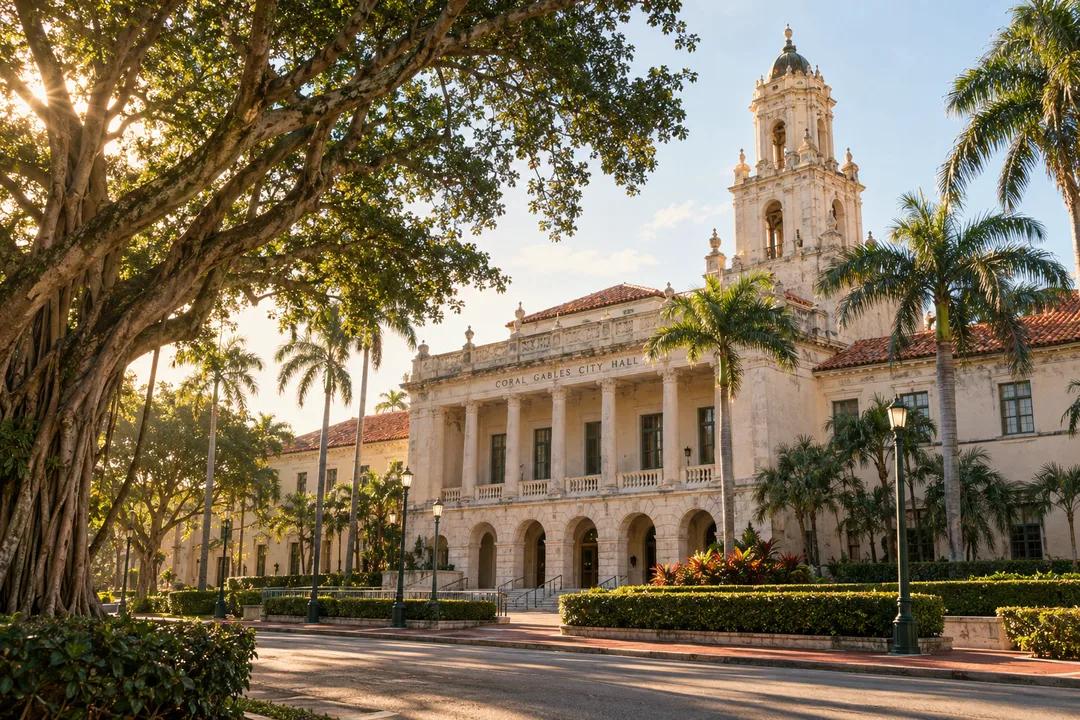
Your audio route begins by approaching Coral Gables City Hall, located at 405 Biltmore Way, completed in 1928 under the direction of master architect Phineas Paist and artistic advisor Denman Fink. Rising three stories above a broad travertine stairway, this monumental Mediterranean Revival civic landmark is crowned by an ornate three-tiered clock tower modeled after the iconic Giralda tower in Seville, Spain. Standing before its fluted Corinthian colonnade, notice how native oolitic limestone and warm stucco walls are embellished with hand-wrought iron railings and cast-stone classical crests.
Step briefly into the semi-circular interior rotunda to view the magnificent ceiling fresco murals painted by Denman Fink, depicting the Four Elements—Earth, Wind, Fire, and Water—alongside allegorical representations of Florida's agricultural and maritime riches. Listed on the National Register of Historic Places, City Hall anchors the ceremonial spine of the city, gazing down the grand vista of Coral Way toward the western residential districts.
Pioneer Heritage at the Coral Gables Merrick House
Continuing westward along the tree-shaded sidewalk of Coral Way leads you to the Coral Gables Merrick House at 907 Coral Way. Built between 1899 and 1906 by the Reverend Solomon Greasley Merrick and his family, this historic homestead was constructed from rough-hewn coral rock quarried directly from the surrounding citrus groves. The home's deep wraparound verandahs, gabled wooden dormers, and thick limestone walls showcase the transition from late nineteenth-century Florida pioneer vernacular to the formal Mediterranean Revival style that defined George Merrick's grand urban master plan.
Strolling through the surrounding heritage gardens, which feature heirloom citrus trees, silver buttonwoods, and flowering bougainvillea vines, your audio commentary details young George Merrick's poetic ambitions and his collaboration with landscape architects Frank Button and William Lyman Phillips. Merrick's vision integrated strict architectural zoning, ensuring that all public buildings and residences adhered to harmonious Mediterranean proportions, color palettes, and terracotta rooflines.
Subtropical Paradise at the Historic Venetian Pool
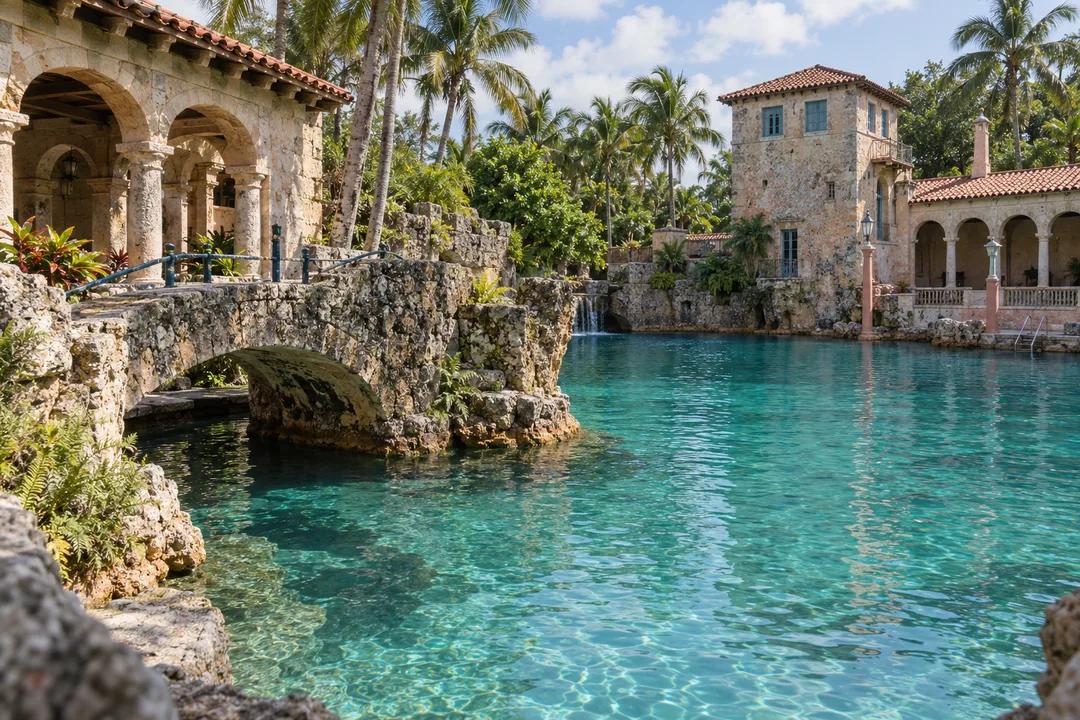
Your audio walk circles south along Toledo Street toward the world-famous Venetian Pool, situated at 2701 de Soto Blvd. Created in 1924 out of an 820,000-gallon abandoned coral rock quarry, this one-of-a-kind aquatic landmark was designed by Phineas Paist and Denman Fink as an enchanting Venetian lagoon. The pool features picturesque stone footbridges, Italianate loggias, observation towers, and natural coral rock grottos carved directly into the exposed limestone quarry walls.
Fed continuously by natural subterranean artesian springs that pump fresh, cool groundwater into the basin daily, the Venetian Pool served as a glamorous social gathering place during the 1920s land boom, hosting beauty pageants, theatrical aquatic galas, and orchestral performances where the basin was periodically drained to create a dance floor. Standing beneath the swaying royal palms outside the coral entrance arches, your audio guide paints a vivid picture of Jazz Age South Florida leisure. Just southwest of the pool across Anastasia Avenue lies the historic Biltmore Hotel at 1200 Anastasia Ave, designed by Schultze and Weaver in 1926, whose towering three-hundred-foot Giralda spire provides a majestic visual beacon across the tree canopy.
Strolling Miracle Mile and Historic Commercial Plazas
Heading northeast toward the city's commercial district brings you onto Miracle Mile along Coral Way, famously conceived in 1946 by retail developer George Zain as a luxury pedestrian promenade. Among its most prominent architectural anchors is the historic Colonnade Building at 169 Miracle Mile, designed by Phineas Paist and completed in 1926 as George Merrick's primary land sales headquarters. The building showcases grand neo-classical arches, towering Roman columns, and classical urns carved from native Florida limestone.
Miracle Mile's wide, landscaped sidewalks are lined with bridal boutiques, independent art galleries, bookshops, and European sidewalk bistros. As you walk beneath the shade trees, the audio guide highlights discreet architectural details along upper building facades, where decorative escutcheons, glazed ceramic tile inserts, and ornamental wrought-iron balconies reflect early twentieth-century Spanish Renaissance revival influences.
Shaded Canopy Pacing and Best Walking Windows
Because Coral Gables was designed as a walking community, broad pedestrian avenues like Coral Way and Biltmore Way are completely sheltered by mature weeping banyan trees whose aerial roots hang in dramatic, living curtains over the roadway. The optimal time for undertaking this audio walk is morning hours from 8:00 am to 10:45 am, when cross-breezes keep temperatures mild and early sunlight illuminates the pale coral stonework and vibrant bougainvillea blossoms.
Take a restful break at one of the European-style outdoor cafes or espresso bars along Aragon Avenue near the Coral Gables Museum at 285 Aragon Ave. Enjoy an iced cortado or sparkling water while listening to the audio guide describe the Mediterranean public fountains, including the historic DeSoto Fountain and Granada Entrance plaza that guard the city's historic boundary gateways.
Transit Connections and Route Accessibility Guidance
Visiting Coral Gables by public transit is seamless via the Miami Metrorail system. Disembark at the Douglas Road Station at 3100 SW 37th Ave, where you can board the complimentary, air-conditioned Coral Gables Trolley. The trolley runs frequent service directly up Ponce de Leon Boulevard, depositing passengers at Miracle Mile and City Hall within minutes. Free parking garages are also conveniently located along Andalusia Avenue for those arriving by personal vehicle.
Karpo APP provides curated self-guided walking route maps and architectural landmark references, allowing you to wander side streets and residential lanes at an unhurried, independent pace. The entire route spans roughly two miles of wide, smooth concrete sidewalks with curb cuts throughout, making it fully accessible for walkers, runners, and strollers. Conclude your tour with a newfound appreciation for George Merrick's enduring Mediterranean architectural legacy.
Ask Karpo for more information.
Keep reading
- Brickell Tailor Alteration Shop Finder: First Work Suit Fit
 Coconut Grove Tailor Alteration Shop Finder: Heat-Proof Fits
 Little Havana Tailor Alteration Shop Finder: Guayabera Fits