 Brickell Tailor Alteration Shop Finder: First Work Suit Fit
Neighborhood Guides

Miami Historic Walking Route: Read Overtown Before Music
An Overtown historic walking route pairs a named history source with street observation, helping you separate cultural evidence from visitor assumptions.
An Overtown historic walking route should start with a source you can name, rather than a promise that music will spill from every doorway. This Miami outing pairs a short historical reading with a public-street observation and a question to research afterward. It is designed for someone interested in Black cultural history who wants more than a performance checklist. The practical result is a small, attributed reading record: what a source says, what the street shows now, and what remains outside your knowledge.
Choose whose account starts the walk
Greater Miami’s official visitor bureau places Historic Overtown just west of Downtown and describes its roots as a neighborhood for Black residents under segregation. That is enough context to begin asking questions about where people lived, worked and gathered. It is not a complete account of those lives. Read the bureau’s Historic Overtown guide as an introduction, and notice the organizations it names. The Black Archives offers a particularly relevant direction for further research because the outing concerns how community history is recorded and interpreted.
Select one paragraph from your reading before leaving. Write the source’s title, publisher and link beside a short paraphrase in your own words. Underline the part that interests you most: a connection between a cultural institution and a neighborhood, for example. Avoid copying an entire page into your notes. A compact passage is easier to interrogate on a walk, and it lets you keep the author’s actual claim separate from everything you might infer once you see a building or street.
A useful starting question is how a cultural place relates to the blocks around it. A less useful starting claim is that the neighborhood exists to supply a visitor with entertainment. The difference changes the walk. You begin noticing ordinary approaches, street connections and the relationship between public and private space, rather than waiting for a picturesque moment to validate the trip. People who happen to be outside have their own reasons for being there. They do not become guides or performers simply because you have arrived with a historical question.
Give the notebook three different jobs
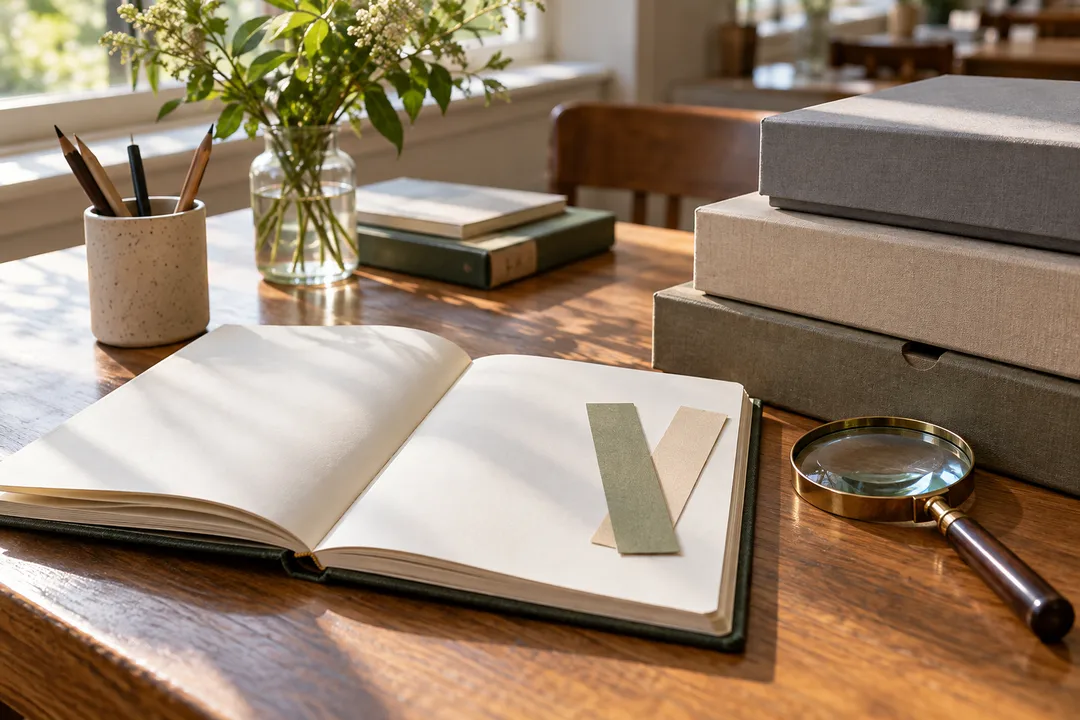
Use the first part of the page for attributed history. Limit it to statements actually supported by the reading. Use the second part for present observation: a road crossing, the orientation of an entrance, a view interrupted by an elevated structure. Reserve the third part for questions. This is a working method, not a claim that the three categories are equally authoritative. A present-day photograph cannot establish what happened in an earlier decade, and a historical narrative cannot tell you whether today’s pavement is unobstructed.
At the first comfortable place to stop, write a neutral description before adding an interpretation. For instance, describe which direction an entrance faces and what public approach reaches it. Then ask whether that arrangement helps you understand the passage you read. Sometimes it will not. Put the unresolved relationship in the question area rather than stretching the description to make it fit. A walk can expose the limits of a source or of your own perspective without yielding a dramatic answer.
Choose the public approach around the Lyric Theater area as one possible orientation point, using a map for the actual streets. Mentioning the theater here does not include an indoor visit or a performance. The Black Archives and the theater provide cultural context in the visitor bureau’s account, while an event or archive appointment has its own arrangements. If your main goal is hearing a speaker or exploring a collection, organize around that specific offering. A sidewalk route cannot substitute for the knowledge or access involved.
Treat a gap in the view as a question
A broad roadway, an altered building or an empty parcel can be visually striking. Record what is there without inventing the property’s previous use. To connect a present gap with displacement or redevelopment, you need an identified place and an appropriate historical record. Avoid pointing at an anonymous lot and narrating a former club into existence. The more emotionally powerful the claim, the more important it is to preserve the distinction between an account that can be cited and a scene that merely feels suggestive.
The contemporary generated images here illustrate that distinction. One suggests an ordinary low-rise street in relation to elevated infrastructure. The other depicts a generic reading table with blank paper and archival-style boxes. Neither identifies an Overtown address, reproduces an archival object or documents a historic demolition. The pictures support the reading-and-observation method. They do not supply evidence for it. A real historical image deserves its creator, date, place and repository attached, even if all those details make the caption less tidy.
If two people are walking together, divide the work by source and observation rather than assigning one person the role of neighborhood expert. One can keep the wording of the selected passage visible, while the other describes the street without reading it. Compare the two accounts at the next pause. Where do they meet, and where do they fail to meet? That exercise can reveal how easily a visitor fills in missing context. Do not turn a disagreement into an argument about what local people must have experienced.
End with a research request someone can answer
Your closing question should identify a place, period or relationship. Asking which collection might explain the cultural role of a particular venue is more useful than asking for the entire history of Overtown. Asking for a source is also different from expecting someone at a doorway to provide unpaid personal testimony. If an organization offers interpretation, use its actual program or enquiry route. Listen to the scope of the answer, and leave room for evidence that complicates the account you arrived with.
Skip the attempt to add a live-music stop just to make the outing feel complete. A performance is worth organizing on its own terms, and a quiet street does not mean the history walk has failed. You have a successful result if your notebook holds a supported historical statement, a precise observation and a better question. Carry those three pieces into your later reading. Their value lies in the relationship between them, rather than in the number of cultural names you can attach to the day.
Practical Notes for a source-led outing
Keep the walking section short enough that there is time to read at both ends. Select the actual start, crossings and finish on an ordinary map before setting out. Carry drinking water and choose a comfortable public place for stopping. An exterior approach is sufficient for this method, so remove an interior from the plan when it is not independently arranged. For a wet afternoon, a reading session elsewhere can advance the same question without pretending that a business doorway is public shelter.
Karpo APP can help you discover ideas for a Miami cultural outing. Describe your interest in Overtown history and your preference for a small public-street walk. Keep source attribution and your research notes in your own record, and take any archive or event arrangements to the relevant organization. Background reading: the official Historic Overtown guide at https://www.miamiandbeaches.com/plan-your-trip/insider-guides/historic-overtown-guide . The next action is to follow one source trail, with a question specific enough to invite a useful answer.
Ask Karpo for more information.
Keep reading
- Brickell Tailor Alteration Shop Finder: First Work Suit Fit
 Coconut Grove Tailor Alteration Shop Finder: Heat-Proof Fits
 Little Havana Tailor Alteration Shop Finder: Guayabera Fits