 Brickell Tailor Alteration Shop Finder: First Work Suit Fit
Neighborhood Guides
Coral Gables Historic Covered Passage Walk: Free Shaded Mile
A historic covered passage walk in Coral Gables is free and starts on Miracle Mile. Pair the 1926 Colonnade with Giralda Plaza and go before afternoon rain.
In Coral Gables, shelter from the Miami sun was designed in from the start. George Merrick planned his downtown in the early 1920s so that every business would sit within two blocks of one main shopping street, and the city's rules made Mediterranean Revival the house style: arched entries, deep doorways, clay tile roofs and loggias meant for subtropical heat. Walk the half-mile of Miracle Mile and the blocks behind it and you get a historic covered passage walk built from arcades, awnings and shaded plazas rather than one glass-roofed gallery.
The Plan Behind Miracle Mile
Miracle Mile is the stretch of Coral Way between LeJeune Road and Douglas Road, about 0.5 miles end to end. It opened in 1922 as the core of the city's central business district and only took the Miracle Mile name in 1955, after the Depression and the Second World War had left the street struggling. That gap between plan and name matters on the walk: the buildings you see are a layering of Merrick-era landmarks, mid-century storefronts and newer infill, all held to the same Mediterranean vocabulary.
A 2016 streetscape project designed by the New York firm Cooper Robertson, budgeted at about $21 million, widened the sidewalks and replaced hard curbs with low stones and planting. The result is a promenade where you can drift between shopfront overhangs and street-tree shade without stepping into traffic. Start at the LeJeune Road end, where Coral Gables City Hall anchors the western edge, and move east so the morning sun stays mostly at your back.
The Colonnade Building, the Walk's Centerpiece
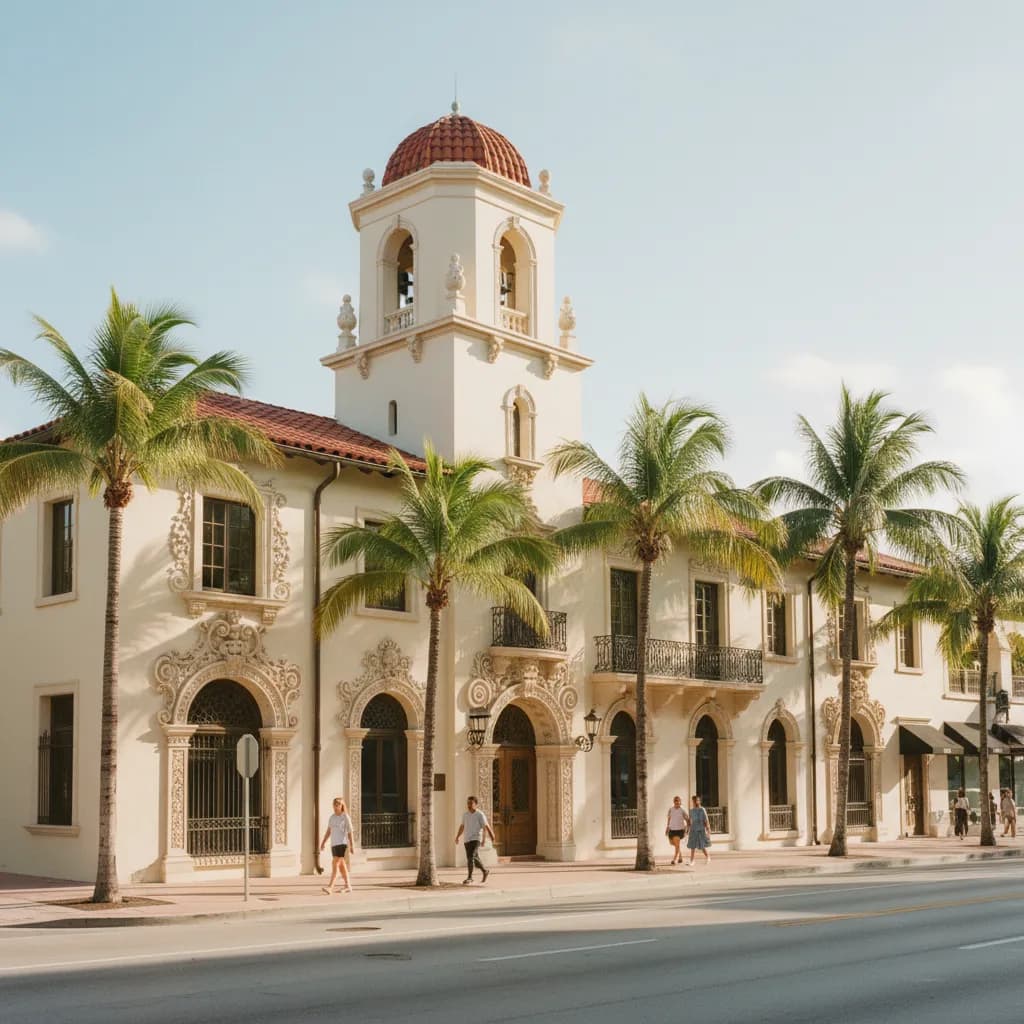
Halfway along the Mile, at 133 to 169 Miracle Mile, stands the Colonnade Building, completed in 1926. Phineas Paist designed it with Walter De Garmo and Paul Chalfin in a blend of Spanish Colonial and Baroque, and its bell tower was patterned after one in Seville. The barrel roof tiles came from Cuba. Merrick built it to house his sales operation at the height of the land boom, and arched openings along the street front are the closest thing here to a true covered arcade.
The building's later lives are part of the reason to stop. After the boom collapsed it housed the Colonnade Movie Studios, and during the Second World War it served as a parachute factory. Today it holds a hotel and offices. Cross to the opposite sidewalk to see the tower and ornament in one frame, then return and walk slowly beneath the arches, looking at the carved surrounds and iron balconies above the doors. Mornings, before shops open, give you the arches with almost no one under them.
Detour to the 1939 Police and Fire Station
From the Colonnade, turn north toward Aragon Avenue, one block over, to find the former Coral Gables Police and Fire Station. Completed in 1939 as a Works Progress Administration project and also designed by Phineas Paist, it replaced a smaller interim station that stood at Salzedo Street and Alcazar Avenue. The building now houses the Coral Gables Museum, which opened its first full program of exhibits in November 2011.
Even if you do not go inside, the exterior is worth a careful look. The civic architecture of the late 1930s is plainer and heavier than the Colonnade's boom-era flourishes, and comparing the two within a few minutes' walk shows how the city's Mediterranean style shifted between the 1920s and the WPA years. The museum also curates exhibits on the city's planning history, which makes it a natural midpoint for anyone curious about how Merrick's downtown came together.
Giralda Plaza After the Heat Breaks
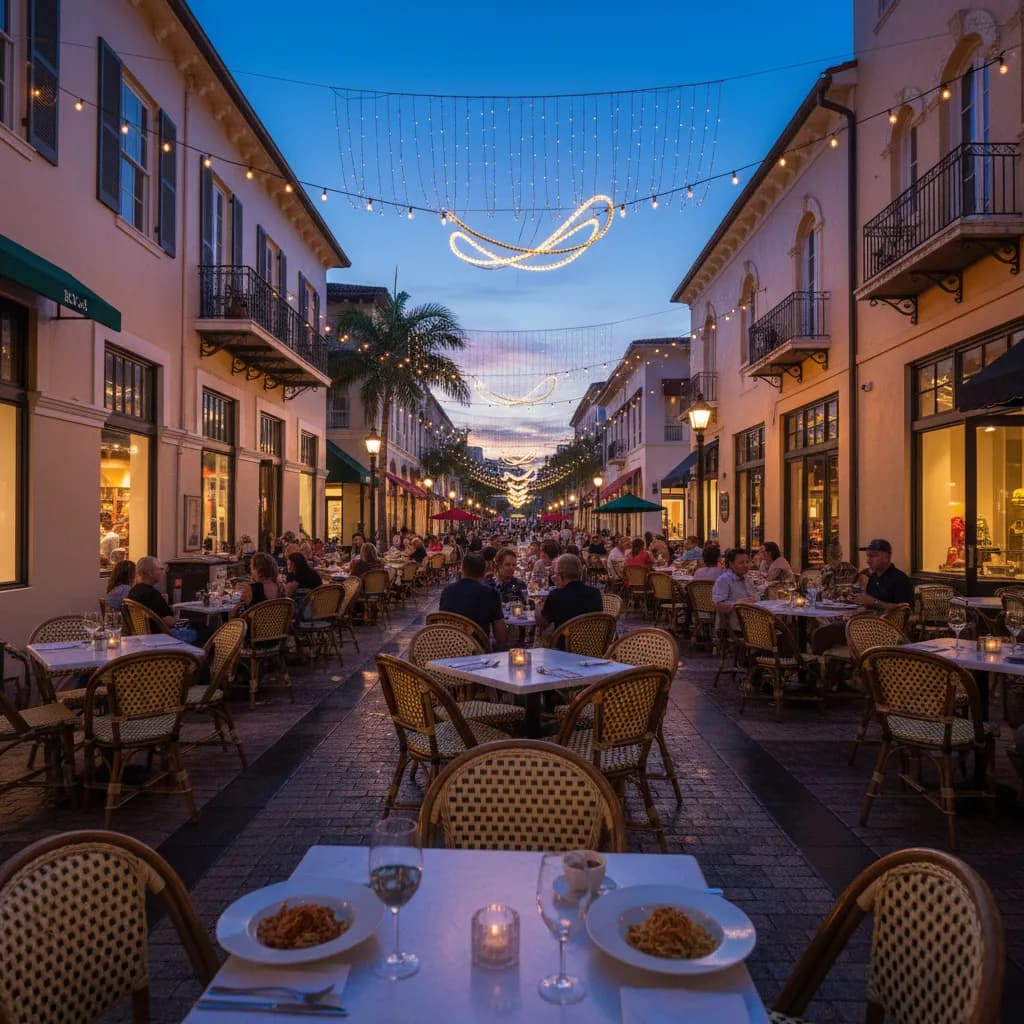
Continue east to Ponce de Leon Boulevard and look for the 100 block of Giralda Avenue. In 2017 the city reopened this block as Giralda Plaza, a car-free walkway lined on both sides with restaurants, bars and coffee shops, and known for the art installations suspended overhead. It is open to the sky, but the low buildings and the overhead pieces give it the enclosed feel of a passage, especially once the lights come up in the evening.
Giralda works best as the last stop. Walk the Mile and the Aragon detour in the morning, break for the hottest hours, then come back around sunset when the plaza fills with diners. Walking the block end to end takes only a few minutes, so treat it as a place to sit rather than a corridor to pass through. Look down the length of the block from either end to see the overhead installation line up with the facades.
Getting Around Without a Car
Coral Gables runs a free trolley along Ponce de Leon Boulevard, a service that began in its current form in November 2003, which makes it easy to link the Giralda end of the walk with points farther along Ponce. If you arrive by car, aim for a municipal garage a block off the Mile rather than circling for street parking, then do the whole loop on foot. The route from City Hall along Miracle Mile, up to Aragon Avenue and over to Giralda Plaza is compact enough to finish in about two hours at an easy pace.
Weather, Shade and Timing
South Florida weather shapes this walk more than distance does. From late spring through early fall, afternoon thunderstorms are common, so start early and keep the Colonnade arches and storefront overhangs in mind as places to wait out a sudden downpour. Winter mornings are the most comfortable time for photographs, with lower humidity and cleaner light on the cream stucco. Carry water, wear a hat for the open crossings, and allow extra time to stop at the Miracle Theatre facade on the Mile.
Planning the Loop With Karpo
Use the Karpo APP to turn this into a route you can follow on the day. Tell it the stops you care about, such as City Hall, the Colonnade Building, the Coral Gables Museum and Giralda Plaza, and ask for an order that starts in the morning and ends at the plaza around sunset. Save the plan and add a coffee or dinner stop nearby. Karpo will not book tables or watch the weather radar for you; it helps you shape a walk around Coral Gables' 1920s architecture so you spend the time looking up rather than looking for directions.
Ask Karpo for more information.
Keep reading
- Brickell Tailor Alteration Shop Finder: First Work Suit Fit
 Coconut Grove Tailor Alteration Shop Finder: Heat-Proof Fits
 Little Havana Tailor Alteration Shop Finder: Guayabera Fits