 Brickell Tailor Alteration Shop Finder: First Work Suit Fit
Neighborhood Guides
Coral Gables Historic Architecture Walking Route: 5 Stops
This Coral Gables historic architecture walking route links the 1928 City Hall, Giralda Plaza, the Merrick House and Venetian Pool in about three miles.
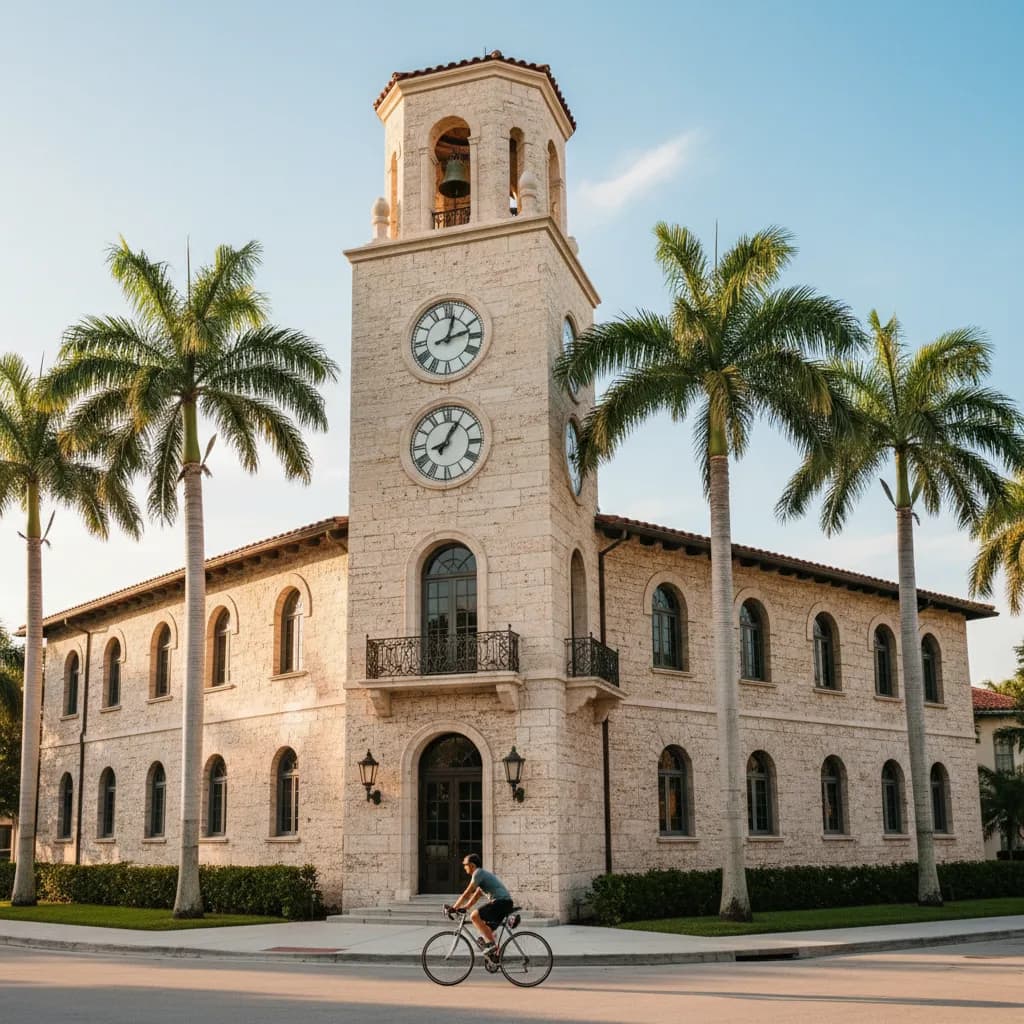
Coral Gables City Hall at 405 Biltmore Way was finished in 1928, and its curved coral limestone front and three-tiered clock tower make the ideal opening to a historic architecture walking route through the city George Merrick planned in the 1920s. Over roughly three miles, you will pass Giralda Plaza, the Merrick family's coral rock home, the De Soto fountain and the Venetian Pool, all built when Merrick was selling a Mediterranean fantasy to buyers from the north.
How George Merrick Designed a City of Coral Rock
Merrick grew up on his family's citrus plantation here and set out in the early 1920s to build a planned city instead of a generic subdivision. He hired a team that included his uncle, artist Denman Fink, landscape architect Frank Button and architect Phineas Paist, and they drew streets with Spanish names, plazas, fountains and grand entrances. The city was incorporated in 1925, just before the land boom collapsed, which is why so much of the original vision remains intact.
Coral rock, the local oolitic limestone, ties the buildings together. Much of it came from a quarry that later became the Venetian Pool, so the stone you see in walls, columns and fountains literally came out of the ground a mile away. Look for barrel tile roofs, wrought iron balconies, arched loggias and pastel stucco throughout the route, all governed even today by a strict city design review board that has protected the Mediterranean character.
Stop One: The Curved Facade of Coral Gables City Hall
Designed by Phineas Paist and Harold Steward, City Hall curves around the junction of Biltmore Way and Coral Way like a theater facade, with columns on the ground floor and a tiered tower crowned by a clock and bell. Inside the bell tower, a mural by Denman Fink depicts the four seasons in rich color. Weekday mornings bring residents paying bills and commissioners heading to meetings, so keep your visit discreet and brief.
Stop Two: Miracle Mile and Giralda Plaza
Walk east along Coral Way, known as Miracle Mile between LeJeune Road and Douglas Road, the city's main shopping street since the 1940s. Many storefronts date to the postwar decades, so the architecture here is more Streamline and mid-century than Mediterranean, with flat canopies and terrazzo entries. Look up at the upper floors for surviving original windows, and notice how wide arcaded sidewalks and street trees were designed for strolling rather than parking.
Turn north on Ponce de Leon Boulevard to Giralda Avenue, where a block has been converted into Giralda Plaza, a pedestrian street lined with restaurant terraces under string lights. Office workers lunch here on weekdays and families crowd the tables on weekend nights. Here is the honest skip: do not bother looking for historic interiors along Giralda itself. The appeal is the open-air room the street creates, not the individual buildings, which are mostly modest commercial blocks.
Stop Three: The Merrick House on Coral Way
Head west along Coral Way to 907 Coral Way, where the Merrick House shows the family's modest beginnings. George's father, Solomon Merrick, a Congregational minister, built the core of the coral rock and wood home around the turn of the twentieth century, and the gables in its design gave the city its name. The surrounding garden includes fruit trees that recall the original citrus grove, and the house is now a city-owned museum.
Notice how the house blends the vernacular wood frame of early South Florida homesteads with coral rock walls, porches and a steep roof, quite different from the stucco palaces of later Coral Gables. The block is quiet, shaded by large oaks, and neighbors walk dogs past the low coral walls. Compare it with nearby 1920s homes on the same street, where Mediterranean details took over within just a decade of the family settling here.
Merrick also marked the edges of his city with monumental gateways, and two are worth knowing about even if they sit beyond this walk. The Granada Entrance on Tamiami Trail, completed in the early 1920s, is a coral rock arch inspired by Spanish city gates, while the Douglas Entrance, known as La Puerta del Sol, combines a tower, arcades and shops. Both show that he imagined visitors arriving through ceremonial thresholds rather than ordinary road signs.
Stop Four and Five: De Soto Fountain and the Venetian Pool
Continue south to De Soto Plaza at the intersection of De Soto Boulevard and Granada Boulevard, where Denman Fink's 1925 fountain sits in a traffic circle with four spouting lion heads and an obelisk-like column. It was conceived as a landmark at the meeting of key boulevards and a reminder of Merrick's plan to give every major intersection a feature. Cyclists loop the circle on weekend mornings, and photographers frame it against the canopy of oaks along Granada.
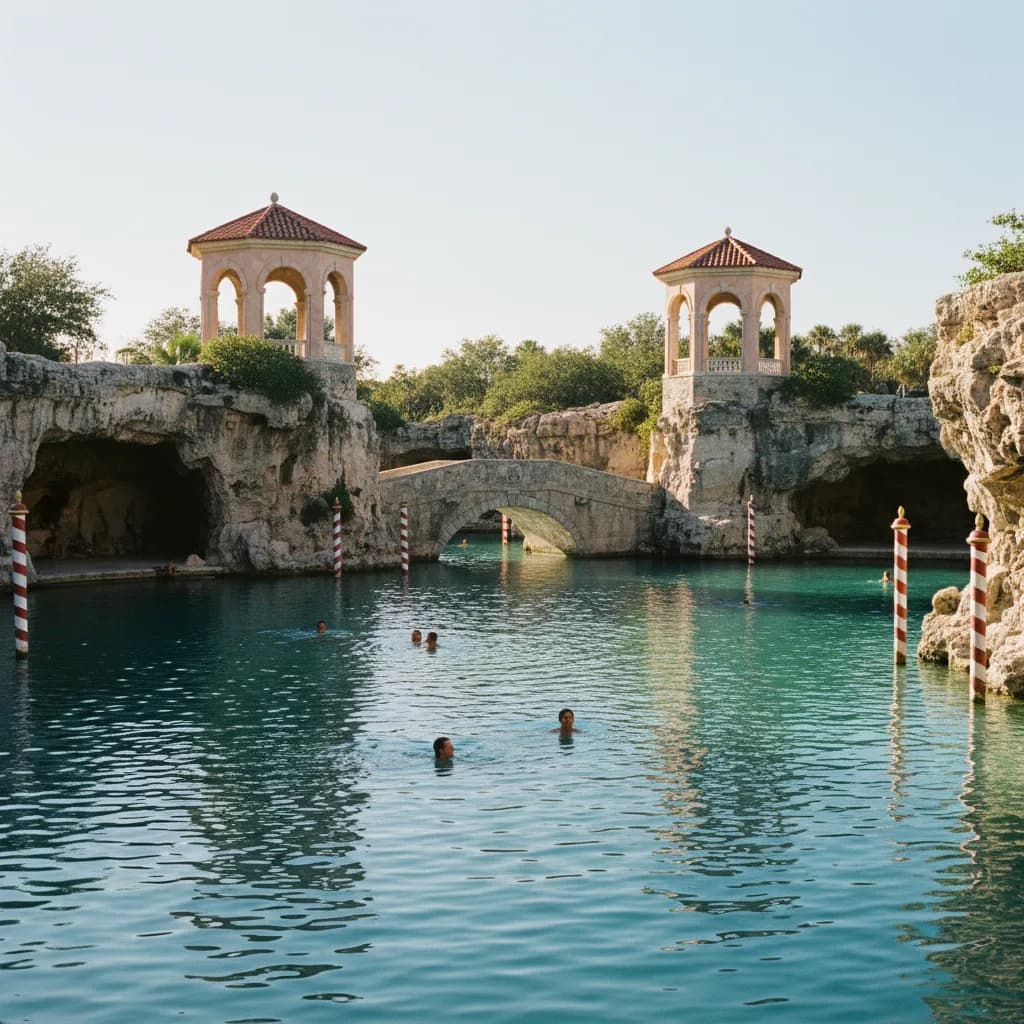
Walk a short block to 2701 De Soto Boulevard, where the Venetian Pool opened in 1924 inside the former coral rock quarry. Designed by Phineas Paist and Denman Fink, it is a spring-fed public swimming lagoon with grottoes, waterfalls, a stone bridge and loggias with striped Venetian poles. It is listed on the National Register of Historic Places, and even from the entrance plaza you can see how the quarry walls were turned into architecture.
Timing, the Biltmore Detour and a Plan B
Allow about two and a half to three hours. Mornings before eleven are best for light and shade, and the free Coral Gables trolley along Ponce de Leon Boulevard helps if your feet tire. If it is past noon on a summer day, skip walking all the way to the Biltmore Hotel, the 1926 Schultze and Weaver landmark whose tower echoes the Giralda in Seville. Its tower is visible from Granada Boulevard, so admire it from a distance and save the walk for a cooler day.
If the Venetian Pool is closed for its seasonal maintenance, swap that stop for the Coral Gables Museum at 285 Aragon Avenue, housed in the 1939 former police and fire station built by Paist and Steward, or for the Alhambra Water Tower, a lighthouse-like 1931 landmark on Alhambra Circle. Save the stops in the Karpo APP and ask Karpo to suggest a loop that fits the trolley schedule you plan to use.
Ask Karpo for more information.
Keep reading
- Brickell Tailor Alteration Shop Finder: First Work Suit Fit
 Coconut Grove Tailor Alteration Shop Finder: Heat-Proof Fits
 Little Havana Tailor Alteration Shop Finder: Guayabera Fits