 Brickell Tailor Alteration Shop Finder: First Work Suit Fit
Neighborhood Guides
Coconut Grove Historic Architecture Walking Route: 5 Stops
This Coconut Grove historic architecture walking route links the 1891 Barnacle, Plymouth Church's coral rock walls and Bahamian cottages on Charles Avenue.
Coconut Grove was a settled bayfront village before Miami was a city, and the evidence is still standing along Main Highway, Devon Road and Charles Avenue. This historic architecture walking route of about two and a half miles links the 1891 Barnacle bungalow, a coral rock church cut by hand in 1917 and the Bahamian cottages of the West Grove, mostly under a canopy of banyans and live oaks that keeps the walk bearable even on warm afternoons.
Start Where the Grove Began: Peacock Park and the Bayfront
Begin at Peacock Park on McFarlane Road, the bayfront green that occupies the site of the Peacock Inn, often described as the first hotel on the South Florida mainland when it opened in the 1880s. Charles and Isabella Peacock ran it for sailors, naturalists and winter visitors, and Bahamian workers who came to staff the inn laid the foundation of the West Grove community you will visit later. Today the lawn draws picnickers, pickup soccer players and paddleboarders launching toward the mangroves.
Before leaving, look along the shoreline toward Dinner Key, where seaplanes once linked Miami to Latin America in the 1930s. The bayfront explains why the village grew here: a protected anchorage, breezes off Biscayne Bay and high limestone ground. Walk south along McFarlane Road and Main Highway, and notice how the old village core still bends with the shoreline instead of following the strict grid that shaped the rest of Miami.
The Barnacle: Ralph Munroe's 1891 Bungalow on Main Highway
At 3485 Main Highway, a narrow drive leads through a patch of hardwood hammock to the Barnacle, now a Florida state park. Yacht designer Ralph Middleton Munroe built the house in 1891 from timber salvaged from shipwrecks, raising it off the ground to catch breezes and avoid floods. In 1908, needing room for his growing family, he jacked the original floor up and built a new story beneath it, a typically practical Munroe solution.
Notice the wide verandas, the central octagonal room that vents hot air through a roof opening and the broad overhanging eaves, all early experiments in climate-responsive design that architects still cite. The lawn sweeping down to the bay is where Munroe and friends founded the Biscayne Bay Yacht Club, and on quiet weekdays you will share it with families on blankets and painters setting up easels. The house is the oldest in Miami-Dade County still standing on its original site.

The Coconut Grove Playhouse and the Village Center
Across Main Highway at Charles Avenue stands the Coconut Grove Playhouse, opened in 1927 as a movie palace designed by Kiehnel and Elliott in a Mediterranean Revival style. It later became a celebrated live theater, hosting the American premiere of Waiting for Godot in 1956, before closing in 2006. Since then it has been the subject of long-running restoration and redevelopment plans, so treat it as a sidewalk stop and study the arched front facade and tower.
Here is the honest skip: do not spend your walk inside CocoWalk or the shopping blocks of Grand Avenue near the village center. Most of what you see there was rebuilt in recent decades and has little to say about the Grove's past. Grab water at a café on Commodore Plaza if you need it, then head back toward the quiet residential streets where the architecture is older and the shade is deeper.
Plymouth Congregational Church and Its Hand-Cut Coral Rock
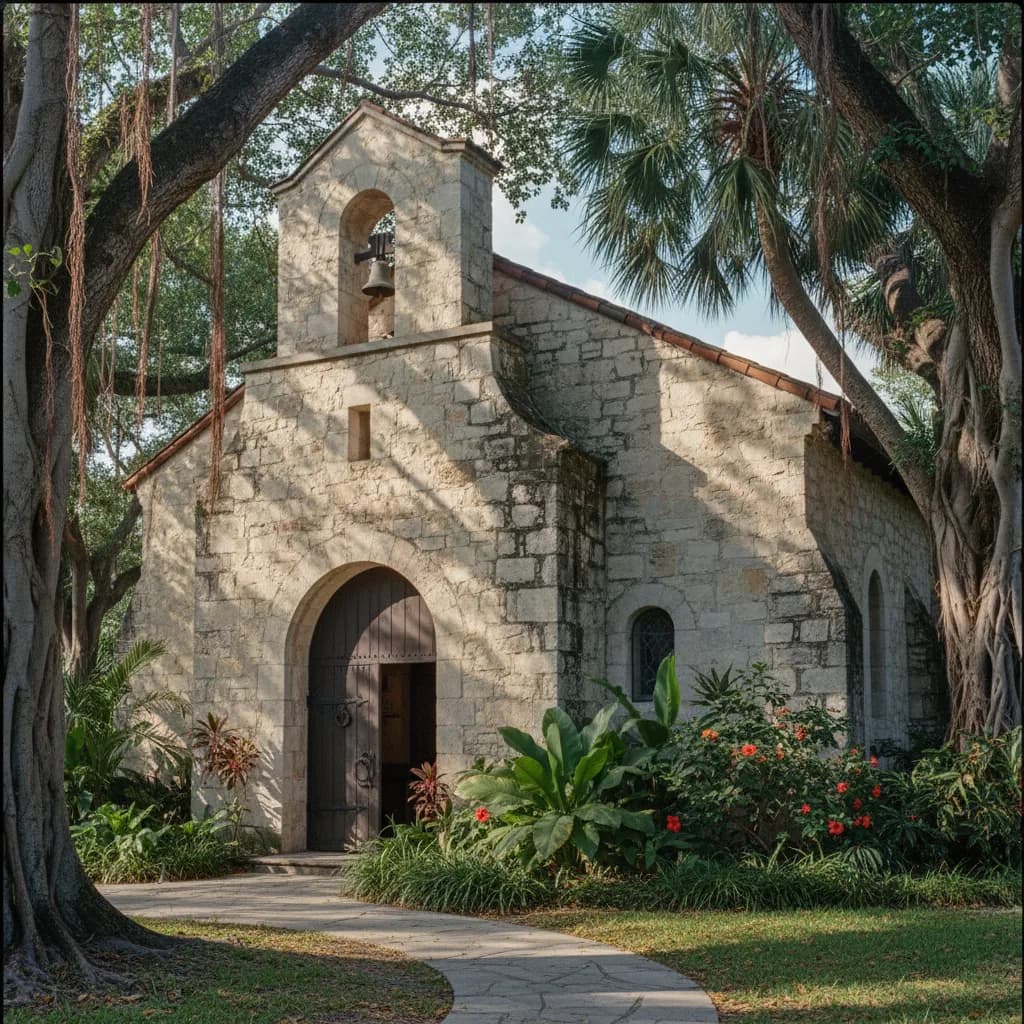
Walk south on Main Highway and turn onto Devon Road to reach Plymouth Congregational Church at 3400 Devon Road, completed in 1917 in a Spanish Mission style. Its walls are made of coral rock, the local oolitic limestone, and the story goes that a single stonemason, Felix Rebom, cut and laid the blocks by hand over several years. Stand back across the lawn to see the bell tower, the arched entry and the uneven, honey-colored stone texture.
The grounds are a favorite of wedding photographers on weekend afternoons, and neighbors walk dogs past the hedges every morning. Look for the massive carved wooden doors at the entrance, which the church says came from an old Spanish monastery, and for coral rock garden walls on neighboring streets that echo the same craftsmanship. Coral rock appears all over the Grove in walls, gates and foundations, and once you notice it you will spot it everywhere.
Charles Avenue and the Bahamian Roots of the West Grove
Cross Main Highway and follow Charles Avenue west into the West Grove, settled by Bahamian immigrants in the 1880s and 1890s who built the homes, docks and businesses of the early village. At 3298 Charles Avenue, the Mariah Brown House is a small wooden cottage associated with Mariah Brown, a Bahamian woman who came to work at the Peacock Inn and became one of the first Black homeowners in the area.
Further along, look for other modest wood-frame homes raised on piers with deep porches and tin roofs, a Caribbean building tradition adapted to Florida heat and storms. The Charlotte Jane Memorial Park Cemetery on Charles Avenue holds generations of Bahamian families, with above-ground graves suited to the high water table. Walk respectfully, since this remains a lived-in neighborhood where porch conversations and church gatherings carry on just as they have for more than a century.
Timing, Festival Weekends and a Vizcaya Plan B
The loop takes about two and a half hours, and mornings before eleven give you the softest light on the coral rock and the coolest air under the trees. Avoid the Coconut Grove Arts Festival weekend in February, when Bayshore Drive and the village streets fill with tents and traffic. The free Coconut Grove trolley connects the village with the Metrorail station on US 1, which helps if you walk one way and ride back.
If the weather turns or you want one grand interior, head north to Vizcaya Museum and Gardens at 3251 South Miami Avenue, the bayfront estate James Deering completed around 1916 with an Italian Renaissance villa and formal gardens. It is a striking contrast to Munroe's practical bungalow, built only a few miles away. Save the Grove stops and Vizcaya in the Karpo APP and ask Karpo to help you split them across two mornings.
Ask Karpo for more information.
Keep reading
- Brickell Tailor Alteration Shop Finder: First Work Suit Fit
 Coconut Grove Tailor Alteration Shop Finder: Heat-Proof Fits
 Little Havana Tailor Alteration Shop Finder: Guayabera Fits