 Brickell Tailor Alteration Shop Finder: First Work Suit Fit
Neighborhood Guides
Miami Historic Architecture Stroll: Free MiMo District
Tour the Biscayne Boulevard corridor on this free architecture stroll past atomic-era motels, cheese-hole walls, and mid-century modern neon signs.
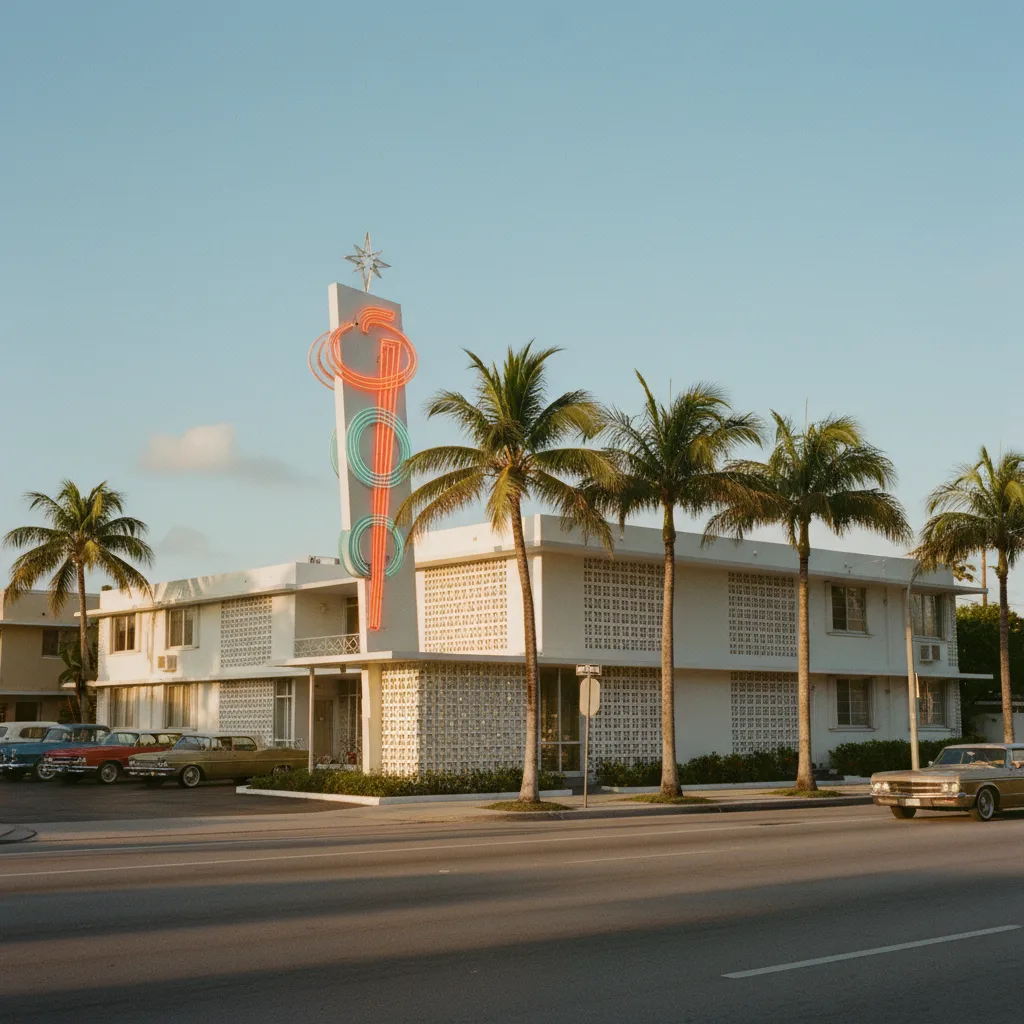
Along the historic northern stretch of Biscayne Boulevard between 50th Street and 77th Street lies the epicenter of postwar South Florida modernism: the MiMo on BiBo Historic District. Following the conclusion of World War II, a dramatic economic boom fueled by expanding family automobile ownership, interstate highway construction, and affordable commercial aviation transformed Miami into a year-round vacation destination. Visionary local architects discarded pre-war Mediterranean historicism in favor of an exuberant, space-age aesthetic known as Miami Modern, or MiMo. Characterized by playful asymmetrical cantilevers, atomic-era pylon neon signs, breeze-block screen walls, and open-air tropical courtyard motels, this district celebrated the freedom and optimism of mid-century American road culture. This self-guided historic architecture stroll guides you along the boulevard, highlighting the architectural geometry, restored retro motels, and neon landmarks that define this mid-century modern corridor.

Atomic Optimism at The Vagabond Hotel
Begin your architectural exploration at 7301 Biscayne Blvd before the celebrated centerpiece of the MiMo district: The Vagabond Hotel, opened in 1953. Designed by master architect B. Robert Swartburg—who also created the landmark Delano Hotel in South Beach—this pristine two-story motor hotel represents the absolute zenith of postwar resort motel design. The building is framed by a dramatic, angular porte-cochère with a sweeping cantilevered roof, floor-to-ceiling glass lobby walls, and an iconic geometric neon pylon sign featuring an atomic arrow pointing skyward with playful mid-century lettering.
Walk through the lobby into the open-air central courtyard to admire the signature kidney-shaped swimming pool, complete with restored mosaic mermaid tile art inlaid on the pool floor. Notice the open exterior catwalks, angled metal railings, and decorative breeze-block screens that promoted natural airflow across motel guest room corridors. During the 1950s and 1960s, The Vagabond was a fashionable cocktail lounge hangout for Frank Sinatra, Dean Martin, and the Rat Pack during their Miami performances, standing today as the premier model of historic MiMo motel restoration in South Florida.
Polynesian Whimsy at the South Pacific Motel
Stroll southward down Biscayne Boulevard to 6301 Biscayne Blvd to examine the distinctive facade of the South Pacific Motel, completed in 1953. Reflecting the widespread postwar American fascination with South Seas tiki culture popularized by returning Pacific veterans and Broadway musicals, this two-story motel incorporated exotic Polynesian design flourishes into a functional mid-century modern motor inn. The building's signature feature is an asymmetrical, dramatic zigzag folded-plate roofline that crowns the central entrance canopy, evoking the angular outrigger canoes of the South Pacific.
Look closely at the exterior walls, which incorporate textured native stone rubble masonry juxtaposed against smooth pastel-painted stucco surfaces. Postwar MiMo architects frequently contrasted rough natural stone with industrial concrete and glass to inject visual warmth into streamlined modern structures. The original roadside pylon sign still stands proudly on the sidewalk edge, featuring sweeping retro neon script and geometric boomerang accents that captured the attention of passing motorists cruising south toward Miami Beach.
Space-Age Pylon Signs at the Sinbad Motel
Continue south along the boulevard to 6150 Biscayne Blvd to view the Sinbad Motel, constructed in 1953. The Sinbad illustrates how mid-century roadside architects utilized bold, dynamic street signage as an integral component of the building's overall architectural composition. The motel's iconic neon pylon sign incorporates overlapping triangular geometric shapes, atomic-era starbursts, and Arabic-inspired lettering that created an alluring roadside fantasy for mid-century automobile travelers exploring the Atlantic coast highway.
Examine the building's clean horizontal massing, featuring ribbon windows, cantilevered concrete overhangs, and recessed private room balconies. The motel is configured in a classic U-shape around a central driveway and swimming pool courtyard, a strategic layout that allowed motorists to park directly outside their ground-floor rooms. This democratic architecture catered to the rising American middle class, offering sleek, modern resort amenities at accessible roadside rates without the rigid formalities of pre-war grand hotels.
Breeze Blocks and Cantilevers at the Shalimar Motel
Cross the boulevard to 6200 Biscayne Blvd to inspect the historic Shalimar Motel, dedicated in 1950. The Shalimar is celebrated for its masterful use of decorative architectural breeze blocks, commonly known among architectural historians as 'cheese-hole' concrete screens. These perforated precast concrete blocks were deployed extensively across postwar Miami facades to provide decorative visual texture, ensure privacy for guest walkways, and permit cooling Atlantic sea breezes to circulate while deflecting harsh tropical solar heat.
Notice the sharp, angular roof cantilevers that extend out over the parking bays and entrance stairs, defying gravity with slender steel support posts. The building features an elegant two-tone pastel color palette that highlights the interplay of light and shadow across the perforated screen walls. The Shalimar was among the early wave of Biscayne Boulevard motels to earn designation as contributing structures within the historic district, preserving the authentic physical scale of 1950s automobile hospitality.
Late MiMo Geometry at the Royal Motel
Conclude your boulevard architecture walk at 7411 Biscayne Blvd before the striking Royal Motel, completed in 1958. Representing the late evolutionary phase of the MiMo style, the Royal Motel features bold, trapezoidal window surrounds, sharply angled vertical fins, and geometric stucco cutouts that lean toward the space-age 'Googie' modernism that emerged alongside the American space program in the late 1950s.
Observe how the building's corner configuration maximizes street visibility, using sharp diagonal roof lines and asymmetrical massing to create visual drama from multiple approaching traffic lanes. The Royal Motel exemplifies how commercial architecture in postwar Miami embraced playful experimentation, discarding solemn civic rules in favor of lively, dynamic forms that celebrated sunshine, leisure, and the democratic open road.
Transit Logistics and Practical Architecture Stroll Notes
This self-guided historic architecture stroll spans approximately one point zero miles along the sidewalks of Biscayne Boulevard between 60th Street and 75th Street, taking roughly fifty to sixty minutes at an observant walking pace. Because Biscayne Boulevard is an active multi-lane thoroughfare, pedestrians should utilize designated crosswalks at signalized intersections when crossing between east and west motel properties. The ideal time for architectural photography is late afternoon between three and five o'clock, when low-angled western sunlight casts deep, graphic shadow patterns through perforated breeze-block screens.
Public transit connections along Biscayne Boulevard are frequent and convenient: Metrobus routes 3 and 93 (Biscayne MAX) run continuous north-south service along the boulevard, stopping every few blocks directly in front of the historic motel properties with direct connections to Downtown Miami. Karpo APP provides detailed walking GPS waypoints, architect biographies, and vintage postcard comparison overlays, making your exploration of Miami's retro MiMo district seamless, engaging, and historically enlightening.
Ask Karpo for more information.
Keep reading
- Brickell Tailor Alteration Shop Finder: First Work Suit Fit
 Coconut Grove Tailor Alteration Shop Finder: Heat-Proof Fits
 Little Havana Tailor Alteration Shop Finder: Guayabera Fits