 Brickell Tailor Alteration Shop Finder: First Work Suit Fit
Neighborhood Guides

Miami Historic Architecture Stroll: Free Downtown Route
Walk downtown Miami on this free self-guided historic architecture stroll past the Freedom Tower, Alfred I. duPont Building, and 1920s boomtown banks.
Surrounded by modern glass skyscrapers overlooking Biscayne Bay, Downtown Miami preserves an extraordinary historic core forged during the legendary Florida land boom of the 1920s. Following the arrival of Henry Flagler's Florida East Coast Railway in 1896, Miami rapidly evolved from a remote mangrove trading post into an ambitious subtropical metropolis. Between 1920 and 1926, national banking empires, newspaper syndicates, and real estate visionaries poured millions of dollars into Flagler Street, erecting towering commercial palaces clad in limestone, terracotta, and polished granite. Designated as the Downtown Miami Historic Commercial District on the National Register of Historic Places, this compact urban grid showcases an eclectic dialogue between Mediterranean Renaissance grandeur and sleek Art Deco modernization. This self-guided historic architecture stroll guides you through the historic business core, highlighting the engineering triumphs, civic symbols, and cultural milestones that shaped Miami's downtown skyline.
Spanish Renaissance Majesty at the Freedom Tower
Begin your architectural exploration at 600 Biscayne Blvd before the towering silhouette of Miami's most beloved historic monument: the Freedom Tower, completed in 1925. Designed by the esteemed New York architectural firm Schultze & Weaver—the same visionary practice that created the Biltmore Hotel in Coral Gables—this seventeen-story steel-framed skyscraper was built as the prestigious corporate headquarters and printing plant for The Miami News. Rising two hundred and eighty-nine feet into the coastal sky, the tower's architectural composition is modeled directly after the celebrated Giralda bell tower of the Cathedral of Seville in southern Spain.
Admire the elaborate Spanish Renaissance and Mediterranean Revival ornamentation adorning the upper tower, featuring ornate cast-stone Corinthian pilasters, heraldic shields, arched belfry openings, and a gilded copper dome topped with an ornamental lantern. In 1962, the building took on profound international humanitarian importance when the United States federal government transformed it into the Cuban Refugee Center, processing and welcoming hundreds of thousands of Cuban exiles fleeing political oppression. Today, as a National Historic Landmark operated by Miami Dade College, the Freedom Tower stands as an eternal beacon of democratic liberty and architectural majesty.
Art Deco Supremacy at the Alfred I. duPont Building
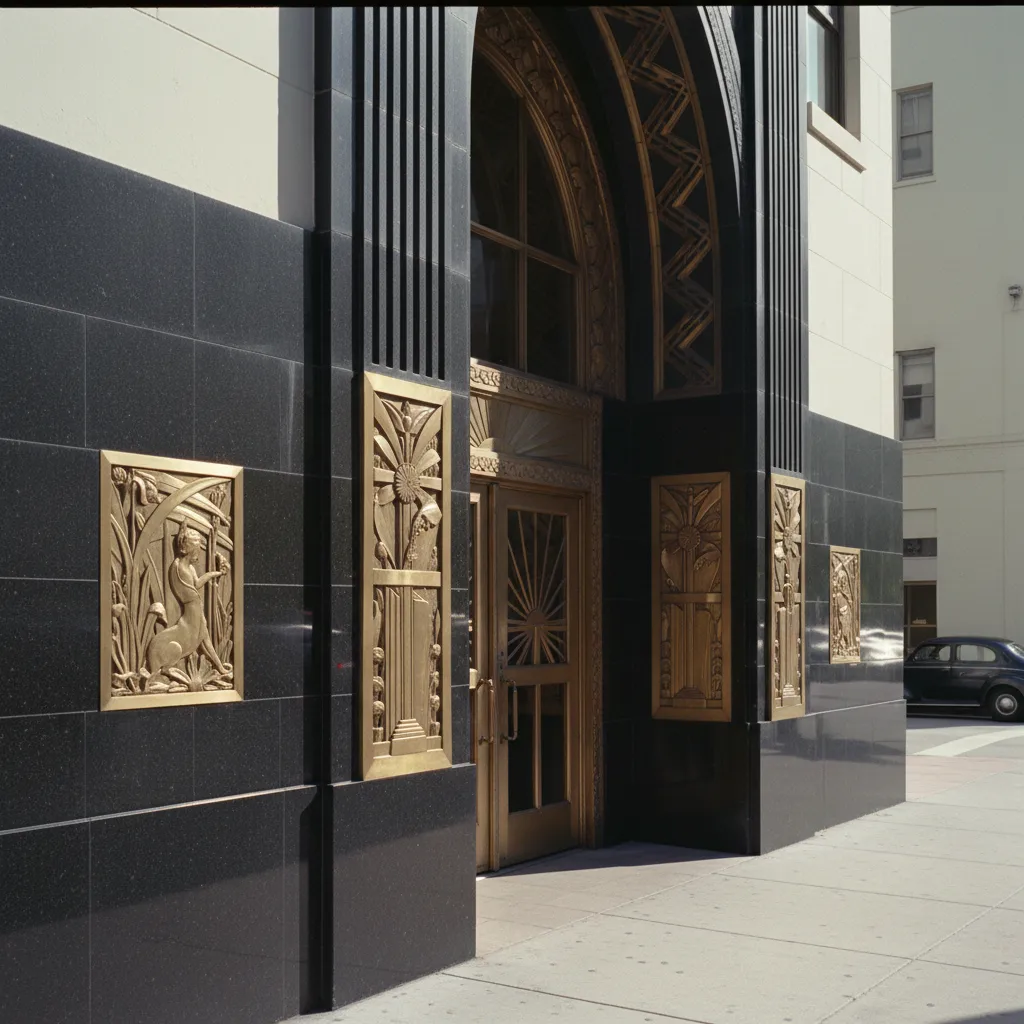
Walk south along Biscayne Boulevard and turn west onto Flagler Street to 169 E Flagler St to inspect the crown jewel of Miami Art Deco skyscrapers: the Alfred I. duPont Building, dedicated in 1939. Designed by the renowned Jacksonville architectural practice of Marsh & Saxelbye, this seventeen-story commercial tower was constructed for the Florida National Bank estate of industrialist Alfred I. duPont. Rising with dramatic stepped setbacks, the building's exterior is clad in polished black granite at the street level, transitioning to smooth native Florida limestone and rich decorative bas-relief friezes above.
Step inside the grand entrance lobby and take the escalator to the second-floor banking hall to experience one of the most opulent Art Deco public interiors in the American South. The massive banking room features soaring hand-painted cypress-wood ceiling beams decorated in polychrome Florida floral and Seminole Indian motifs, bronze teller grilles adorned with sculpted herons and cranes, and magnificent hand-wrought iron entrance gates designed by metal craftsman Samuel Yellin. The building stands as a triumph of Depression-era modernism, signaling financial resurgence through unyielding quality and permanent craftsmanship.
Florentine Renaissance Grandeur at the Ingraham Building
Stroll around the corner to 25 SE 2nd Ave to stand before the stately facade of the Ingraham Building, erected in 1927. Also designed by Schultze & Weaver, this thirteen-story commercial office building was commissioned by the Model Land Company, a subsidiary of Henry Flagler's Florida East Coast Railway, and named in honor of railroad pioneer James E. Ingraham. The building's exterior represents a sophisticated exercise in Italian Florentine Renaissance palace design, featuring heavy stone rustication on the lower three stories, elegant arched second-floor windows, and a monumental projecting terra-cotta cornice supported by sculpted classical brackets.
Enter the central arcade to view the breathtaking barrel-vaulted ceiling, lavishly hand-painted with Renaissance grotesque murals, mythological figures, and intricate gilded arabesques by artist Giovanni Smeraldi. The lobby features hand-carved Italian marble pilasters, bronze elevator doors etched with classical friezes, and antique bronze directory boards. The Ingraham Building served as the executive office hub for Florida's leading maritime, agricultural, and railroad corporations during the land boom era, radiating Old World European prestige.
Venetian Gothic Sanctity at Gesu Church
Proceed north to 118 NE 2nd St to reach the serene sanctuary of Gesu Catholic Church, dedicated in 1925. Designed by architect Owen J. Williams, Gesu represents the oldest Catholic parish in Miami, founded in 1896 on land personally donated by railroad magnate Henry Flagler. The church's architecture is a dramatic fusion of Venetian Gothic and Spanish Renaissance revival styles, constructed with pale stucco walls, pointed Gothic lancet arches, and an imposing central rose window flanked by twin octagonal bell towers.
Step into the cavernous interior nave to admire the spectacular collection of stained-glass windows, handcrafted by the world-famous Franz Mayer & Co. studios in Munich, Germany. The windows depict vivid biblical scenes and saints, casting brilliant jewel-toned light across the polished terrazzo floor and hand-carved mahogany pews. Gesu Church provided an enduring spiritual anchor for generations of downtown residents, from railroad construction laborers in the 1890s to thousands of Caribbean and Latin American immigrants throughout the twentieth century.
Classical Revival Commerce at the Huntington Building
Conclude your downtown architectural walk by visiting 168 SE 1st St to admire the historic Huntington Building, completed in 1926. Designed by architects Louis Kamper and Harold Hastings Mundy, this thirteen-story Classical Revival office tower features a distinctive rusticated limestone base, decorative terra-cotta friezes with classical urn motifs, and a handsome copper roof parapet. Built during the peak frenzy of the 1925 real estate speculation boom, the building housed scores of land syndicates, legal firms, and surveyors who mapped the rapid expansion of South Florida.
Examine the street-level entrance portal, which features ornate cast-iron transoms and classical dentil moldings that demonstrate the high level of architectural detailing applied to commercial speculation buildings of the era. The Huntington Building stands alongside its neighboring historic high-rises to form a cohesive, walkable street wall that recalls the vibrant energy of 1920s downtown Miami before postwar suburban decentralization shifted commercial retail outward.
Transit Logistics and Practical Architecture Stroll Notes
This self-guided historic architecture stroll covers approximately one point one miles through the compact, walkable street grid of Downtown Miami, requiring about sixty to seventy-five minutes to explore thoroughly at an appreciative walking pace. The route is entirely flat with wide paved sidewalks. For the best exterior photography, schedule your walk during the mid-morning hours between nine and eleven o'clock, when bright sunlight illuminates the east-facing facades of the Freedom Tower and Ingraham Building without casting deep urban skyscraper shadows.
Public transit connections are extraordinarily convenient: ride the free Metromover Inner Loop to College/Bayside Station to start right beside the Freedom Tower, or disembark at First Street Station to begin near the duPont Building and Flagler Street. The Government Center transit hub connects Metrorail and multiple Metrobus lines within two blocks of the route. Karpo APP provides turnkey GPS walking maps, architectural feature diagrams, and archival land-boom photographs, enabling you to explore Downtown Miami's historic heritage effortlessly and with rich historical insight.
Ask Karpo for more information.
Keep reading
- Brickell Tailor Alteration Shop Finder: First Work Suit Fit
 Coconut Grove Tailor Alteration Shop Finder: Heat-Proof Fits
 Little Havana Tailor Alteration Shop Finder: Guayabera Fits