 Brickell Tailor Alteration Shop Finder: First Work Suit Fit
Neighborhood Guides

Coral Gables Colonial Heritage Architecture Trail by Trolley
Coral Gables City Hall at 405 Biltmore Way starts a walk of 1920s Mediterranean Revival landmarks, and the free Ponce trolley runs Monday to Saturday.
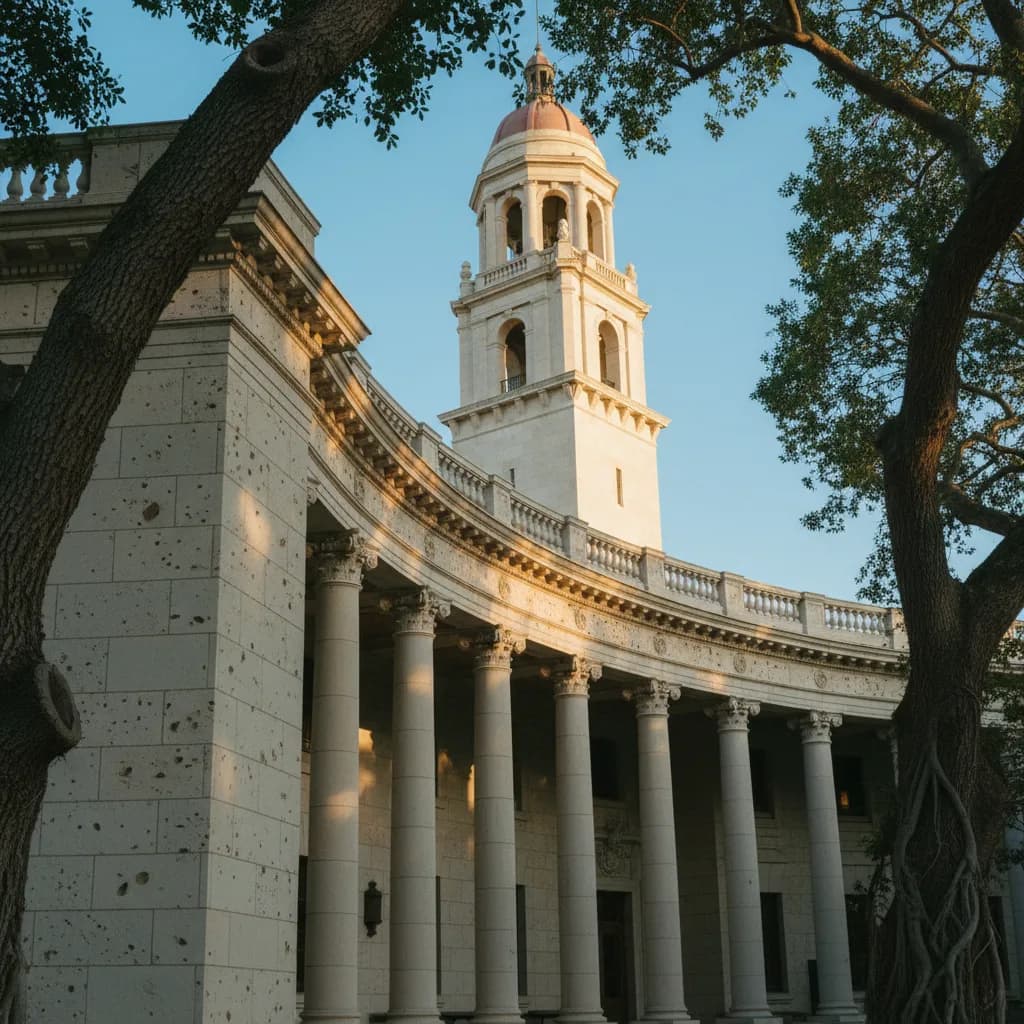
Coral Gables City Hall, at 405 Biltmore Way, faces the west end of Miracle Mile with a curved colonnade completed in 1928 from local oolitic limestone, and it is the logical start of a colonial heritage architecture trail in Miami. Be clear about the label: George Merrick's planned city borrowed Spanish and Italian colonial forms in the 1920s rather than inheriting them. The free city trolley on Ponce de Leon Boulevard runs Monday through Saturday, so Sunday walkers go on foot.
Why Miami's Colonial Look Dates From the 1920s
Florida's surviving Spanish colonial buildings are far to the north, in St. Augustine, where the stone Castillo de San Marcos was built between 1672 and 1695. Miami-Dade has nothing standing from that era. Coral Gables is something else: a city planned from scratch by developer George Merrick, artist Denman Fink and architect Phineas Paist, and incorporated in 1925 with rules that kept new buildings in a Mediterranean idiom.
The result reads as Spanish colonial at a glance, with barrel-tile roofs, arcades, courtyards and fountains, yet it was designed as a single, coherent fantasy for buyers in the Florida land boom. That makes it ideal for a walking trail. The landmarks are close together, built from the same local stone, and documented well enough that you can trace who designed what and why.
City Hall and the Coral Rock Under Your Hand
Paist and Harold Steward designed City Hall with Fink as artistic adviser, and the semicircular colonnade wraps the corner where Biltmore Way meets Miracle Mile. Run your hand along a column base: the oolitic limestone, called coral rock locally, is full of tiny fossil shells and pits. The multi-tier clock tower above repeats the Mediterranean theme and stays visible from several blocks away, which makes it a handy landmark.
Stand across the street for the best view of the curved front, then walk the length of the colonnade in the shade. Summer storms here arrive suddenly in the afternoon, and the covered walkway is the nearest shelter if one breaks while you are on Miracle Mile. Morning light from the east falls directly on the stone and brings out its texture far better than flat midday sun.
From Quarry to Venetian Pool
The stone for many early Coral Gables buildings, including the Merrick family home, came from a single quarry. Rather than leave the pit as a scar, Merrick had Fink and Paist turn it into a lagoon, opened in 1924 as the Venetian Casino. Today it is the Venetian Pool at 2701 De Soto Boulevard, where coral rock grottoes, a waterfall and loggias with striped awnings surround the water.
The pool is filled with spring water from the aquifer, roughly 820,000 gallons, which keeps it cool even in August. It is a working city pool with its own admission and swim seasons, so swimming is a separate decision from the walk. From City Hall, plan on about 20 minutes on foot heading southwest. Stop at De Soto Plaza on the way, where Fink's 1925 De Soto Fountain marks a traffic circle.
The Biltmore Tower and Its Seville Model
Continue west to the Biltmore Hotel at 1200 Anastasia Avenue, opened in 1926 and designed by Schultze and Weaver. Its central tower is modeled on the Giralda, the bell tower of Seville Cathedral, and it is the tallest piece of Spanish imagery on the whole trail. The hotel remains a working luxury property, so treat its lobby and loggia as you would any hotel and keep photography discreet.
Across Anastasia Avenue, the Coral Gables Congregational Church at 3010 De Soto Boulevard adds a carved Spanish Baroque doorway and bell tower at a smaller scale. Kiehnel and Elliott designed it, and it was dedicated on Palm Sunday in 1925 as the first church in the city. Here is a frank recommendation: if heat or time forces a cut, drop the hotel interior rather than the pool. The Venetian Pool is the one stop where the coral rock story becomes physical, and it has no equivalent anywhere else in Miami.
Merrick House and the Banyans of Coral Way
Head back east along Coral Way, where huge banyan trees form a canopy over the median. Merrick's boyhood home stands at 907 Coral Way, a modest coral rock house that started as a family farmstead before the city existed. It shows the local stone in a domestic form and explains how a plantation family ended up planning a city around the material in their own backyard.
The Coral Gables Museum at 285 Aragon Avenue, set in the city's former 1939 police and fire station, finishes the story with exhibits on Merrick's plan and the Mediterranean style. Paist designed it before his death in 1937, and Steward saw it through to completion. Ending the walk near Miracle Mile puts you close to lunch and back within reach of the trolley line on Ponce de Leon Boulevard.
Trolley, Heat and Timing
The free Ponce trolley runs north and south along Ponce de Leon Boulevard between Douglas Road Metrorail station and Flagler Street, Monday through Saturday, and does not run on Sundays. Riding it from Metrorail to the Miracle Mile area saves the least shaded stretch of the day. A newer Southern Loop pilot route also links Douglas Road station with Red Road along Ponce de Leon Boulevard.
Between May and October, start before 10 AM and expect a thunderstorm most afternoons. The full loop from City Hall to the pool, the Biltmore, Merrick House and back runs about four miles, so many walkers split it in two: City Hall, De Soto Plaza and the Venetian Pool in the morning, then the Biltmore and Coral Way after a long lunch.
Who Else Walks These Streets
Weekend mornings bring quinceañera photo shoots in full gowns at the Venetian Pool gate and the Biltmore steps, a Miami tradition that turns the revival architecture into a backdrop. Golfers in carts cross paths with walkers near the hotel course. On weekdays, office workers from Ponce de Leon Boulevard take long lunches under the City Hall arcade, and architecture students with sketchbooks settle on the benches facing the colonnade.
Shaping the Day With Karpo
Tell the Karpo APP whether you will arrive by Metrorail or car and how much walking you can manage in the heat, then ask for lunch ideas on Miracle Mile or a coffee stop between the Venetian Pool and the Biltmore. Use the suggestions to split the loop into a cooler morning section and an afternoon section, and keep the Sunday trolley gap in mind when you set the order.
Ask Karpo for more information.
Keep reading
- Brickell Tailor Alteration Shop Finder: First Work Suit Fit
 Coconut Grove Tailor Alteration Shop Finder: Heat-Proof Fits
 Little Havana Tailor Alteration Shop Finder: Guayabera Fits