 Brickell Tailor Alteration Shop Finder: First Work Suit Fit
Neighborhood Guides
Downtown Miami: Free Architectural Landmark Walk Route
Follow a free architectural landmark walk through Downtown Miami to admire the 1925 Freedom Tower, Boom Era terra cotta towers, and historic bank vaults.
Behind the glass-and-steel curtain walls of contemporary Biscayne Bay skyscrapers lies a dense, historic urban core forged during the roaring Florida Land Boom of the 1920s. Concentrated along Flagler Street, East 1st Avenue, and Biscayne Boulevard, Downtown Miami preserves a dramatic architectural narrative where ambitious industrialists transformed a remote railway terminus into a soaring metropolis. Embarking on a self-guided architectural landmark walk through these canyon-like streets reveals grand Beaux-Arts banking temples, Spanish Renaissance bell towers, and atmospheric movie palaces that established Miami as an international commercial capital.
The Florida Land Boom and Skyscraper Ambition
When Henry Flagler extended the Florida East Coast Railway to Miami in 1896, the town consisted of wooden shacks, pioneer docks, and citrus packing sheds. Thirty years later, the speculative frenzy of the 1920s triggered an unprecedented vertical building boom that reshaped the downtown street grid. Wealthy developers commissioned premier New York architectural firms to design commercial headquarters that would rival Manhattan, importing fine Italian marble, glazed architectural terra cotta, and heavy bronze fixtures to display institutional permanence.
Downtown's urban plan is anchored by Flagler Street, the city's historic commercial spine, which was widened and paved to handle surging streetcar lines and automobile traffic. The sudden crash of 1926 followed by the Great Depression effectively froze this landscape in time, preserving a remarkable density of early twentieth-century high-rises that escaped the sweeping urban renewal demolitions common in other American cities during the post-war era.
The Freedom Tower: A Mediterranean Beacon
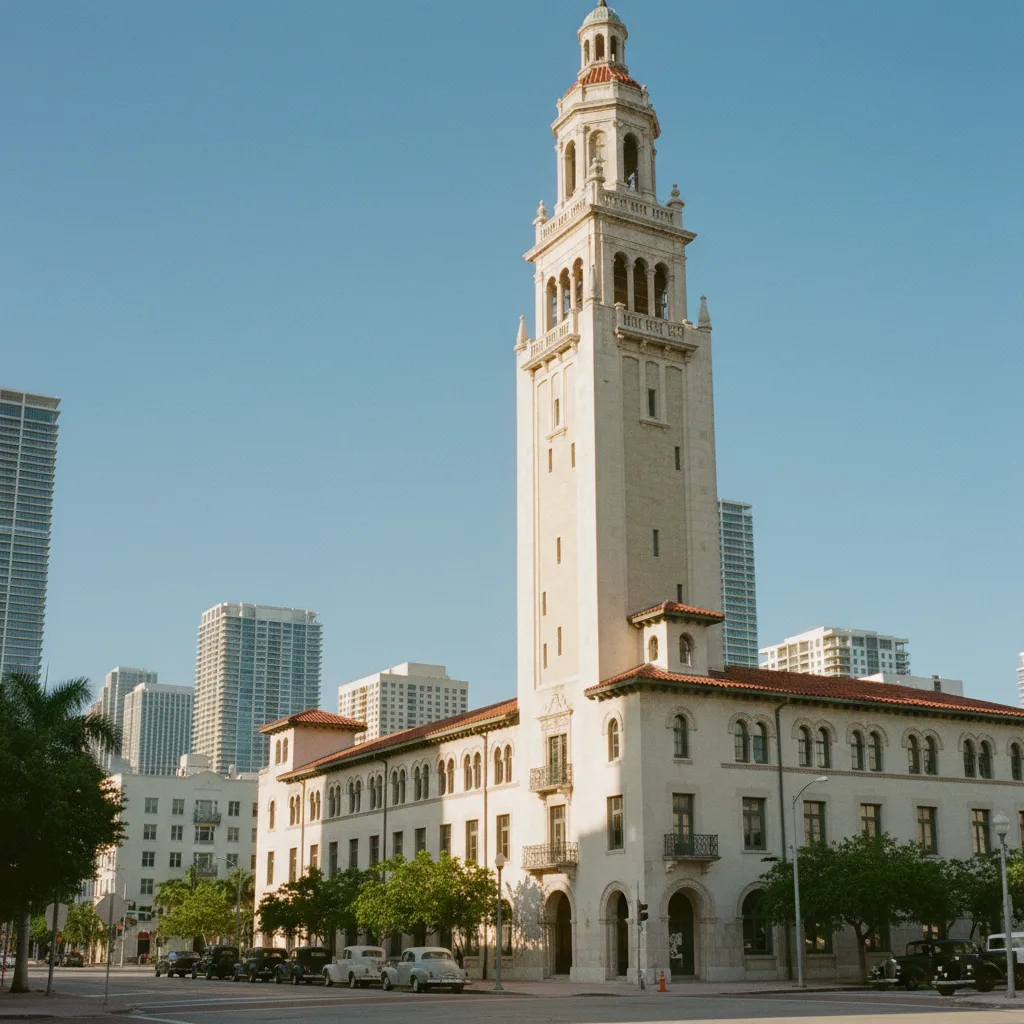
The undisputed architectural icon of downtown's waterfront is the Freedom Tower at 600 Biscayne Boulevard, designed in 1925 by celebrated New York architects Schultze and Weaver. Standing seventeen stories tall, the tower's design was directly inspired by the Giralda bell tower of the Cathedral of Seville in Spain, featuring an ornate Spanish Renaissance cupola, cast-concrete heraldic shields, and intricate Corinthian pilasters. Built originally as the home of The Miami News, the tower served as an imposing beacon greeting passenger steamers arriving in the port.
Beyond its architectural brilliance, the Freedom Tower holds profound historic significance as the federal processing center for over four hundred thousand Cuban refugees between 1962 and 1974, earning it the affectionate moniker 'The Ellis Island of the South.' Designated a National Historic Landmark in 2008, the building stands as an enduring monument to freedom and immigration, its yellow-ochre masonry and decorative wrought-iron balconies glowing brilliantly against the modern waterfront skyline.
The Ingraham Building and Banking Palaces
Heading south along Southeast 2nd Avenue brings walkers to the Ingraham Building at 25 Southeast 2nd Avenue, another Schultze and Weaver triumph completed in 1927. Named in honor of railway pioneer James Ingraham, this thirteen-story limestone and brick office edifice was explicitly modeled after the Florentine Palazzo Strozzi in Italy. Its heavy rusticated stone base, classical arched entrance, and deep dentil cornice demonstrate the dignity of early twentieth-century corporate headquarters.
Step inside the ground-floor arcade to witness one of the finest historic interiors in Florida, featuring a barrel-vaulted ceiling adorned with hand-painted polychrome frescoes, brass elevator doors, and polished terrazzo floors with geometric borders. The building's bronze directory board and ornate pendant chandeliers remain preserved from its opening season. A block to the west on 1st Avenue stands the Security Building at 117 Northeast 1st Avenue, erected in 1926 by architect Robert Greenfield. Featuring a dramatic French Second Empire copper mansard roof, classical arched colonnade, and rusticated limestone piers, it housed the Capital National Bank and remains a premier example of Boom-era financial opulence.
Atmospheric Theaters and Sacred Monuments
At 174 East Flagler Street, the Olympia Theater at the Gusman Center represents an extraordinary union of Mediterranean Revival exterior massing and Atmospheric fantasy. Completed in 1926 by master theater architect John Eberson, the theater was engineered as an escape into an open-air Spanish courtyard under a twilight sky. Eberson installed hidden projectors that cast drifting clouds across a royal blue ceiling embedded with twinkling crystal stars, surrounded by faux balconies, Moorish turrets, and classical statues.
Further north at 118 Northeast 2nd Street stands Gesu Church, the oldest Catholic parish in Miami, constructed in 1925 by architect Owen B. Hunter. Its majestic facade combines Spanish Baroque curvilinear gables with Venetian Gothic arches, constructed from warm cast stone that resists marine winds. The interior contains priceless antique stained glass windows crafted by Franz Mayer and Company of Munich, casting gem-toned light across carved wooden pews, side chapels, and historic vaulted naves.
Courthouse Ziggurats and Pedestrian Strategy
At 73 West Flagler Street, the Old Miami-Dade County Courthouse rises twenty-eight stories into the sky, completed in 1928 by architects A. Ten Eyck Brown and August Geiger. For decades it reigned as the tallest building south of Atlanta, capped with a stepped Babylonian ziggurat and a pyramid roof. Its neoclassical colonnade of Raymond granite and terra cotta friezes housed both city jail cells and historic courtrooms where pivotal civil rights and labor trials unfolded across twentieth-century South Florida.
When planning your walking route, morning between 8:30 and 11:00 AM offers ideal east-facing illumination on the facades along Biscayne Boulevard and 2nd Avenue, while building canyons provide comfortable shade from the Florida sun. The lower angle of morning light emphasizes the deep relief of carved limestone pilasters and terra cotta pediments. Avoid walking late on weekend evenings when ground-floor commercial offices are shuttered; weekday lunch hours provide lively foot traffic, open building lobbies, and the full metropolitan pulse of the historic financial center.
Practical Transit and Downtown Walking Notes
Downtown Miami offers the best public transit connectivity in South Florida, making an architectural walk completely car-free. Take the free, elevated Metromover system, disembarking at the Freedom Tower Station, Government Center, or First Street Station to step directly onto the historic sidewalks. The walking loop connecting the Freedom Tower, Ingraham Building, Gesu Church, and County Courthouse spans approximately 1.5 miles of paved urban sidewalks.
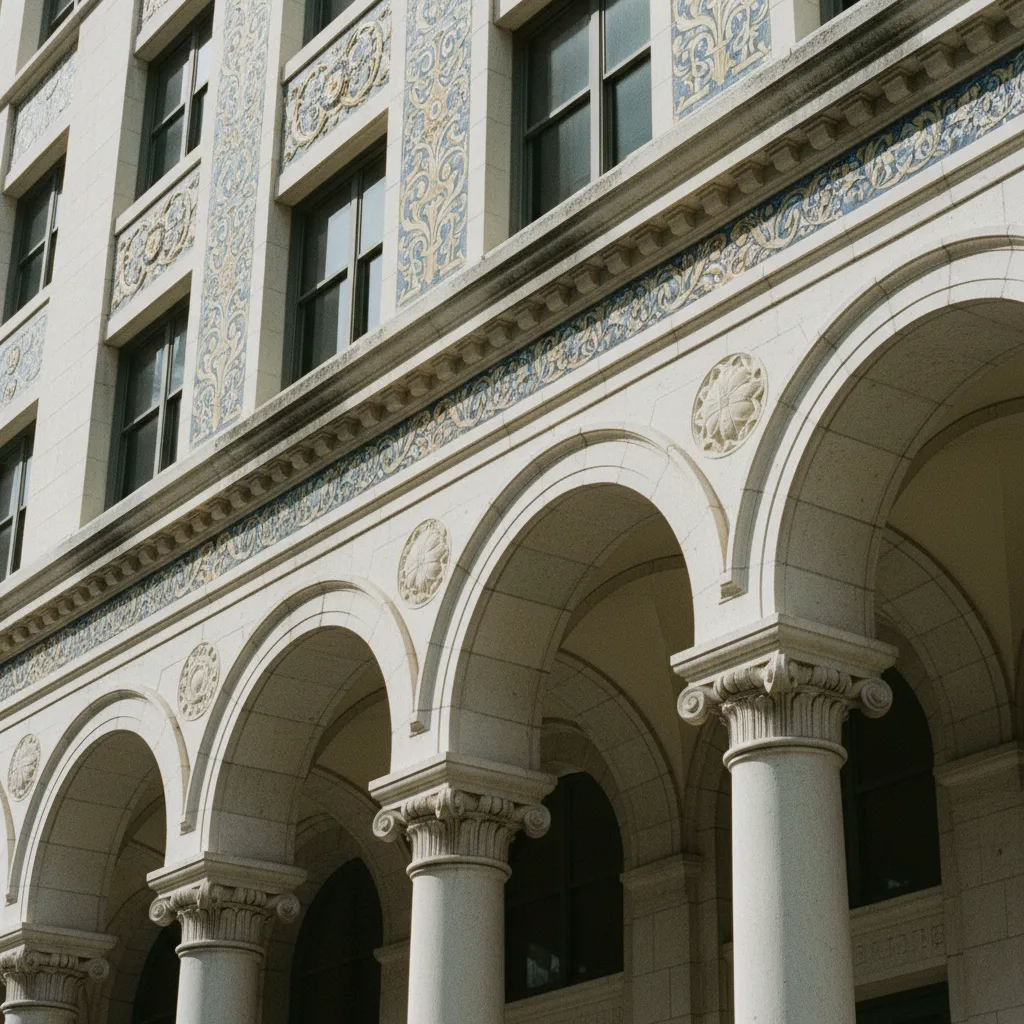
Take time to inspect the decorative terra cotta reliefs at street level, which often feature stylized Florida flora, alligator crests, sailing galleons, and classical acanthus leaves crafted by master modelers. Use Karpo APP to navigate transit transfers between Metrorail and Metromover, track self-guided walking routes through downtown corridors, and discover historic landmarks tucked away between modern downtown towers.
Ask Karpo for more information.
Keep reading
- Brickell Tailor Alteration Shop Finder: First Work Suit Fit
 Coconut Grove Tailor Alteration Shop Finder: Heat-Proof Fits
 Little Havana Tailor Alteration Shop Finder: Guayabera Fits