 Brickell Tailor Alteration Shop Finder: First Work Suit Fit
Neighborhood Guides
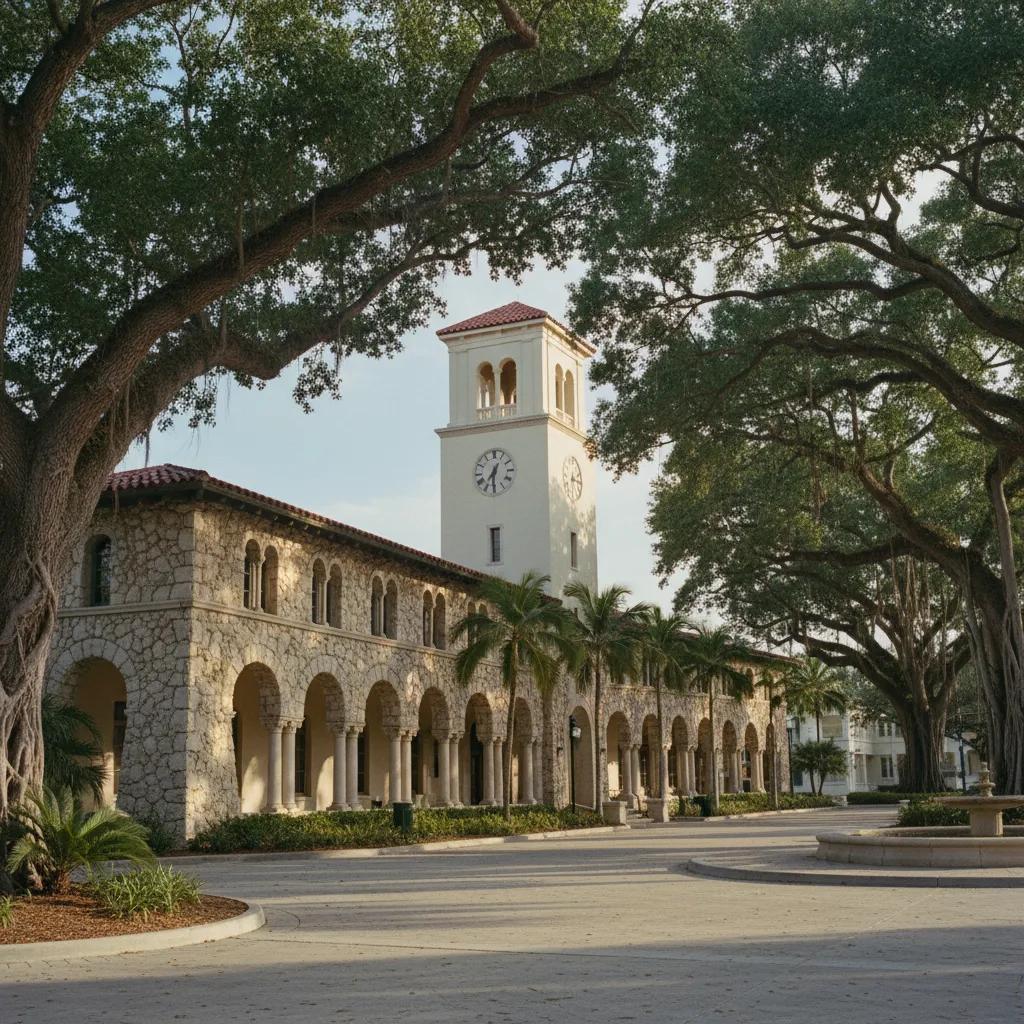
Coral Gables: Free Architectural Landmark Walk in Miami
Enjoy a free architectural landmark walk through Coral Gables to explore Mediterranean Revival plazas, hand-carved coral rock arches, and Spanish loggias.
Conceived in the early 1920s by visionary developer George Merrick, Coral Gables was designed from its inception as a meticulously planned paradise rooted in the City Beautiful movement. Rather than allowing haphazard subdivision, Merrick assembled a team of master architects, landscape designers, and artists to establish a unified Mediterranean Revival aesthetic across Southern Florida. Tracing the historic civic axis from Miracle Mile down Biltmore Way toward Anastasia Avenue offers a magnificent self-guided architectural landmark walk through shaded colonnades, native oolitic limestone arches, and grand Spanish baroque plazas.

George Merrick and the City Beautiful Plan
Merrick envisioned Coral Gables not as a standard real estate development, but as a Mediterranean dream city woven with Spanish, Italian, and Moorish architectural motifs. Working alongside his uncle, artist Denman Fink, and supervising architect Phineas Paist, Merrick instituted strict zoning codes that mandated red barrel-tile roofs, exterior stucco in warm earth tones, and generous setbacks for public greenery. Wide boulevards were aligned with mature live oaks and weeping banyans to provide continuous shade, creating a pedestrian realm where architecture and nature harmonized seamlessly.
The founding core of Merrick's vision began at his family homestead, the Coral Gables Merrick House at 907 Coral Way, begun in 1899. Built from native coral rock quarried directly on site and framed with dense Dade County pine, this pioneer vernacular residence demonstrated how local fossilized stone could withstand hurricanes and heat. Merrick transformed his family's citrus groves into a monumental metropolis, utilizing the very limestone extracted from the ground to pave roadways and erect municipal monuments.
Phineas Paist and the Civic Masterpieces
At the eastern terminus of Biltmore Way stands the Coral Gables Colonnade Building at 169 Miracle Mile, designed by Phineas Paist in 1926. Originally constructed as Merrick's primary sales office, the structure commands the street with its colossal neoclassical colonnade, ornate cast-stone entablature, and soaring central rotunda. Paist ingeniously blended Spanish baroque ornamentation with classical monumentalism, reassuring prospective home buyers during the Florida Land Boom that Coral Gables was an enduring institutional city rather than a temporary frontier town.
Proceeding southwest along Biltmore Way leads to the undisputed civic crown of the district, Coral Gables City Hall at 405 Biltmore Way. Completed in 1928 by Paist and Harold Steward, this three-story semi-circular masterpiece is listed on the National Register of Historic Places. The building curves gently to meet the convergence of five roadways, showcasing a grand Corinthian colonnade carved from local coral stone, an imposing three-tiered bell tower, and a painted interior rotunda ceiling executed by Denman Fink depicting the four seasons.
The Poetry of Native Coral Stone and Spanish Tiles
A defining hallmark of Coral Gables architecture is the expressive use of oolitic limestone, commonly known as coral rock, quarried from prehistoric Pleistocene sea deposits across the Miami ridge. Unlike quarried marble or granite imported from the north, local coral rock is porous, riddled with fossilized sea shells, and soft enough when freshly excavated to be shaped with hand chisels before hardening upon exposure to air. Paist and his craftsmen left the stone rough-faced, giving public gateways, retaining walls, and facades a romantic, centuries-old European patina.
Paired with this rugged stonework are genuine Spanish barrel tiles, known as tejas, laid across hipped roofs and covered arcades. During the construction boom, Merrick imported hundreds of thousands of antique clay tiles reclaimed from historic buildings across Spain and Cuba to ensure irregular textures and variegated terracotta hues. Notice how the covered arcades and projecting loggias along Biltmore Way provide continuous shelter from sudden subtropical downpours while framing picturesque street vistas.
The Venetian Fantasy and Giralda Spire
A short detour south along de Soto Boulevard brings you to the Venetian Pool at 2701 de Soto Boulevard, another genius collaboration between Paist and Denman Fink completed in 1924. Merrick needed vast amounts of limestone to build his city, so Paist transformed the resulting four-acre limestone quarry pit into a romantic Venetian lagoon complete with stone bridges, covered loggias, and mooring posts. The facility remains an extraordinary example of adaptive landscape infrastructure integrated into civic architecture.
Continuing further south reveals the towering silhouette of the Biltmore Hotel at 1200 Anastasia Avenue, designed by Schultze and Weaver in 1926. Its majestic 315-foot tower is a faithful homage to the historic Giralda bell tower of the Seville Cathedral in southern Spain. The hotel's grand open loggias, vaulted ceilings hand-painted with Renaissance heraldry, and sprawling colonnaded terraces represent the apex of 1920s resort luxury, standing as a beacon visible across the tree canopy for miles.
Walking Strategy and Shaded Promenade Tips
The optimal walking window for exploring the civic core of Coral Gables is late morning between 9:00 and 11:30 AM, or late afternoon from 3:30 to 5:30 PM. The towering banyan trees along Biltmore Way and Coral Way provide dense overhead canopies, making this walk significantly cooler than exposed oceanfront boulevards. Skip midday driving down Miracle Mile, where heavy traffic and metered parking detract from the architectural rhythm; this corridor is strictly built to be experienced on foot.
Start your walk at the Colonnade Building, stroll down the wide central parkway of Biltmore Way past historic plazas and civic monuments, and pause in the public courtyard of City Hall to admire the fountain and stone balustrades. Respectful visitors may enter the public rotunda of City Hall during standard weekday municipal hours to examine the interior frescoes and marble staircases without any admission charge.
Practical Notes for Exploring Coral Gables
The walking distance from the Colonnade on Miracle Mile to Coral Gables City Hall and the surrounding plazas is an easy 1.2 miles round-trip on level, tree-shaded sidewalks. Transportation is seamless via the free Coral Gables Trolley, which connects the Douglas Road Metrorail Station directly to Miracle Mile, Ponce de Leon Boulevard, and the civic center corridor. Bicycle parking and shady public benches are plentiful throughout Segovia Plaza and Biltmore Way.
After completing the civic walk, wander north toward the historic Coral Way residential gates to see how Merrick scaled grand civic motifs into modest single-family Mediterranean homes. Use Karpo APP to check real-time trolley schedules, chart walking routes through the lush suburban garden sections, and locate nearby historic landmarks across the Coral Gables preservation district.
Ask Karpo for more information.
Keep reading
- Brickell Tailor Alteration Shop Finder: First Work Suit Fit
 Coconut Grove Tailor Alteration Shop Finder: Heat-Proof Fits
 Little Havana Tailor Alteration Shop Finder: Guayabera Fits