 Costume Rental Near Me in Williamsburg: Hit and Run Productions Archive
Hidden Gems & Odd Finds

McGolrick Park's Civil War Ironclad Monument When Greenpoint Dog Walkers Circle at Dusk
A forgotten Civil War naval monument anchors Greenpoint's evening dog run ritual, where neighborhood regulars gather nightly around an elaborate memorial to the USS Monitor while their pets socialize and history quietly recedes.
Most monuments demand attention through scale or placement. McGolrick Park's tribute to the USS Monitor does neither. Tucked into a residential corner of Greenpoint, the granite-and-bronze memorial occupies the center of what has become, by evening ritual and canine consensus, the neighborhood's unofficial dog parliament. As dusk settles over the park, the ironclad warship that revolutionized naval combat becomes a backdrop for leash juggling and tennis-ball retrieval. History here doesn't shout. It waits, patient and largely unread, while the living claim the space for softer purposes.
The Monument Nobody Stops to Read
The monument was erected in 1938 to commemorate the USS Monitor and Greenpoint's shipbuilding history, commemorating Greenpoint's role in Civil War naval construction. By the time the memorial went up, the neighborhood's shipbuilding glory had already faded, the Continental Iron Works long shuttered. The timing lent the monument an elegiac quality from the start—a remembrance of a remembrance, bronze figures frozen in gestures few passersby could contextualize. The Works Progress Administration funded the project during the Depression, part of a broader effort to memorialize American history while putting sculptors and stoneworkers back to work. The irony wasn't lost on everyone: building monuments to past industrial glory while present industry crumbled.
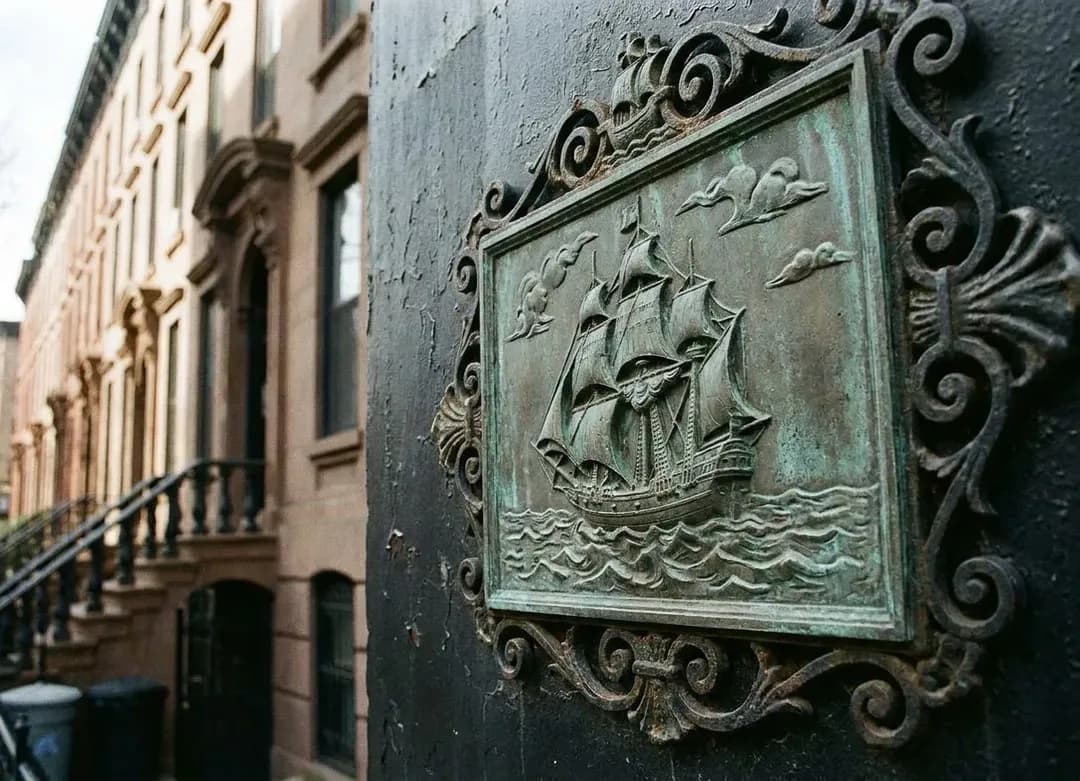
Interpretive plaques explaining the ironclad's design and the neighborhood's shipbuilding history are mounted on the monument's base but often overlooked, their text weathered but legible for anyone who pauses. Most don't. The monument functions instead as landmark-by-habit: meet me at the Monitor, third bench from the ironclad, you know the spot. The plaques describe how John Ericsson's revolutionary rotating turret changed naval warfare forever. The dogs couldn't care less. On rare occasions, a history teacher brings a school group through, gathering students around the base for a lesson that competes poorly with the distraction of playing dogs and the ambient life of the park. The kids squint at the plaques, take photos for assignments, and leave—the information retained just long enough for the test.
The Evening Assembly
The evening dog walker congregation gathers in the early evening, with regulars often occupying the same areas. There's a social geometry to it, unspoken but observed: the border collie contingent favors the north side, the small-dog diplomats claim the eastern benches, and the mixed-breed moderates circulate in between. By late 2026, the rhythm has calcified into neighborhood infrastructure, as reliable as the G train's delays. Newcomers to the ritual learn quickly which unwritten rules matter—pick up after your dog, don't let the aggressive one off-leash, remember people's dogs' names even if you forget their owners'. The monument serves as the central anchor point, the place where sight lines converge and where lost dogs inevitably return.
Watch long enough and you'll notice how the humans negotiate space around the monument's base while their dogs map the territory in scent and sprint patterns. Conversations layer over one another—apartment renovations, school waitlists, which bodega still stocks the good kibble. The Monitor's bronze sailors gaze toward the horizon, oblivious. It's one of the city's free things to do that costs only time and tolerance for cold noses and tangled leashes. Friendships form here with the peculiar intimacy of repeated proximity: you might not know someone's last name, but you know their dog's hip dysplasia diagnosis and their opinion on the building going up on Franklin Street.
The Neighborhood That Built Warships
Walk west from McGolrick Park toward the former Continental Iron Works area in Greenpoint; the exact former shipyard footprint should be verified before naming current uses—but the street grid still follows the old industrial logic, wide enough for hauling massive iron plates and ship components. In the 1860s, this stretch of Greenpoint shoreline rang with the sound of hammers on metal, the glow of foundries visible across the East River. The neighborhood built more than the Monitor; it produced engines, boilers, and components for dozens of Union vessels. The work was dangerous, loud, and lucrative. It transformed Greenpoint from a quiet township into an industrial powerhouse practically overnight.
Today's Greenpoint residents—the ones circling the Monitor monument with their rescue mutts and designer breeds—mostly arrived after the industrial decline, drawn by cheaper rents that have since stopped being cheap. Few realize they're walking through what was once Brooklyn's foundry district. The warehouses have become artist studios, then tech offices, then luxury residential. The transformation is nearly complete, the last gaps filling in with new construction. Only the street names hint at the past: West Street, Franklin Street, Oak Street—the plain functional names of a working waterfront, not the aspirational monikers developers favor now.

What the Plaques Don't Mention
The ironclad was built a few blocks away, assembled in sections at the Continental Iron Works foundry that once dominated Greenpoint's industrial waterfront. Launch day in January 1862 drew crowds; the ship itself drew skepticism. Critics called it a "cheese box on a raft." Two months later, it fought the CSS Virginia to a draw at Hampton Roads, rendering wooden warships obsolete overnight and proving Ericsson's critics magnificently wrong.
That history lives in the plaques, but the monument itself speaks a different language. The bronze figures—sailors in period uniform, gestures heroic and vague—tell the story naval memorials always tell: duty, sacrifice, the sea's indifference. What they omit is the neighborhood's transformation, the foundries giving way to loft conversions, the waterfront shifting from industry to aspiration. The Monitor became a relic twice: once when it sank, again when the neighborhood forgot how to build such things.
The Light at Dusk
Late autumn light does something particular in McGolrick Park. The sun drops behind the rowhouses on the western edge, and for twenty minutes the monument glows bronze-warm while the rest of the park dims to blue. Dogs become silhouettes. Their humans check phones, half-watching, trusting the pack to self-regulate. The air smells of fallen leaves and wet grass, occasionally punctuated by the yeasty exhale from a nearby brewery. The temperature drops noticeably once the sun disappears, sending the less hardy dog walkers home early, their departures staggered and unhurried.
This is when the park feels most itself—not historic, not notable, just lived-in. The monument anchors the space without insisting on reverence. A terrier mix lifts his leg against the base. A toddler climbs the low wall, supervised loosely. The bronze sailors endure it all with the same stoic expression they've worn since 1938, their war long over, their ship long claimed by the Atlantic.
Why This Matters (or Doesn't)
There's an argument to be made for preservation of memory, for teaching the neighborhood's children about the ironclad's significance, for laminated plaques and QR codes linking to detailed histories. There's an equally valid argument for letting monuments slip into functional obscurity, becoming furniture for the living rather than shrines to the dead. McGolrick Park has chosen, through benign neglect and daily use, the latter path.
The result is oddly democratic. The monument doesn't gatekeep its space or demand solemnity. It simply exists, sturdy and available, while the neighborhood writes new stories around its base. The USS Monitor changed naval warfare. Its memorial changes nothing, demands nothing, and in that humility finds a second life as gathering point, landmark, and—when the light is right—something briefly beautiful.
Practical notes
McGolrick Park is located at Russell Street and Nassau Avenue in Greenpoint, Brooklyn. Nearest subway: Nassau Avenue G train (ten-minute walk). Street parking is residential-permit challenging; consider biking or walking from the train. The park is open dawn to dusk year-round, though dog-walker density peaks in the early evening. The monument stands at the park's center, impossible to miss. Bring a jacket in cooler months—the benches are exposed—and patience for off-leash chaos if you're visiting during the 6 to 7:30 p.m. window. The plaques are readable in good light; bring reading glasses if needed. Accessibility is good: paved paths throughout, though winter ice can complicate navigation.
Tags: #McGolrickPark #Greenpoint #Brooklyn #TheOddEdit #USSMonitor #CivilWarHistory #NYCParks #DogWalkersNYC #NeighborhoodHistory #NavalHistory #BrooklynLife #HiddenNYC #GreenpointBrooklyn #UrbanMemorials #Fall2026
Sources consulted: USS Monitor · McGolrick Park · NYC Parks - McGolrick Park · Greenpointers · New York Times - NY Region
All trademarks are the property of their respective owners.
Ask Karpo for more information.
Keep reading
- Costume Rental Near Me in Williamsburg: Hit and Run Productions Archive
 Costume Rental Near Me in Flatiron: Abracadabra NYC Showroom Floor
 Costume Rental Near Me in NoHo: Albright Fashion Library Archive