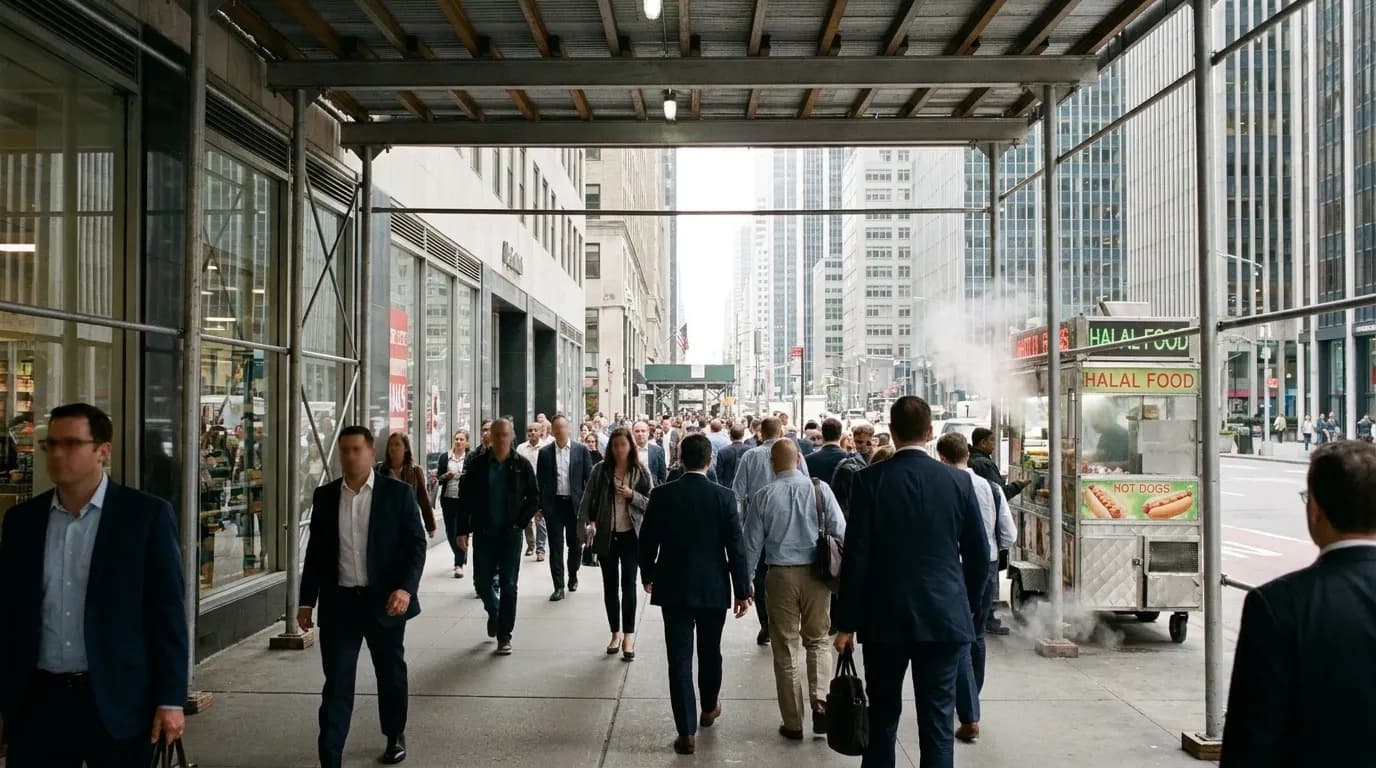
The New York lunch problem is not a shortage of food. It is that four hundred thousand people in Midtown want lunch in the same forty minutes, and every counter within walking distance absorbs that the only way a counter can. The fix is not finding a secret restaurant; it is choosing formats that are structurally fast and shifting your hour by fifteen minutes.
The difference between a ten-minute lunch and a forty-minute one is mostly format and timing. Ask Karpo what is quick near you now.
The twelve formats, ranked by speed
Fastest first. The halal cart, ninety seconds, a full platter of chicken or lamb over rice. The bodega griddle, three minutes, a hot sandwich made to order. The pizza counter, one minute for a reheated slice. The Chinese roast meat window, ninety seconds for pork or duck over rice. The dumpling and bao counter, two minutes. The banh mi shop, two minutes.
Then: the salad or grain bowl counter with a fixed menu rather than a build-your-own, four minutes. The deli sandwich counter, five minutes. The Japanese lunch set, seven minutes seated. The taqueria, five minutes. The food hall stall, variable but usually fast. And the sit-down lunch special at a proper restaurant, twenty-five to forty minutes but the best value of the twelve.
What makes a format slow
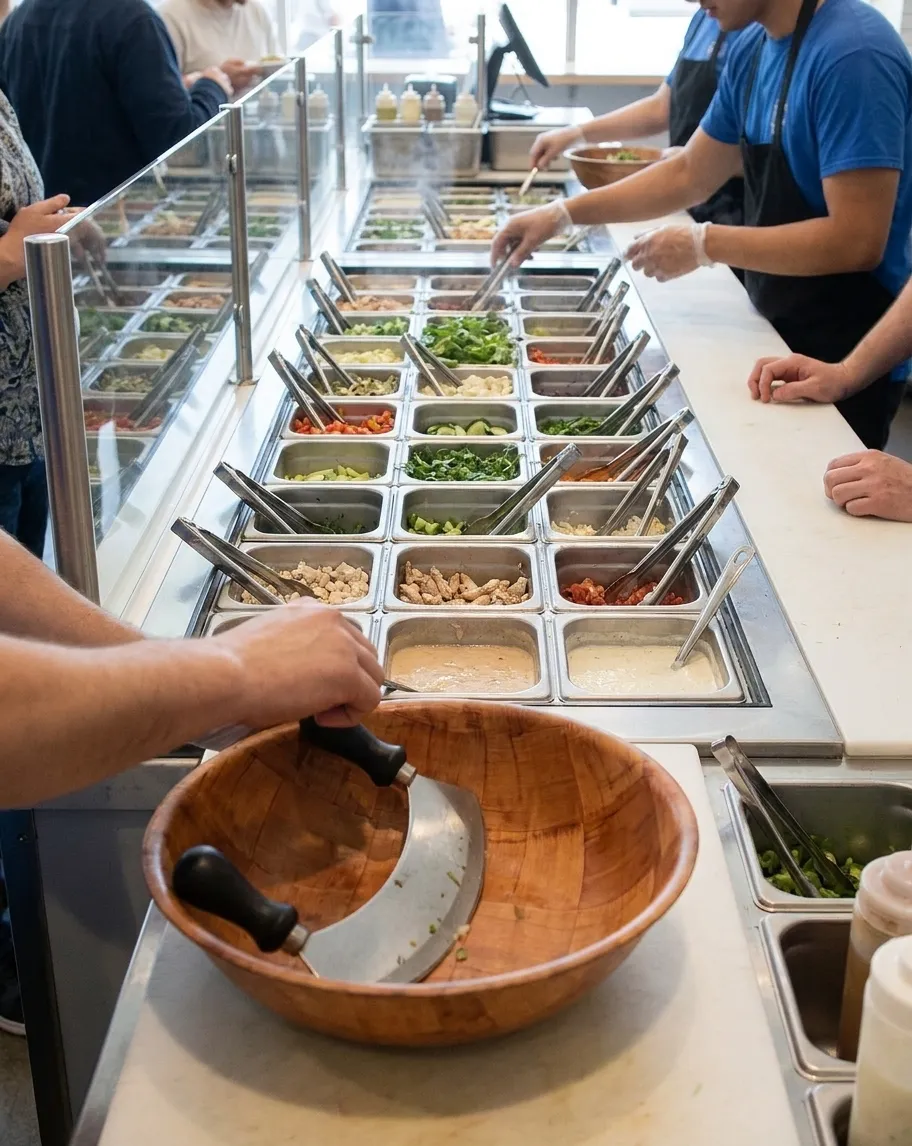
Individual composition. A build-your-own bowl with a dozen choices is slow regardless of how many staff are working, because every customer is making twelve decisions at the counter. A single fryer with limited capacity bottlenecks the whole queue. And any place where one person is both taking orders and cooking will move at the speed of one person.
The tell at the door is how fast the queue moves, not how long it is. A twenty-person line at a halal cart is four minutes; a six-person line at a made-to-order bowl shop can be fifteen. Watching a queue for ten seconds is a better use of time than reading a review.
Timing, which is half the answer
The Manhattan lunch peak is sharp: roughly twelve-fifteen to one o'clock. Going at eleven-forty-five or after one-fifteen changes the queue at almost any counter by a factor of three or four. There is a second lull between about twelve-fifty and one-ten, when the first wave has been served and the second has not yet arrived.
This is the single highest-leverage adjustment available and it costs nothing. If your calendar allows an early or late lunch even twice a week, that is an hour a week returned.
The sit-down exception
One format is worth breaking the speed rule for. A weekday lunch special at a proper restaurant — a Japanese set, a Korean lunch, an Indian thali, a two-course prix fixe — takes thirty to forty minutes and costs a fraction of what the same kitchen charges at dinner. If you have an hour rather than half of one, that is comfortably the best value meal available in New York, and it is a genuinely different experience from eating at a counter. Twice a week is a reasonable ambition.
Where the hidden capacity is
One block off the main drag. Office workers walk in a predictable radius, and the counters just outside it — up towards Chinatown from the Financial District, east towards the water, north of the Midtown core — have the same food and a fraction of the queue. A three-minute walk regularly saves fifteen minutes of standing.
Food halls look busy and are usually faster than they appear, because a dozen counters share one crowd and the shortest queue is frequently the best stall. And the city's privately owned public spaces — the atriums and plazas built into large office developments in exchange for extra floor area — are a network of free indoor and outdoor seating that most people walk past. Several have tables, and none require a purchase.
Where to actually sit
The other half of a New York lunch is somewhere to eat it, and the city has more free seating than almost anyone uses. Privately owned public spaces — the atriums, plazas and terraces built into large developments in exchange for extra floor area — are scattered through Midtown and Lower Manhattan, are legally open to everyone, and are marked with a small plaque rather than a sign. Several are indoor, heated and half empty at one o'clock. Add the parks, the plazas around Bryant Park and the Seaport, and the seating problem largely solves itself.
Ordering ahead
Mobile ordering is genuinely effective at the chains and underused at independents. A great many New York counters take a phone order and will have it bagged in ten minutes, which removes the queue entirely. This is more effective than any app deal because you are skipping a line rather than saving a dollar.
The caveat is that at the very busiest counters, ahead-orders and the physical queue compete for the same kitchen, so a shop that is overwhelmed will be late on both. Ordering ahead works well at a busy counter and brilliantly at a moderately busy one — another argument for the eleven-forty-five approach.
A final note about the weekend, which inverts everything above. Midtown and the Financial District are empty on a Saturday and most of their lunch counters are closed, while the neighbourhood restaurants in Brooklyn, Queens and the residential parts of Manhattan carry the load and have queues that are far worse than anything on a weekday. If you are looking for lunch at noon on a Saturday, the whole map above should be read backwards.
Practical notes
Watch queue speed rather than queue length. Shift lunch fifteen minutes either side of the peak. Walk one block off the main corridor. Carry a little cash for carts. Weekday lunch specials at sit-down restaurants are the best value in the city and are almost always weekday-only. And note that many counters close between services in the mid-afternoon, so a two-thirty lunch has fewer options than you would expect.
Tags: #NYC #NewYorkCity #Lunch #LunchNearMe #QuickLunch #Midtown #FinancialDistrict #Chinatown #HalalCart #Bodega #FoodNearMe #NYCEats #OfficeLunch #FastFood
All trademarks are the property of their respective owners.
Ask Karpo first
Want to know which counters near you are moving fastest right now, which take orders ahead, and where there is somewhere to sit? Ask Karpo before you leave the desk.