 Greenwich Watercolour Mops Quill Brush Picker: Wet Skies
Hidden Gems & Odd Finds

Secondhand Bookshop Near Me: What to Find at Any Amount of Books
A practical guide to Any Amount of Books on Charing Cross Road: window displays, changing stock, and a flexible West End reading walk.
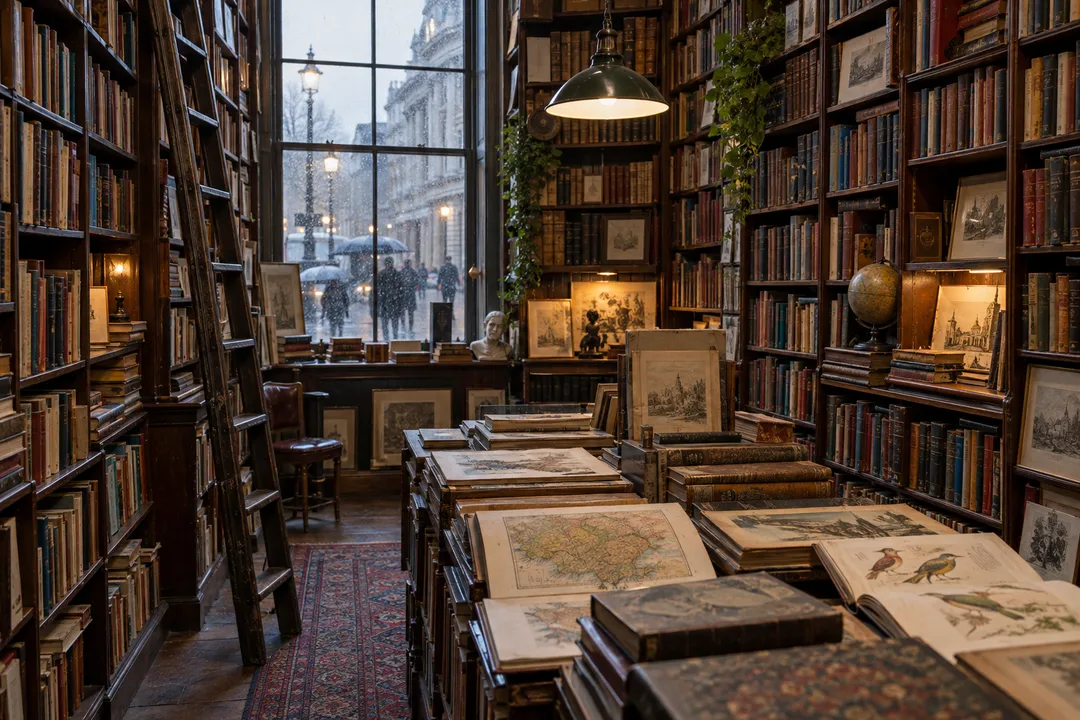
Any Amount of Books: begin with the shelves that match your mood. Any Amount of Books does that through a multi-level rummage through literature, history, art, and the unpredictable finds that make Charing Cross Road useful. At 56 Charing Cross Road, London WC2H 0QA, the sensible approach is to slow down at the entrance, read the shop’s strongest shelves first, and only then chase a specific title. The reward is a visit with texture: old paper, mismatched editions, handwritten traces, and the occasional book that changes the afternoon’s direction.
The Slow-Browse Version of the Visit
Any Amount of Books rewards a first pass before a deep dive. This is not a shop to treat like a checkout queue. Give yourself a small route: entrance display, strongest subject section, one unfamiliar shelf, then the tables or special cases. That sequence keeps the visit from becoming a blur of titles and makes it easier to explain what you actually found when you leave. At Any Amount of Books, use the first pass to understand the room. Notice whether the stock is arranged by subject, author, format, language, or a mix of all four. That tells you how to search. If you are looking for a particular writer, scan the surrounding names too. At Any Amount of Books, nearby names can reveal an adjacent tradition more clearly than a new-book display does.
Near the shop, keep your first route narrow. A secondhand shop rewards condition-aware decisions. Check the binding, look for names or inscriptions, and open the middle pages rather than trusting the cover. For a reference book, inspect the publication date. For fiction, decide whether the object itself matters more than having the newest edition. For this shop, the most rewarding question is not simply whether a title is in stock. Ask what kind of reader the section is built for. A multi-level rummage through literature, history, art, and the unpredictable finds that make charing cross road useful becomes more useful when you compare two or three editions and think about what you want to keep: a clean reading copy, an illustrated object, a scholarly reference, or a worn volume with evidence of earlier hands.
Inside the shop, let different browsing speeds coexist. Choose one shelf, finish its first metre, then step back and look for tables, endcaps, or display cases. In a busy Charing Cross Road shop, that prevents the common mistake of spending twenty minutes circling the same obvious titles. It also leaves room to ask a staff member a precise question instead of saying only that you are looking for something interesting.
What to Buy and What to Leave
For a the shop purchase, choose the book that earns a place. Regulars tend to arrive at the shop with a subject in mind. Collectors look for condition and provenance. Casual visitors follow a cover or a handwritten note. Let those different browsing speeds coexist. Keep your voice low, avoid blocking a narrow aisle, and return uncertain books to a visible, sensible place. Those habits sound minor, but they are what keep a small shop pleasant during its busiest hour.
With the shop, avoid the frantic search. A famous title at a low price is fine, but the stronger souvenir is often a modest book with a memorable introduction, unusual illustrations, or a local connection. If the shop’s stock is especially specialist, write down the author and subject of a near miss. At the shop, that note becomes a more useful search brief for the next stop than a vague wish for another old book.
Around the shop, make the neighborhood part of the outing. Do not arrive five minutes before another commitment and expect to make a thoughtful choice. If you have less than half an hour, focus on the entrance display and one section only. If you have a full afternoon, do the opposite: browse once, leave for a walk, and return with a clearer sense of which book is still occupying your attention.
A Neighborhood Route That Leaves Room to Browse
On a return to the shop, change the question. the shop sits in Charing Cross Road, so pair the shelves with a nearby public square, market, museum, café, or a simple street walk rather than trying to stack three distant bookshops back-to-back. The best route has one anchor shop and one optional stop. That way, an unexpected find does not become a scheduling problem. At the shop, the unexpected find becomes the reason to linger.
To reach the shop, use the address as your navigation anchor. The first visit can be about fiction or general reading. On a return to the shop, the second visit can target art, history, travel, children’s books, languages, or a publisher you noticed last time. Because secondhand inventory moves unevenly, the shop’s character may remain stable while the actual shelf changes. That is why a modest local shop can reward several short visits more than one exhaustive expedition.
While choosing at the shop, avoid guessing from the cover alone. The official shop presence is https://www.anyamountofbooks.com/. Treat the posted opening pattern as part of the day’s logistics, not as an invitation to rush. Carry a light bag, leave room for a purchase, and keep a note of any title you want to search later. If the premises are compact, step outside when you need to reorganise. Leave the aisle clear so the next reader at the shop can still reach the shelf.
Practical Notes for This Bookshop
After the shop, keep the rest of the day flexible. Look at the contents page, publication details, translation, and condition. A secondhand recommendation becomes much more personal when you can explain why this particular edition suits the recipient. For children’s or illustrated books, inspect the images and binding. For specialist books at the shop, check whether the bibliography, plates, maps, or index are intact.
Choose the shop when you want a physical search. Save the shop’s name, address, and neighbourhood in the Karpo APP, then ask for a nearby café, park, gallery, or another bookshop after you know how long the browse took. That is more useful than forcing a fixed chain of destinations before you see the stock. Secondhand shopping is partly about timing, and a good local route leaves space for it.
One last the shop detail is worth keeping in mind. Skip it when your only goal is a guaranteed new bestseller in a particular edition. If that is your only goal at the shop, a conventional retailer will be faster. Choose it when you want a physical search, a little uncertainty, and the chance to leave with a book whose value is not obvious from a search result. That is the difference between buying a title and finding a book.
One last detail at the shop is the pace of the visit. Leave with one book if it genuinely earns its place, or leave with a note when the better discovery is still waiting on another shelf. The shop address is 56 Charing Cross Road, London WC2H 0QA.
Ask Karpo for more information.
Keep reading
- Greenwich Watercolour Mops Quill Brush Picker: Wet Skies
 Camden Watercolour Mops Quill Brush Picker: Canal Sketch Kit
 Wood Carving Gouge Profile Picker for Brixton Stamp Blocks