 Bloomsbury Mews Walk Planner: Literary Brick Passages
Neighborhood Guides

Notting Hill Historic Neighborhood Photo Walk: Sunrise Mews
A Notting Hill historic neighborhood photo walk is free and best at sunrise, when Portobello Road's painted shopfronts and quiet mews are empty of crowds.
A Notting Hill historic neighborhood photo walk rewards the photographer who arrives with the street sweepers. At first light Portobello Road is a curving corridor of turquoise, coral and mustard shopfronts with their shutters down, and the side streets hold cobbled mews, wisteria and grand stucco terraces. This free loop links all three on public pavements, ending in the leafy squares off Westbourne Grove before the crowds take over.
A Village That Grew Out of Farmland and a Failed Racecourse
Notting Hill is a surprisingly young neighbourhood by London standards. Until the nineteenth century this was mostly farmland, pig keeping and brick fields, with Portobello Road a country lane leading to a farm. Developers then laid out ambitious estates of tall stucco houses around private communal gardens, and for a brief spell the hill itself was ringed by a horse racing track. The course failed, but its curved shape survives in the crescents that wrap the hilltop today.
That history explains why the area photographs so well. You get several distinct textures within a short walk: the cheerful jumble of painted market buildings, the strict cream rhythm of Victorian terraces, and the small scale of mews houses that once sheltered horses and carriages for the grand homes behind them. Each layer asks for a different approach, from wide colour studies to tight details of doors, knockers and railings.
Portobello Road Before the Stalls Arrive
Start at the Notting Hill Gate end and walk north along Portobello Road. The first stretch is pure colour: two-storey terraces painted in bold shades, each one slightly different from its neighbour. Stand in the middle of the quiet street, carefully and only when it is clear, and let the gentle curve of the road pull the eye into the frame. Wet tarmac after overnight rain doubles the colours, which is worth an extra early alarm.
As you continue, the buildings change from houses to antique arcades and market halls. With their shutters still closed, you can concentrate on architectural detail rather than merchandise: carved brackets, old ironwork, tiled thresholds and faded painted lettering high on brick walls. Saturday is the famous antiques day, so pick another morning if clean frames matter more to you than market atmosphere, or come back later that day specifically to photograph the bustle.
Further north the road dips under the elevated motorway and the mood turns grittier, with railway arches, older market sheds and the stalls of the Golborne end. Many photographers stop at the colourful southern stretch, but continuing gives your set contrast: concrete and shadow against the painted facades you shot earlier. A fast prime helps in the darker passages beneath the flyover, and pushing the exposure slightly keeps the brickwork from turning muddy.
Cobbled Mews and Wisteria Doorways
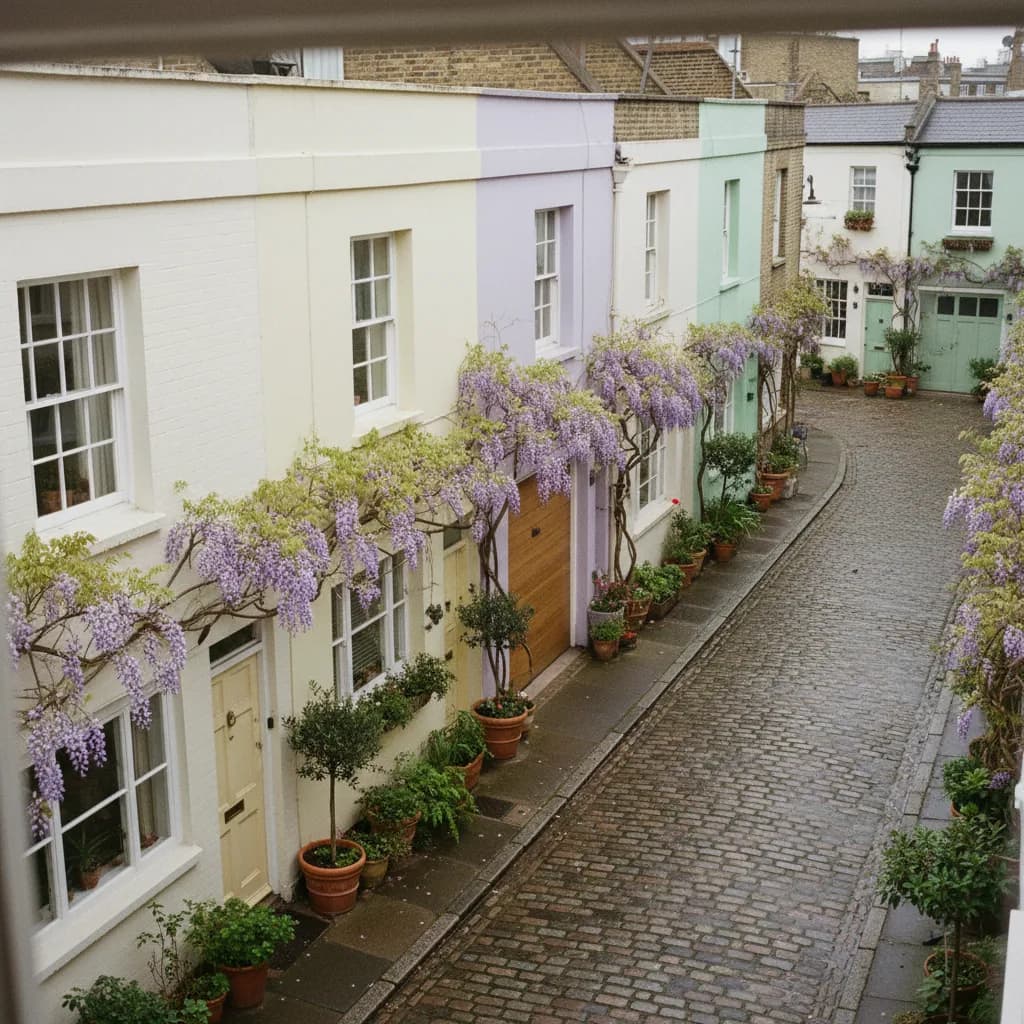
Turn off the main road into the quiet side lanes to find the mews. These narrow cobbled streets were built as stables and coachmen's quarters, tucked behind the larger houses. Today they are some of the most charming homes in London, with pastel walls, potted bay trees, and climbing wisteria that turns purple in spring. Many keep their original wide ground-floor openings, which make strong rectangles of colour when shot straight on.
Composition here is about rhythm and restraint. Use the cobbles as leading lines, keep the frame level so the low rooflines stay crisp, and look for a single splash of colour, perhaps a painted door or a bicycle against a wall. Remember that these are private homes, often with residents leaving for work early. Keep to the edge of the lane, avoid blocking garages, and never photograph through windows or step onto doorsteps.
Overcast skies are a gift in the mews. Soft, even light keeps pale walls from burning out and lets the wisteria and painted doors carry the colour without harsh shadows cutting across the cobbles. A slightly elevated angle, from the top of a public step or the end of the lane, shows the full sweep of the little street and the uneven rooflines that make each mews feel like a hidden village of its own.
Stucco Crescents Around the Hilltop Church
Walk west and uphill toward Ladbroke Grove, where the hilltop church stands at the centre of the old racecourse curve. Around it the streets bend into elegant crescents lined with white and cream stucco villas, many backing onto private communal gardens glimpsed between the houses. The repetition of columns, porches and balconies suits a longer lens, which compresses the facades into a tidy pattern of light and shadow.
Morning sun rakes along these streets from the east, picking out the mouldings on porches and the curves of balconies. Try a vertical frame that takes in a full house from basement railings to roofline, then a horizontal frame that shows the crescent sweeping away. Bare winter trees reveal the architecture most clearly, while summer plane trees create dappled shade that adds depth but can make exposures tricky.
Westbourne Grove and the Leafy Squares
Finish by heading south and east toward Westbourne Grove and the quiet residential squares nearby. Here grand double-fronted villas face railed gardens, and the scale feels calmer than Portobello's bustle. Look for the play between the white facades and the dark green of the square planting, especially when low autumn light hits the upper floors while the street below is still in shade.
This is also a good place to slow down and shoot details: ornate iron balconies, black and white tiled paths, brass door furniture and the occasional surviving coal hole cover set into the pavement. These small objects tell the story of Victorian domestic life and give your final set some variety alongside the wide street views. By the time you reach the boutiques of Westbourne Grove, the neighbourhood will be waking up for coffee.
Timing and Practical Notes
Sunrise to mid-morning on weekdays gives the cleanest frames, while Saturday brings the market energy if you prefer documentary street photography. Spring wisteria season and autumn leaf fall are especially photogenic. The whole loop is walkable in about two hours at a photographer's pace, starts near Notting Hill Gate station and finishes close to Bayswater or Westbourne Park. Bring a light jacket, comfortable shoes for cobbles, and a lens cloth for misty mornings.
If you want help shaping the walk, open the Karpo APP and ask Karpo to order these stops around the time you have, or to suggest a quieter neighbouring street when Portobello starts to fill. It acts as a route planning companion, leaving you free to spend more of the morning watching the light and less of it checking a map.
Ask Karpo for more information.
Keep reading
- Bloomsbury Mews Walk Planner: Literary Brick Passages
 Belgravia Mews Walk Planner: Stucco Arches and Alleys
 Notting Hill Mews Walk Planner: Quiet Painted Lanes