 Haaland Has Seven Goals and Norway Runs Entirely Through Him
⚽️2026 FIFA WORLD CUP

Ramen to KBBQ: Japan and South Korea's LA Comfort Food Map
Japan's squad finds home in Torrance ramen shops and izakayas; South Korea's players hit Koreatown's late-night BBQ and jjigae spots — the Asian World Cup stars' LA food circuit.
Two Squads, Two Neighborhoods
Los Angeles is hosting World Cup matches at SoFi Stadium in Inglewood, and two of Asia's strongest footballing nations — Japan and South Korea — will find something in this city that no other American host can offer: neighborhoods that feel, taste, and operate like extensions of home. Japan has Torrance. South Korea has Koreatown. And the 20-mile stretch of the 405 freeway that connects them will become, for four weeks in the summer of 2026, the most culinarily significant corridor in the World Cup.
Japan's Blue Samurai and South Korea's Taegeuk Warriors have a rivalry that extends beyond the pitch into food, culture, and national pride. When both squads are based in the same metropolitan area, each eating their way through their respective diaspora neighborhood, the parallel becomes impossible to ignore. This is a food map of that parallel — two teams, two cuisines, one city.
Japan in Torrance
Torrance, a city of 145,000 in the South Bay region of Los Angeles County, has the highest concentration of Japanese restaurants, markets, and cultural institutions outside of Japan in the continental United States. The connection dates to the post-World War II era, when Japanese-American families resettled in the South Bay after internment, and was reinforced in the 1980s when Japanese corporations — Honda, Toyota, and Mitsubishi among them — established North American headquarters in the area, bringing thousands of Japanese expatriates and their families.
The result is a food ecosystem that operates at a level of authenticity rare in the United States. Santouka Ramen on Artesia Boulevard, located inside the Mitsuwa Marketplace food court, serves a tonkotsu broth that has been simmering for 20 hours — pork bones broken down into a milky, collagen-rich base that coats the back of the spoon. The shio (salt) ramen is the signature: thin, straight noodles in a clear-ish broth with chashu pork, a seasoned soft-boiled egg, and a small square of pork cheek that melts on contact. A bowl costs $14.50. The line at lunch extends past the bookstore section of the marketplace.
For the Japanese national team, whose players come from clubs across Europe where Japanese food is limited to approximations, Torrance is a reset button. Midfielder Takefusa Kubo, who plays for Real Sociedad in Spain, has spoken about missing the specific texture of properly made udon — the thick, chewy wheat noodles that require a particular kneading technique that most European Japanese restaurants cannot replicate. Marugame Monzo on Sawtelle Boulevard (technically in West LA, but considered part of the broader Japanese food corridor) hand-pulls udon to order and serves it in a dashi broth made from katsuobushi (bonito flakes) and kombu (kelp) that is prepared fresh each morning. A basic kake udon costs $12. The tempura — shrimp, sweet potato, shiso leaf — is fried in cottonseed oil at 340 degrees and arrives within 90 seconds of ordering.
The Izakaya After Dark
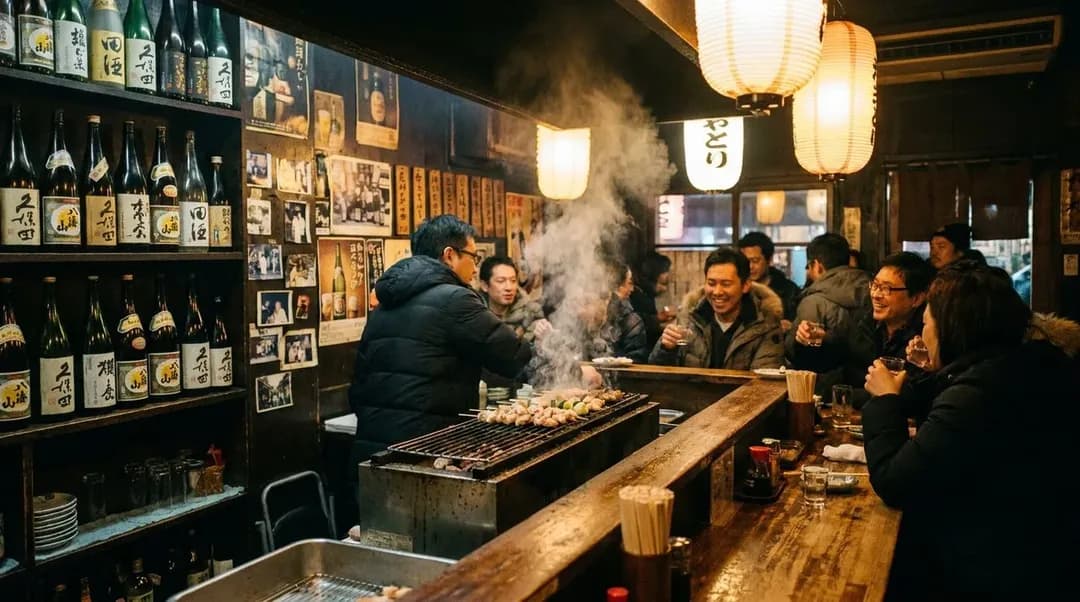
Japanese dining culture has a clear division between daytime eating (lunch sets, ramen, teishoku) and nighttime eating (izakaya — the pub-restaurants that serve small plates designed for sharing over beer and sake). For the national team's rest-day evenings, Torrance's izakaya scene provides the social format that Japanese players grew up with.
Otafuku on Crenshaw Boulevard in Torrance specializes in okonomiyaki — the savory Japanese pancake made from a batter of flour, shredded cabbage, and dashi, topped with pork belly, bonito flakes, Kewpie mayonnaise, and okonomiyaki sauce. The restaurant prepares the pancake on a large teppan griddle at each table, and the cooking process — about eight minutes per pancake — is part of the experience. A pork okonomiyaki costs $16. A large Asahi draft is $8. The combination of a sizzling griddle, cold beer, and the team sitting around a shared cooking surface creates exactly the communal dining experience that izakaya culture is built on.
South Korea in Koreatown
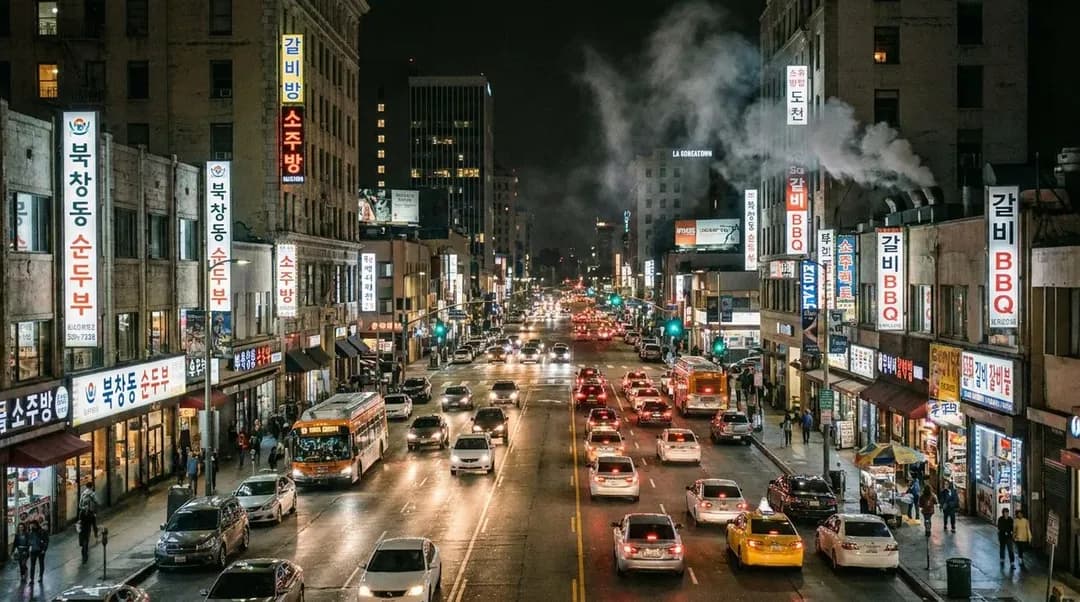
LA's Koreatown occupies a dense rectangle of blocks centered on Western Avenue and Olympic Boulevard, roughly three miles west of downtown. It is the largest Korean community in the United States and, for culinary purposes, the most comprehensive Korean food district outside of Seoul. The neighborhood operates on a schedule that seems designed for professional athletes: many restaurants open for lunch, close briefly in the afternoon, and reopen for a dinner service that extends past midnight.
Park's BBQ on South Vermont Avenue is widely considered the best Korean BBQ restaurant in Los Angeles. The restaurant sources USDA Prime beef and offers a premium cut selection — including a wagyu-grade galbi (short rib) that costs $78 per serving — that exceeds what most Seoul BBQ restaurants provide. The standard BBQ set for two includes marinated galbi, samgyeopsal, and chadol bagi, served with 15 to 18 banchan dishes, for approximately $60 per person. The grills are charcoal — not gas — which produces a smokier, more intense flavor and a char pattern on the meat that gas grills cannot replicate. Reservations are strongly recommended; the wait without one exceeds 45 minutes on weeknights.
For post-match recovery meals, the jjigae (stew) restaurants on Olympic Boulevard offer the Korean equivalent of medicine food. Sun Nong Dan on South Vermont serves a galbi-jjim — braised short ribs in a sweet soy sauce with potatoes, carrots, and glass noodles — that costs $38 and arrives in a pot large enough for two to share. The broth is rich in collagen from the extended braising process, and the carbohydrate density from the glass noodles and root vegetables makes it an effective glycogen-replenishment meal. The restaurant is open until 1 a.m. on weeknights and 2 a.m. on weekends.
The Supply Chain
Both teams' private chefs rely on local markets that stock ingredients unavailable in standard American supermarkets. For Japan, Mitsuwa Marketplace in Torrance — a 70,000-square-foot Japanese supermarket and food court — stocks everything from fresh wasabi root (which loses potency within 15 minutes of grating) to natto (fermented soybeans, a breakfast staple that most non-Japanese find challenging) to the specific brand of short-grain rice — Koshihikari, grown in California's Sacramento Valley — that Japanese chefs consider the minimum acceptable standard.
For South Korea, H Mart on Western Avenue — the flagship of the Korean-American supermarket chain — carries over 300 Korean-specific products including multiple grades of gochujang (fermented chili paste), freshly made kimchi from local producers, and the particular cut of pork belly — skin-on, 1.5 centimeters thick — that Korean BBQ requires. The store is open until 10 p.m. and includes a food court where the team chef can quality-check ingredients before purchasing in volume.
The Corridor
The drive from Torrance to Koreatown takes 30 to 45 minutes on the 405 and 110, depending on traffic — which, this being Los Angeles, means it could also take 90 minutes. But the corridor is the point. Two neighborhoods, two culinary traditions, two national teams, connected by a freeway that runs past SoFi Stadium in Inglewood, where both squads will play their group-stage matches.
On match days, the stadium's parking lots will fill with tailgaters flying Japanese and Korean flags. The smells will overlap: yakitori smoke from one tent, galbi smoke from the next. And after the final whistle, the players will scatter north and south along the 405 — Japan toward Torrance, South Korea toward Koreatown — to eat the food that tastes like the place they miss most. Los Angeles has always been a city that contains other cities. During the World Cup, it will contain Tokyo and Seoul, too.
Tags: #WorldCup2026 #Japan #SouthKorea #LosAngeles #Torrance #Koreatown #Ramen #KBBQ #SoFiStadium #Santouka #ParksBBQ #Mitsuwa #HMart #Izakaya #Udon #ComfortFood
Sources consulted: Japan national football team · South Korea national football team · Koreatown, Los Angeles · Torrance, California · SoFi Stadium · FIFA World Cup 2026
Please drink responsibly. You must be 21 or older to purchase or consume alcohol in California.
All trademarks are the property of their respective owners.
Ask Karpo for more information.
Keep reading
- Haaland Has Seven Goals and Norway Runs Entirely Through Him
 World Cup Trophy Ceremony Timing Medals and Postmatch Celebrations
 Olise and France's Attack: The Semifinal Tactical Question