The Emerald Necklace is a dare disguised as a park system. Frederick Law Olmsted designed it in the late nineteenth century as a chain of green spaces threading through Boston, and walking the full stretch from Jamaica Pond to the Back Bay Fens is a study in urban patience. This is not a shortcut. It's not even particularly efficient. The route takes about two and a half hours if you walk steadily, longer if you stop to watch the light shift on the water or to sit on one of the low stone walls that Olmsted placed with the confidence of someone who understood that rest is part of the design. The walk is one of the better free things to do in the city, though it asks for time in exchange.
Starting at Jamaica Pond
Jamaica Pond sits in a basin surrounded by old trees and a paved loop that draws runners, dog walkers, and people pushing strollers at all hours. The pond loop itself adds an extra mile and a half if walked in full before continuing toward the Fens, and most through-walkers skip it entirely, starting instead at the pond's northern edge near the boathouse. This is practical but slightly regrettable—the full loop offers a chance to settle into the rhythm of the walk, to leave behind whatever urgency brought you here.
The water is glacial, clear in some lights and dark in others. In late autumn, as in most years, the trees around the perimeter turn in uneven waves, the maples flaring orange while the oaks hold onto green. The boathouse rents sailboats in warmer months, but by fall the pond belongs mostly to gulls and the occasional heron standing motionless in the shallows.
Through Olmsted Park
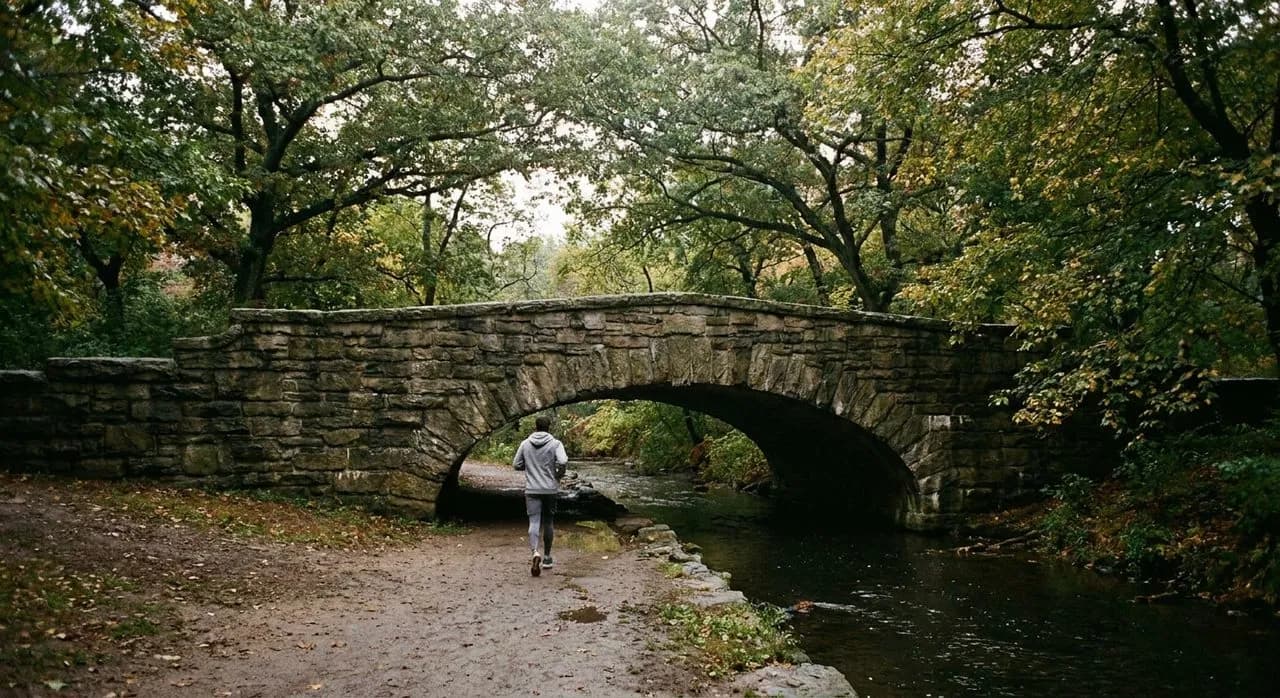
The path northward from Jamaica Pond enters Olmsted Park, where the landscape compresses into something narrower and more intimate. The water here becomes Leverett Pond, then Ward's Pond, small bodies connected by stone bridges and narrow channels. The design is deliberate—Olmsted wanted the parks to feel like a continuous ribbon, a single unbroken gesture through the city. The bridges are low and mossy, their railings worn smooth by a century of hands.
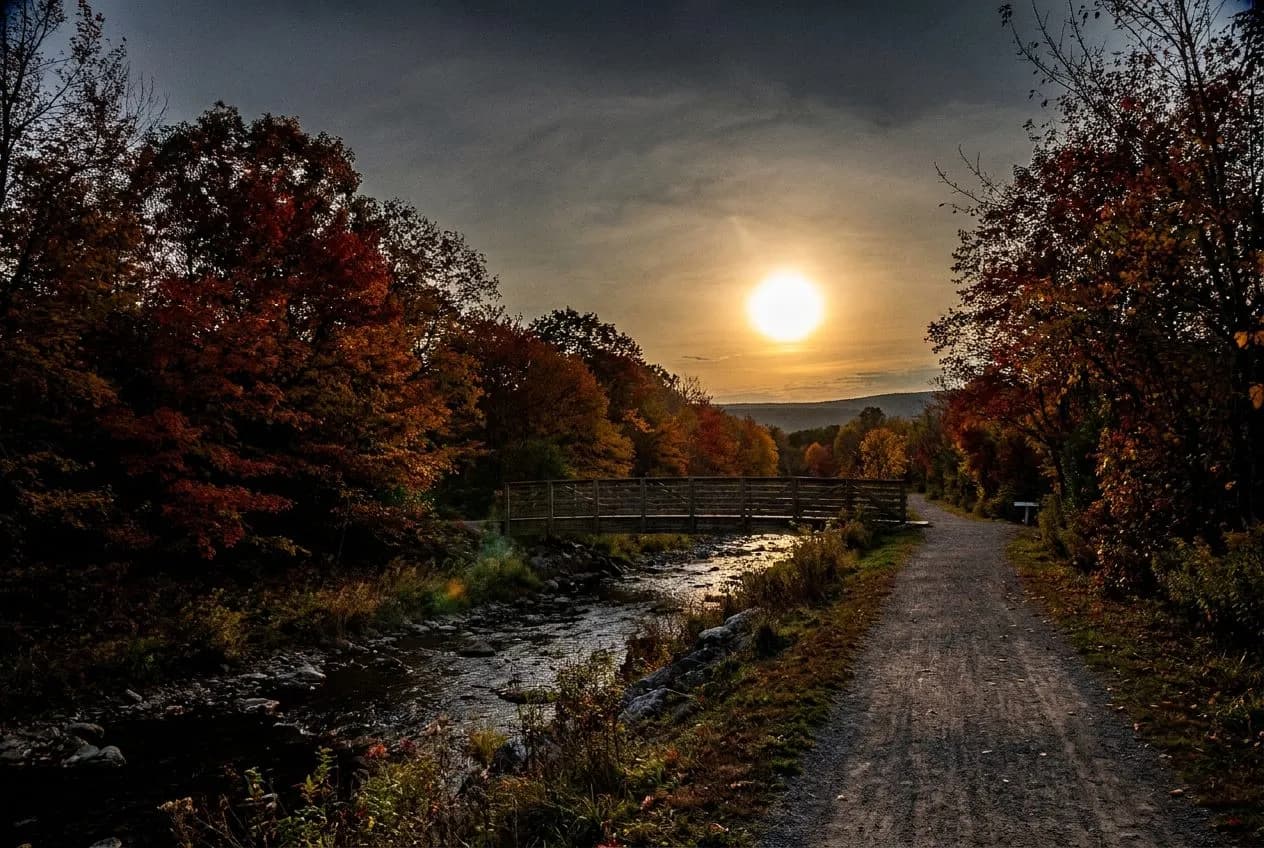
The path weaves close to the water, then pulls away into groves of oak and beech. In fall, the leaf litter mutes footsteps, and the air smells faintly of wet wood and mud. There are benches placed at intervals, always facing the water or a cluster of trees, never the road. You'll hear traffic from the Jamaicaway, but it fades when the path dips into the hollows Olmsted carved to hold sound and light in specific ways.
The Riverway and Its Floods
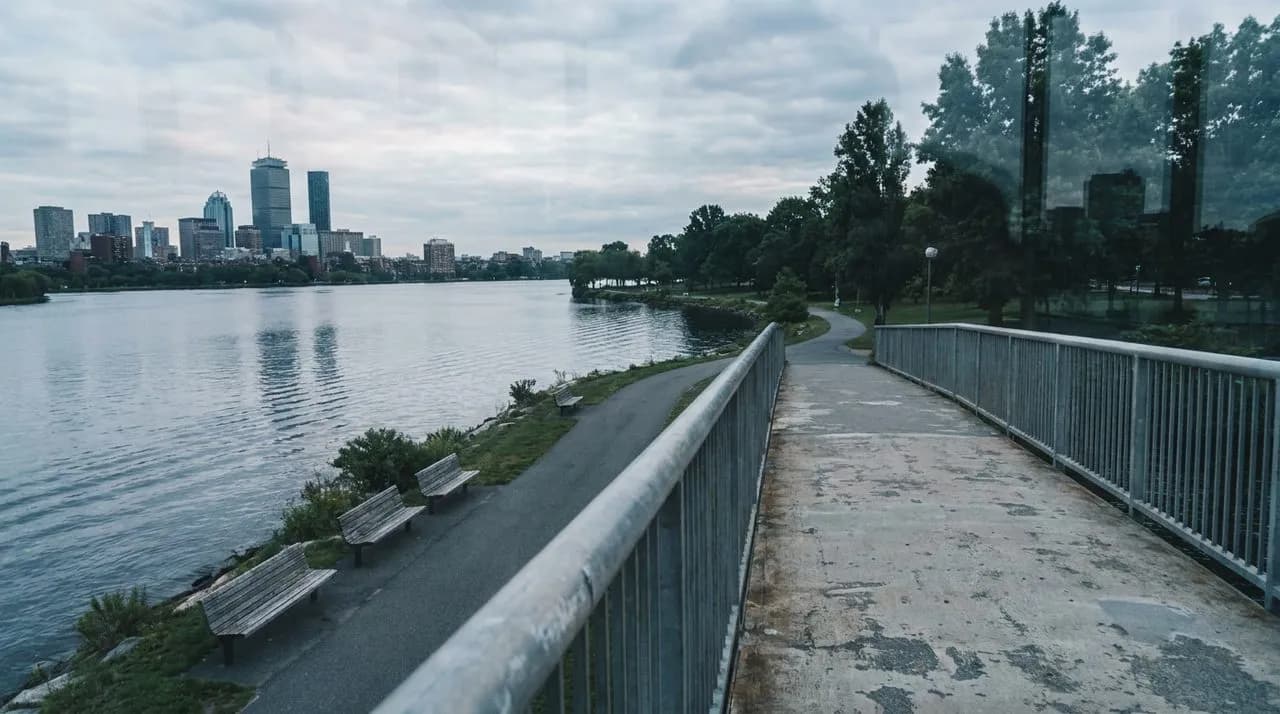
The Riverway is where the system's utility becomes visible. Olmsted designed it as both park and drainage channel, a solution to Boston's chronic flooding problems. The Muddy River—narrow, slow, lined with reeds—runs through the center, and the path follows its curves past Longwood and Brookline Avenue. The landscape here is flatter, more exposed, and the water moves sluggishly when it moves at all.
This section floods during heavy rain, particularly near the Brookline Avenue crossing, where storm runoff overwhelms the drainage system and makes the route temporarily impassable until the water clears. It's worth checking conditions before committing to the walk in wet weather; the detour through surrounding streets breaks the continuity and adds confusion. On clear days, though, the Riverway is all dappled light and willow branches trailing in the current, the kind of scene that looks composed until you remember it was.
Arriving at the Fens
The Back Bay Fens announces itself with a shift in scale and character. The path opens into broader meadows, community gardens, and the formal plantings near the rose garden. By late fall the roses are mostly finished, but the garden itself remains a natural rest stop—the Orange Line to Stony Brook or Green Line to Fenway serve as bookends for the full walk, and the route between the two stations is rarely done in one go without pausing here to sit on the low stone walls or stretch tired legs.
The Fens were originally saltwater marsh, and Olmsted's design transformed them into freshwater wetland while preserving their essential wildness. In 2026 the landscape still carries that tension between cultivation and neglect. The community gardens are meticulously tended, their plots bursting with late-season kale and winter squash, while the meadow edges grow shaggy with goldenrod and wild asters. Egrets wade in the shallow channels, unbothered by the traffic humming along Park Drive.
The Point of the Long Way
There are faster routes between Jamaica Pond and the Fens. You could cut through neighborhoods, catch a train, drive in ten minutes. The Emerald Necklace asks you not to. It insists on the slow accumulation of small shifts—pond to stream to marsh, residential to institutional to urban. The design is not about efficiency. It's about the experience of continuous green space in a city that otherwise moves in blocks and grids.
Walking it in full is a commitment to a different kind of movement, one that measures distance not in miles but in changes of light and texture. The route will take as long as it takes. Your legs will ache near the end. The light will have changed by the time you reach the Fens, and you'll have moved through the city in a way that makes it feel temporarily legible, temporarily whole. That's the point. That's the long way.
Practical notes
The walk begins at Jamaica Pond near the boathouse (Jamaica Plain) and ends at the Back Bay Fens near the Fenway Victory Gardens. Access the start via the MBTA Orange Line to Stony Brook or Green Line E to Heath Street; finish near the Green Line at Fenway or nearby stations on the route. Street parking is available but limited near Jamaica Pond. The parks are open dawn to dusk; paths are paved but may flood near Brookline Avenue in wet weather. Bring water, comfortable shoes, and layers for variable conditions. The route is mostly flat and accessible, though some bridges have slight grades. Verify current path conditions before starting in late fall or early spring.
Tags: #EmeraldNecklace #BostonWalks #JamaicaPond #BackBayFens #TheLongWayHome #OlmstedParks #UrbanHiking #BostonParks #FallInBoston #SlowTravel #CityWalks #FreeThingsToDo #ExploreBoston #WalkableBoston #GreenSpace
Sources consulted: Emerald Necklace · Frederick Law Olmsted · Emerald Necklace Conservancy · Boston Parks and Recreation · Jamaica Pond
All trademarks are the property of their respective owners.