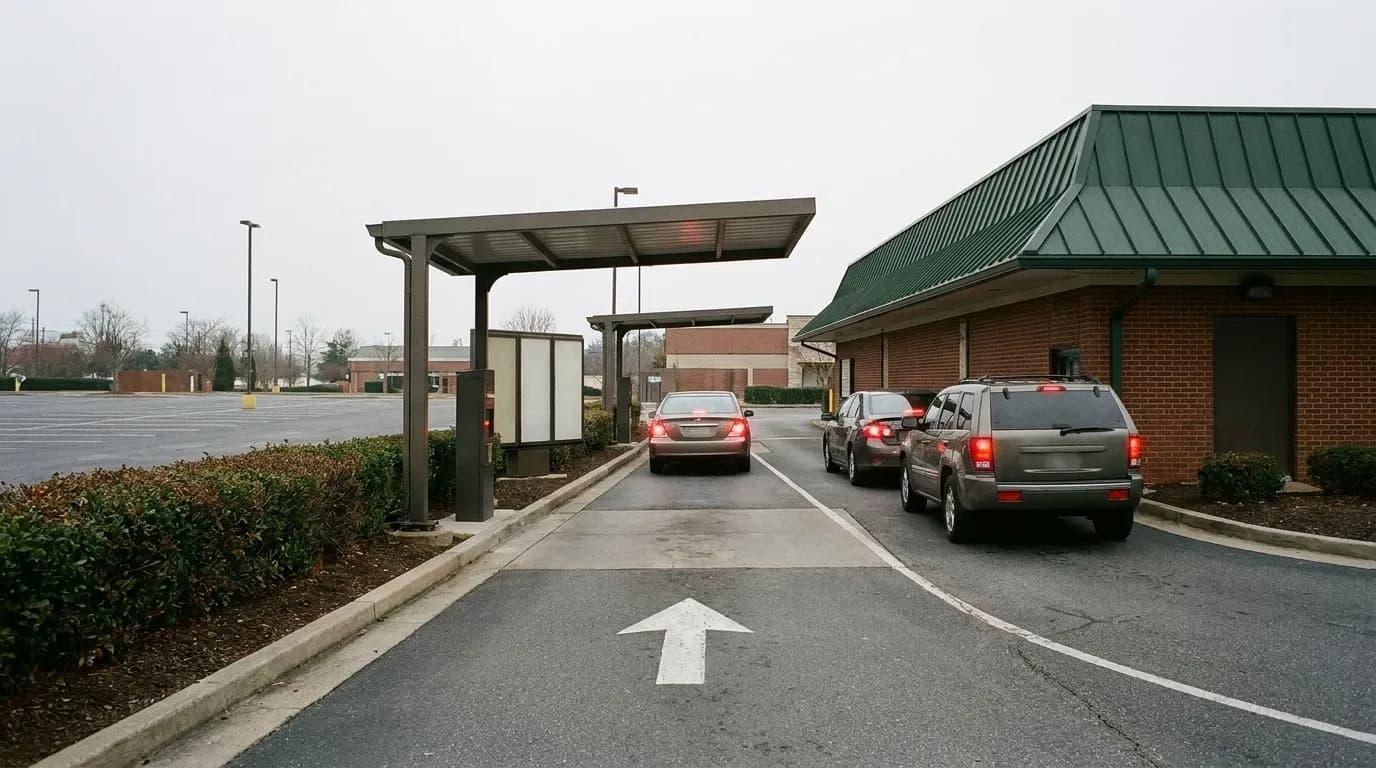
Searching for a drive-thru in New York returns a short and geographically strange list, and the reason is structural. A drive-thru needs a lot with room for a queue of cars, a curb cut, and zoning that permits an accessory drive-through use. In most of Manhattan and large parts of Brooklyn and Queens, at least two of those three are unavailable at any price. The result is a city where the format barely exists, and where the things that replaced it are usually faster anyway.
The drive-thrus that exist here are clustered in a few outer-borough corridors and the queue can be worse than parking. Ask Karpo what is genuinely quickest near you.
Why they are so rare
Land economics is the first reason. A drive-thru lane occupies a substantial amount of ground area that generates no rent, which in a city with New York's land values is an expensive way to use a lot. The second is traffic regulation: a queue of cars waiting to order backs up onto the street, and the city's planning and transportation agencies treat that as a hazard rather than an inconvenience. Several parts of the city restrict new drive-through uses outright.
The third reason is simply that they are not needed. In a city where most people do not drive to buy food, a counter with a fast line serves the same purpose more efficiently. The drive-thru is a solution to a problem — getting food without leaving a car — that most New Yorkers do not have.
Where they survive
The surviving drive-thrus are concentrated where the city looks least like itself: the automobile-oriented commercial corridors of eastern Queens, southern Brooklyn, the eastern Bronx and almost all of Staten Island. Think of the arterial roads — the stretches along Northern Boulevard, Hylan Boulevard, Flatbush Avenue at its southern end, Boston Road — where lots are deep enough to hold a lane and the customer arrived by car in the first place.
Manhattan has effectively none. The handful of quick-service restaurants near the bridge and tunnel approaches are counter operations rather than drive-thrus. If a search shows you one in Manhattan, it is almost certainly a delivery pickup point rather than a lane.
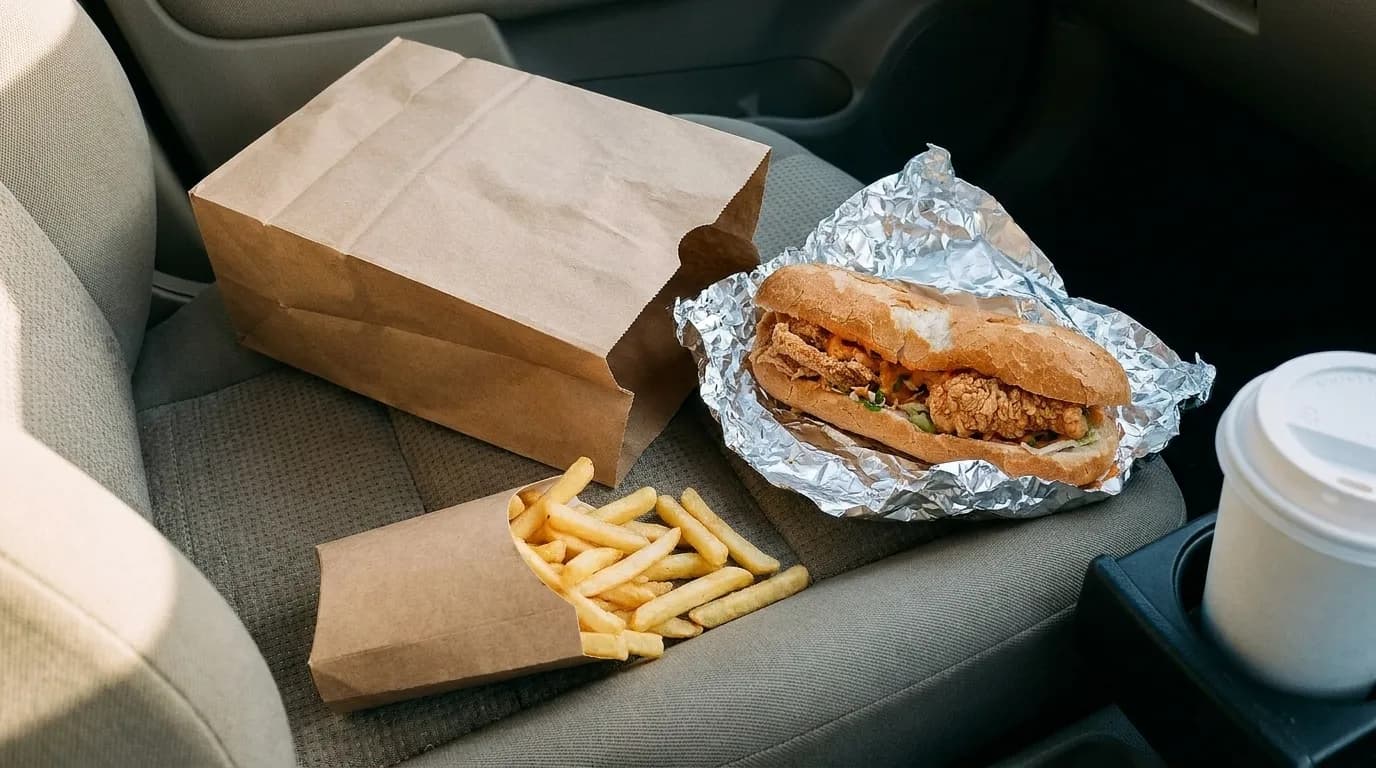
What replaced it
New York solved the same problem three other ways, all of them faster in practice. The first is the street cart, which is a drive-thru without the car — you stop, you order, you have food in ninety seconds. The second is the bodega griddle, which will make a hot sandwich to order in about the same time and is open at every hour a drive-thru would be. The third is mobile ordering for collection, which at a busy quick-service counter is genuinely quicker than a lane.
The maths is worth doing honestly. A drive-thru queue at a busy hour is frequently ten to fifteen minutes, plus the time to get to a location that is by definition on an arterial road. Parking once and walking to a counter is often faster and always less stressful, particularly in the outer-borough neighbourhoods where the drive-thrus actually are.
If you are driving through the city
For anyone actually passing through — driving to the airports, crossing on the Belt or the Cross Bronx, heading out to Long Island or up to Westchester — the useful list is different. The corridors near the airports and along the major approaches have the highest concentration of quick-service options with parking, and the service plazas on the parkways outside the city proper are the reliable fallback.
The other thing worth knowing is that New York's diners, which are open at hours a drive-thru would be, almost all have a parking lot in the outer boroughs and will do a takeaway order at the register in a few minutes. For a driver at two in the morning, a diner counter is a better version of the same transaction.
Ordering ahead
The single biggest improvement available is mobile ordering. Every major quick-service chain and a growing number of independents will take an order in advance and have it waiting, which removes both the queue and the ordering time. At a location with a drive-thru, collection at the counter is frequently faster than the lane, because the lane is where everyone else is.
Delivery is the other option and in New York it is unusually good, because density means short trips and a very large courier population. For the specific case of wanting fast food without leaving the car, though, the honest answer is that the city is not built for it and a five-minute walk is almost always the quicker route.
Staten Island, which is the exception
Staten Island is the one borough where the drive-thru is a normal part of daily life rather than an oddity. Its commercial strips — Hylan Boulevard above all — are built to a suburban pattern with deep lots, ample parking and the car-oriented land use that the format requires, and the density of quick-service locations there is closer to New Jersey than to the rest of New York. If you are searching for a drive-thru anywhere in the city and getting nothing useful, Staten Island is the borough where the search behaves the way you expect it to.
Practical notes
Check whether a location listed as a drive-thru actually has a lane; listings frequently mark counter locations incorrectly. Lanes in the outer boroughs back up badly at lunch and between six and eight in the evening. Overnight, many locations close the dining room and run the lane only, so a walk-up may not be possible after midnight — the reverse of the daytime situation. Parking regulations near arterial commercial strips are enforced actively. And if the goal is speed rather than the car specifically, mobile ordering at a counter beats a lane almost everywhere in this city.
Tags: #NYC #NewYorkCity #DriveThru #FastFood #FastFoodNearMe #Queens #Brooklyn #StatenIsland #Bronx #FoodNearMe #NYCEats #GrabAndGo #Bodega #OpenLate
All trademarks are the property of their respective owners.
Ask Karpo first
Want to know whether there is a real drive-thru lane near you, how long the queue is right now, and whether collecting a mobile order would be faster? Ask Karpo before you join it.